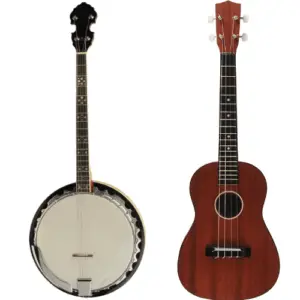
A soprano ukulele is 21 inches long end to end, carries four nylon strings pulling about 33 pounds, and a good one from a real maker costs around $70. A five-string banjo is 37½ inches long, carries five steel strings pulling about 80, and the cheapest one worth owning is around $175 before it has been set up. One note is identical on both: G above middle C, which is the ukulele’s fourth string and the banjo’s fifth.
Which is easier is the question this choice usually gets reduced to, and it is the least useful thing about them: they are easy in different hands, and the answer flips depending on what you want to be playing by Christmas. The difference that actually decides it is volume. A ukulele is a small wooden box; a banjo is a drum with a neck on it, and you cannot make it quiet.
The ukulele — unless the banjo sound is the reason you are here
It costs a quarter as much, it needs nothing doing to it, it will not wake anybody, and four chords learned in an afternoon will get you through most of a songbook. The Kala KA-15S is the entry-level instrument to beat: all mahogany, Aquila strings fitted at the factory, and a bone-substitute nut and saddle at a price where most instruments get plastic. If it is the banjo noise you want, no ukulele will ever make it, and you should go straight to the banjo and accept the extra money and the extra months.
Side by side
| Ukulele | Banjo | |
|---|---|---|
| Strings | 4, nylon | 5, steel |
| Standard tuning | G–C–E–A | G–D–G–B–D |
| The odd string | 4th, tuned high — G above middle C | 5th, the same G, and the highest string on the instrument |
| Open strum gives you | C6 — C major is one finger away | G major, with no left hand at all |
| Scale length | 13⅝” soprano, 14⅞” concert, 17″ tenor | 26–26¼” |
| Nut width | About 1⅜” | 1-3/16″ to 1¼” |
| Frets | 12 on a soprano, 18 on a concert | 22 |
| Overall length | 21″ soprano, 24¼” concert | 37½” |
| Total string tension | About 33 lb | About 80 lb |
| What makes the sound | A wooden top, 9½” long and 2⅜” deep | An 11″ drumhead under tension |
| Played with | The back of a fingernail | Three fingerpicks, or the nail and the thumb |
| Bridge | Glued to the top | Floating — held on by string pressure alone |
| Cheapest one worth owning | ~$70 | ~$175 |
| Buy-once instrument | ~$130 to $250 | ~$600 |
| Setup on arrival | $40 to $75, and often unnecessary | $50 to $100, and effectively required under $300 |
| Time to your first song | An afternoon | Weeks for clawhammer, months for bluegrass |
One of them has a mute you can buy
Deering’s accessory line includes a solid brass mute that slides onto the bridge of a 4-, 5- or 6-string banjo. Their own description of what it is for is unusually direct: the sound becomes much quieter, and “this will help keep peace in the home when the baby is sleeping.” There is a second, more elaborate one in the same catalogue at two and a half times the price. Kala, whose catalogue runs to some 500 products including strings, straps, cases, tuners, capos and polish, do not make a ukulele mute, because there is no market for one.
The reason is structural rather than a matter of degree. A ukulele’s soundboard is a piece of laminated mahogany about nine and a half inches long and two and a bit deep, driven by four nylon strings. A banjo’s is an eleven-inch Mylar head stretched over a rim by sixteen or more brackets, driven by steel — the same arrangement as a drum, and about as efficient at moving air. The banjo does not have a volume control and it does not have a quiet setting. A beginner practicing the same eight bars for forty minutes is audible through a wall.
Read that the other way round and it is the banjo’s best argument. In a room with two guitars in it, a ukulele disappears and a banjo cuts straight through, which is exactly why the instrument sounds the way it does in a string band. If you are buying an instrument to play with other people around a fire or in a circle, the quiet one is the wrong choice. If you live in a flat with thin walls, or somebody in the house goes to bed at eight, the loud one is going to cost you a mute and some diplomacy.
Eighty pounds of steel against thirty-three of nylon
Gold Tone ships the AC-1 with gauges of .011, .013, .016, .024 wound and .011 across a 26-3/16-inch scale. At standard G–D–G–B–D that set pulls just over 80 pounds. A concert ukulele’s four nylon strings pull about 33. Two and a half times the load, on strings a quarter the diameter and made of steel rather than plastic.
Your fingertips feel all of it. A banjo asks for calluses and takes two or three weeks of short daily sessions to build them; a ukulele makes fingers sore for a few days and then stops. That single fact is why ukuleles get handed to seven-year-olds in school music rooms and banjos do not, and it is worth taking seriously if the person learning is a child, or has arthritis, or is going to give up the first time something hurts.
It also decides how much the instrument moves after you buy it. Eighty pounds pulls a neck forward, which is why every banjo worth owning has a truss rod in it, and it presses down on a bridge that is not glued to anything — a banjo bridge is held in place by string pressure alone, and knocking it out of position puts the whole instrument out of tune with itself. A ukulele’s bridge is glued to the top and stays where the factory put it. There is nothing to adjust on a ukulele except the tuning.
Both give you a chord for free, and the banjo’s is freer
A five-string banjo is tuned to an open chord. Strum it with no fingers on the neck at all and you get G major, because the five strings are G, D, G, B and D — nothing but the notes of the chord. Lay one finger flat across the second fret and you have A; across the fifth, C. A ukulele’s open strings give you C6, which is pleasant but not a chord you will be reaching for, and C major costs you one finger on the third fret of the bottom string.
So the banjo wins the very first minute. What that hides is that the left hand was never the hard part of a banjo.
The two instruments also share an oddity worth knowing about, because it confuses people who arrive from a guitar. Both have a string that runs backward. On a ukulele the fourth string — the one nearest your chin, where you expect the lowest note — is tuned high, to G above middle C. On a banjo the fifth string is tuned to exactly the same G, and on a banjo it is the highest-pitched string on the instrument, with its own tuning peg sticking out of the side of the neck at the fifth fret. Neither instrument runs low to high across the strings, and neither is going to behave like a small guitar.
The work is in different hands
On a ukulele, everything is the fretting hand and there is not much of it. C, F, G7 and A minor between them carry an enormous number of songs, all four are two fingers or fewer, and the right hand is a downstroke with the back of a fingernail. There is no technique standing between you and a recognisable song on day one. That is not a beginner’s illusion that wears off later — the ukulele really is a small instrument with a small technique, and the ceiling is lower because of it.
On a banjo the fretting hand is genuinely easy, and the right hand is the entire instrument. Bluegrass means Scruggs rolls: fixed eight-note patterns played with a thumbpick and two metal fingerpicks, the thumb constantly dropping onto that fifth string, at a speed where you cannot think about it. Old-time means clawhammer, which is a downward strike with the back of the middle fingernail followed by the thumb catching the fifth string — a motion that has nothing in common with any strum you have ever done and takes a fortnight of doing it badly before it starts to click.
Clawhammer gets you playing simple tunes in a few weeks. Bluegrass rolls are months. Neither is beyond an adult with twenty minutes a day. But "easier than a guitar" is true of the banjo only as a statement about the fretting hand. Our page on how hard the banjo actually is goes through the timeline properly.
If you are buying it to sing over, that settles it
A ukulele is an accompaniment instrument in the way a shaker is a percussion instrument — it exists to sit under something else. It is quiet enough not to compete with a voice, its chords are simple enough to play while thinking about words, and the strum is steady and mindless once learned. If the picture in your head is you and an instrument and a song, this is the one.
A banjo makes that harder in two ways at once. It is loud enough to sing over rather than under, and a Scruggs roll is a continuous stream of notes that has to keep running while you sing something with a completely different rhythm on top. People do it, and it is a real skill that takes longer than the roll did. Clawhammer is much friendlier here — the bum-ditty is closer to a strum and sits under a voice reasonably well, which is why old-time singers manage it and bluegrass banjo players mostly leave the singing to somebody else.
Size, weight and whether it fits the person playing it
The ukulele is built in a published ladder of four sizes and the specifications are precise about it. Kala’s soprano is 21 inches long overall with a 13⅝-inch scale and 12 frets; the concert is 24¼ inches with a 14⅞-inch scale and 18 frets; the tenor is 26 inches with a 17-inch scale. Adults with normal hands are generally happier on a concert, because the soprano’s frets are cramped exactly where a beginner spends all their time. Our concert versus tenor comparison takes that further up the ladder.
The banjo has no such ladder. Gold Tone lists the AC-1 in one size, and it is an adult one: 26-3/16-inch scale, 22 frets, and 3¾ pounds, which is light for a full-size banjo because the rim is composite rather than wood. Deering’s Goodtime, the standard American-built first banjo, is 37½ inches overall and 4½ pounds. Put a resonator on the back for bluegrass volume and a banjo goes to 11 pounds, which is heavy enough that the strap becomes the thing you notice. Short-scale banjos do exist — see our travel banjo guide — but they are built for adults with small cases, not for children.
One honest gap: nobody publishes a ukulele’s weight. Kala gives nine measurements for the KA-15S, down to the width at the waist, and not one of them is a weight. It is a small instrument made of thin laminate and it plainly weighs a fraction of any banjo, but if you want the number, no maker will give it to you.
What each one costs once it is in the house
The ukulele’s price is nearly the whole cost. Seventy dollars buys a mahogany instrument from a maker with a reputation to protect, with Aquila strings already fitted, and there is nothing it needs on arrival. A set of strings is about $7 when you eventually want one. A professional setup runs $40 to $75 and on a laminate ukulele under $150 it is rarely worth paying for.
The banjo’s price is the beginning of the cost. Budget $50 to $100 for a setup, which on anything under about $300 is not optional — bridge placement, head tension, action and nut slots are what separate a banjo that plays from one that fights you, and it does more for the instrument than another hundred dollars of banjo would. Bluegrass adds fingerpicks at about $10. The head slackens over the first year and wants re-tensioning. Our full banjo cost breakdown takes the ladder from the bottom to the top.
Worth knowing on the banjo side: Gold Tone warrants their AC-model banjos for five years and the cover transfers with the instrument if you sell it, which is unusual at this price and only applies if you buy from an authorized dealer.
What to buy, either way
Kala KA-15S Satin Mahogany Soprano
- 13⅝” soprano scale, 12 frets, 1⅜” at the nut
- Mahogany top, back, sides and neck
- Graph Tech NuBone nut and saddle
- Aquila Super Nylgut strings from the factory
- 21″ long overall — fits a rucksack
- ~$70
This is the instrument most people mean when they say a beginner ukulele, and it earns the position on two components rather than on the wood. The nut and saddle are Graph Tech’s bone substitute where almost everything at this money uses molded plastic, and plastic nut slots are the usual reason a cheap ukulele will not play in tune above the fifth fret. The Aquila strings are the second: on most instruments in this bracket the factory strings are the first thing to throw away, and here they are the strings you would have bought anyway.
Soprano is the small, traditional size and the frets are tight at the top of the neck. If the person playing it is an adult with average hands and this is the only ukulele they will ever own, spend the extra and get the concert instead.
- Bone-substitute nut and saddle at $70
- Good strings fitted from new
- The lightest, most portable thing on this page
- Needs nothing doing to it
- Cramped frets for adult hands
- Nothing in the box but the ukulele
- Laminate, so it will not open up with age
Kala KA-15C Concert, with the accessories
- 14⅞” concert scale, 18 frets, 1.39″ at the nut
- Same mahogany build and NuBone hardware as the soprano
- 24¼” long overall
- Gig bag, clip-on tuner, strap, spare strings and cloth included
- ~$115
The concert is the same instrument with an extra inch and a quarter of scale, and that inch lands exactly where it matters — the first five frets, where a beginner spends every minute of the first year. Nothing about what you learn changes; your fingers simply stop crowding each other. The tone gains a little body with the larger box, though on a laminate instrument that is a smaller difference than the fretboard.
Bought as a bundle it arrives with the tuner and bag you would otherwise buy separately, which is what closes the gap to the bare soprano to about forty dollars rather than fifty. If you already own a clip-on tuner, the bare concert is the cheaper route.
- The right size for adult hands
- Tuner, bag and strap in the box
- 18 frets against the soprano’s 12
- Same nut, saddle and strings as the KA-15S
- Half again the price of the soprano
- Bundled accessories are entry level
- Bigger than the classic ukulele silhouette
Jameson 5-String Banjo
- 24 brackets, where 16 is normal at this price
- Removable resonator — open back or closed
- Geared fifth-string tuner
- Padded gig bag included
- ~$175, plus $50 to $100 for a setup
This is the floor of the market rather than a bargain, and it is worth being clear about which. It has the two things that separate a usable cheap banjo from a wall decoration: a geared fifth-string tuner instead of a friction peg that slips, and a bracket count that lets the head be tensioned evenly. The resonator unbolts, so the same instrument can be the loud bluegrass version or the quieter open-back one, which is a genuinely useful thing to have while you work out which music you actually want to play.
It will not arrive playing well. The bridge is loose in the box, the head is at whatever tension the factory left, and the strings are the cheapest part of it. Budget the setup as part of the price, not as an upgrade — a $175 banjo that has been set up plays better than a $300 one that has not.
- Geared fifth tuner at this money
- Resonator comes off
- 24 brackets for even head tension
- Bag included
- Heavy with the resonator fitted
- Needs a setup before it is properly playable
- Factory bridge and strings both want replacing
Gold Tone AC-1
- 26-3/16″ scale, 22 frets, 1-3/16″ Zero Glide nut
- 11″ composite rim, 11″ Remo frosted head
- 3¾ lb — light for a full-size banjo
- Two-way truss rod, geared fifth tuner
- Adjusted in Florida before it ships; gig bag included
- Five-year transferable warranty
- ~$315
The gap between this and the $175 tier is not the parts list, it is that somebody adjusts the instrument before it leaves. That is the same money you would have spent on a setup, spent by people who do it every day, and it is why the AC-1 is the point at which a beginner banjo stops needing a project doing to it.
The composite rim is the reason for the weight, and it is a real advantage rather than a cost saving — at 3¾ pounds this is the banjo somebody actually picks up in the evening, where an 11-pound resonator instrument stays in its case. It is an open-back banjo, so it suits clawhammer and old-time naturally and will play bluegrass at slightly less volume than a resonator would. If bluegrass is definitely the plan, read our open back versus resonator comparison before deciding.
- Set up by the maker before shipping
- Very light for a full-size banjo
- Truss rod and geared fifth tuner
- Warranty transfers if you sell it
- Composite rim will not satisfy a tone chaser
- Open back only — no resonator option
- Nearly five times the ukulele
The one thing both of them need
A clip-on chromatic tuner works on either instrument and on anything else with strings, because it reads the vibration of the wood rather than the sound in the room — which matters more on a banjo, where the instrument is loud enough to confuse a microphone-based tuner, and on a nylon-strung ukulele, where a brand new set will drift out of tune every twenty minutes for the first week until the strings have stretched. Around $19 buys one that will outlast both instruments. The Kala concert bundle above already includes one.
FAQs
Which is easier to learn, banjo or ukulele?
The ukulele, by a wide margin, if you measure from nothing to a song you can play for somebody. Four chords, two fingers each, one afternoon. The banjo’s left hand is arguably easier still — strum the open strings and you have a G major — but its right hand takes weeks for clawhammer and months for bluegrass rolls, and there is no shortcut past that.
Which is louder?
The banjo, and not by a small margin. It is a drum with a neck: an eleven-inch tensioned head driven by steel strings, against a ukulele’s small wooden box driven by nylon. The clearest evidence is what the makers sell. Deering builds a brass mute for the banjo and say plainly that it is for keeping the peace when there is a baby asleep in the house. Kala's catalogue of ukulele accessories contains nothing of the kind.
Can I play ukulele chords on a banjo?
Not the same shapes. A ukulele is tuned G–C–E–A across four strings and a five-string banjo is G–D–G–B–D across five, so the intervals between strings are different and every shape has to be relearned. What does transfer is the reading and the sense of where a chord change belongs in a song, which is most of what a beginner is actually learning.
Is there something that is both?
Yes, and it is a ukulele rather than a banjo. A banjolele has four nylon strings in ukulele tuning stretched over a small banjo head, so it plays exactly like the ukulele and sounds a good deal more like the banjo. It has no fifth string, so no banjo technique works on it at all. Our banjo versus banjolele comparison goes through what it can and cannot do.
Which is better for a child?
The ukulele, for three separate reasons. It is made in small sizes with published measurements, a soprano being 21 inches long overall. Its nylon strings pull about a third of what a banjo’s steel does, so a child’s fingertips are sore for days rather than weeks. And a banjo is one adult size at four to eleven pounds, which is a lot of instrument on a small lap.
Which is better for singing along?
The ukulele, which is built for the job — quiet enough to sit under a voice and simple enough to play while you concentrate on words. A bluegrass roll is a continuous stream of notes that has to keep going underneath a different rhythm, which is a skill in itself. Clawhammer banjo is much easier to sing over than bluegrass, if the banjo is what you want.
How many strings does each one have?
A ukulele has four. A banjo usually has five, and the fifth is the short one with its own peg partway up the neck. Four-string tenor and plectrum banjos and six-string banjos also exist and are different instruments with different repertoires — our guide to the types of banjo sorts out which is which.
Should I start on the ukulele and move to the banjo later?
Only if you want to play the ukulele too. Almost nothing transfers — different tuning, different chord shapes, a fifth string that does not exist on a ukulele, and a right-hand technique that is the whole difficulty of the banjo and gets no easier for having strummed something first. A year of ukulele is a year of ukulele, which is a good thing to have, and not a run-up.
What do they cost?
A ukulele worth owning starts around $70 and the instrument you would keep for years is $130 to $250, with nothing else to buy. A banjo starts around $175 and needs $50 to $100 of setup on top; the point where it stops needing work is about $315, and an American-built one is about $600. Call it four times the money before the first lesson.
So which one
If you have no strong feeling either way, buy the ukulele. It is a quarter of the cost, it needs nothing doing to it, it will be making music the day it arrives, and if it turns out not to be for you the loss is seventy dollars rather than three hundred.
Buy the banjo if the sound is the point. Nobody arrives at the banjo by process of elimination — they arrive because they heard one and wanted to make that noise, and no amount of ukulele will ever produce it. That is a good enough reason, and it is worth the setup money, the calluses and the months on the right hand. Just make sure of the room you will be practicing in first, because that is the one thing you cannot change afterward.