All the music lovers who are planning to learn an instrument must be looking for a smooth beginning.
And as a beginner, you would be willing to collect all the information to differentiate between specific instruments, in this case the banjo and violin.
To help you in this task, we have got all the information, including the major differences between the two most popular musical instruments Banjo and Violin.
Table of Contents
- What’s a Banjo?
- What’s a Violin?
- The Major Differences Between The Banjo and Violin
- Which one is easier to play?
- Conclusion
What’s a Banjo?
Banjo is a poly stringed musical instrument which comes in three different versions, such as four-stringed, five-stringed, and six-stringed. Learn more about banjo strings.
It possesses a thin membrane that is stretched and covers the big hole or cavity and hence acts as the resonator.
The amazing due of the strings and resonator when coming in contact with your music hands will produce a fantastic musical vibration that soothes your ears.
Banjo is commonly used for playing classical or folk music but can also be used efficiently in playing rock music too.
What’s a Violin?
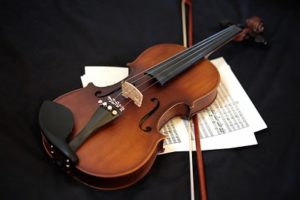
The violin is amongst the most traditional musical instruments. It mostly comes as a hollow wooden body with attached four strings. The build of this instrument varies depending upon its variants.
There is a fifth string also which helps tune into various musical notes such as G3, A4, etc.
It is used to lay traditional folk music as well as classical music too.
The guitar is a modern alternative to the violin for rock music.
The Major Differences Between The Banjo and Violin
Playing techniques:
Banjo
The banjo is commonly played by the double thumbing or drops thumb technique.
The notes can be played by the single thumb or finger techniques also.
The highest notes are played by the five-stringed banjo.
Violin
The violin is performed by the most commonly used left-hand finger and right-hand thumb technique.
The major role in the violin playing lies in the posture and holding of the violin.
One must learn the string notes management to handle and place the fingers on the right notes while playing the violin.
String management
Here occurs the major question as being a beginner, you would always be willing to learn an instrument that isn’t complicated and can be managed easily.
Being an instrument that depends on the notes placed along with the strings, you must opt for the for which has easy string management.
So, let’s learn about this.
Banjo
Being a dependent resonator instrument, the string management and the notes are quite simple in this musical instrument.
There are simply seven basic notes, and the keys are the strings.
The pitches can be easily managed with the different strings depending upon the need.
Violin
Here comes the master of strings.
The hollow wooden body of this musical instrument is non-other than a string dependent vibrator.
The strings of this instrument need to study and fixed each time differently; you are planning to change the pitch.
There are several methods of remembering the keynotes of each string so that you can learn it thoroughly and really really quickly.
Sound
This i quite an obvious one but the sound of the banjo and violin are extremely different.
The banjo is probably more versatile than the violin but the violin is used more in music and other art like movies, tv, etc.
They sound great together especially the banjo and fiddle.
Which one is easier to play?
If you have played a stringed instrument like the guitar before and are decent with it then the banjo is your best bet.
But if you have not then the violin might lead you down an easier path. Not saying it’s necessarilly easier but has the capability of it.
It also depends on what ype of music you want to learn and play. This is probably the primary deciding factor.
As we discussed, the major role in learning these two instruments is one of the strings and the musical keys associated with them.
The violin is a complicated musical instrument with this; hence it is a tough choice to make.
On the other and the banjo can be an excellent option for all the beginners.
Conclusion
So here it is, the musical battle of Banjo vs. Violin.
We hope the article was helpful, and you enjoyed reading it.
