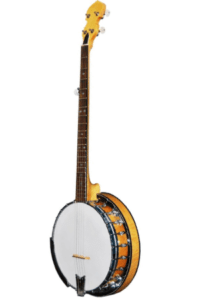
A thousand dollars splits the banjo market in two, and the split is not about quality. One side is Deering, building in California with an eight-year warranty and startlingly little hardware bolted to the instrument. The other is Gold Tone, importing banjos that arrive with a tone ring, a flange, planetary tuners and a bag for the same money. Both make good banjos. They are good at different things, and which one you want depends almost entirely on whether you are heading for bluegrass or old-time.
Deering Goodtime Two
An American-made resonator banjo for well under the full grand, set up properly before it ships, and light enough at six pounds to play standing for an evening. It leaves you enough of the budget for a hard case and a decent set of strings, which is a better use of $150 than any upgrade you could buy inside the instrument itself.
The six at a glance
| Banjo | Back | Tone ring | Weight | Price band | Best for |
|---|---|---|---|---|---|
| Deering Goodtime Two | Resonator | None | 6 lb | ~$850 | The all-rounder, American built |
| Deering Goodtime Americana | Open back, 12″ | None | 4.5 lb | ~$750 | Old-time and clawhammer |
| Gold Tone CC-100R+ | Removable resonator | Rolled brass | 6.5 lb | ~$850 | Not having committed to a style |
| Deering Goodtime Special | Resonator | Steel | 8.75 lb | ~$1,000 | American made with a real ring |
| Gold Tone CC-Carlin12 | Open back, 12″ | Rolled brass | 5.8 lb | ~$850 | Serious clawhammer |
| Gold Tone BG-150F | Resonator, flange | Rolled brass | 8.5 lb | ~$1,000 | Bluegrass hardware for the money |
What a thousand dollars changes
The tone ring is what you are actually shopping for
A banjo’s tone ring is a hoop that sits on top of the wooden rim, under the head. The head presses against it, and the ring decides how much of your playing comes back as ring and sustain rather than thud. It is one of the costliest parts of a banjo to make, and the clearest thing separating one price tier from the next.
There are three answers at this budget. No ring at all — the head bears directly on the wooden rim, which is what every Deering Goodtime does, right up to the $1,300 Blackgrass. It gives a dry, woody, quick-decaying note that old-time players actively want. A rolled or flat-bar brass hoop, which is Gold Tone’s answer across the Cripple Creek and Bluegrass lines: brighter and louder than bare wood, a fraction of the weight and cost of the real thing. And a cast bell-brass ring, three pounds of poured metal, which is the sound of recorded bluegrass and which starts at about $1,300.
The exception in the middle is the Deering Goodtime Special, which puts a patented steel ring on the standard Goodtime pot. It is not a cast bell-brass Mastertone ring and it does not come with a one-piece flange, but it is an American-made banjo with a genuine tone ring at a price where that combination otherwise does not exist.
Weight decides whether you play it
The banjos on this page run from four and a half pounds to nearly nine, and that is the same instrument with different amounts of metal in the pot. A Goodtime Americana at 4.5 lb and a Goodtime Special at 8.75 lb are built by the same people in the same factory; the ring and the resonator are the difference.
Nine pounds on a strap for a two-hour session is genuinely tiring, and the full bluegrass instruments above this budget go past eleven. If you are buying for someone small, someone with a bad shoulder, or someone who plays standing, weight should outrank tone in the decision — a heavy banjo that stays in its case sounds like nothing at all. We put numbers to the whole range in how much a banjo weighs.
Eleven inches or twelve
Almost every banjo is built on an 11-inch pot. Old-time players often prefer a 12-inch one, which drops the pitch of the pot itself and gives a rounder, deeper, less metallic voice. That is the deep, plunky sound old-time playing lives on, and it is why both 12-inch banjos here — the Goodtime Americana and the CC-Carlin12 — are built that way.
The other clawhammer-specific feature is a scooped fingerboard: the last few frets are planed away so you can strike the string over the end of the neck, where the tone is softest, without your nail catching fretwire. If you have already decided on clawhammer, a scoop is worth more than almost anything else you could spend the money on. Our clawhammer picks go further into it, and open back vs resonator covers the broader choice.
American built, or better equipped
Deering builds in California, sets each banjo up before it leaves, backs it for eight years, and holds its value on the used market better than anything else in this bracket. What you do not get is hardware: sixteen hooks, no flange, no tone ring below the Special, and no case in the box.
Gold Tone spends the same money differently. A CC-100R+ brings twenty-four hooks, a brass tone hoop, planetary tuners, an engraved armrest and a resonator you can unbolt. It is the better-specified instrument on paper and the less valuable one in five years. Neither of those is the wrong answer — but if resale and service matter to you, that is a point for Deering, and if you want the most instrument on day one, that is a point for Gold Tone.
Both brands hold their prices, so this is not a trade you can shop your way out of — the price is the price, and hunting for a discount on either one is time you will not get back. The Deering argument is about American building, resale and service rather than price, and at this budget the two brands land close enough together that it comes down to which of those you actually want. There is more context in American-made banjos and why banjos are so expensive.
The six picks
Deering Goodtime Two
- Resonator
- No tone ring
- 3-ply violin-grade maple rim, 11″
- 6 lb
- Made in California
- ~$850
The Goodtime Two is a Goodtime openback with a three-ply resonator on the back, and that is the whole trick — a rock maple neck, a violin-grade maple rim and a geared fifth-string tuner, made in San Diego, with nothing on it that exists to look expensive. It arrives playing in tune with itself, which is not a given at any price and is the main practical argument for buying American here.
Without a tone ring it will not cut through a loud bluegrass jam the way a cast-ring banjo does, and it never will — that is a permanent ceiling, not a setup problem. What it does instead is sound clear, dry and even, hold that sound for decades, and weigh six pounds while doing it. For most people arriving at this budget it is more banjo than they will outgrow.
- American built and properly set up before shipping
- Six pounds — comfortable standing
- Strongest resale value on this page
- Eight-year warranty
- No tone ring, so limited bluegrass projection
- Sixteen hooks and no case in the box
Deering Goodtime Americana
- Open back, 12″ rim
- No tone ring
- 12″ Renaissance head
- 4.5 lb
- Made in California
- ~$750
The lightest banjo here by a pound and a quarter, and the one built specifically for the sound old-time players are after. The 12-inch rim and the Renaissance head — a translucent synthetic skin, warmer and softer than the usual white frosted top — take the edge off the attack and leave a low, woody note that suits fiddle tunes far better than anything with a resonator on it.
Four and a half pounds is genuinely unusual, and it changes how long you play. The trade is volume: this will not be heard next to a banjo with a resonator, and it is not meant to be. Note also that the version sold here has a standard fingerboard rather than the scooped one — if the scoop is what you came for, the Gold Tone below has it.
- 4.5 lb — the lightest banjo on this page
- 12″ rim and Renaissance head give a genuinely old-time voice
- American built, eight-year warranty
- Quiet beside any resonator banjo
- Standard fingerboard, not scooped
Gold Tone CC-100R+
- Removable resonator
- Rolled brass tone hoop
- 24 hooks, planetary tuners
- 6.5 lb
- ~$850
The one to buy if you have not settled the argument with yourself yet. The resonator unbolts, so the same banjo covers bluegrass evenings and old-time afternoons, and unlike most convertibles it is light enough — six and a half pounds — that taking the back off produces something you would actually want to play clawhammer on.
The “plus” over the base CC-100R is a factory-fitted pickup — Gold Tone names the model for it — along with the gloss sunburst finish. If you have no intention of ever plugging in, the plain CC-100R is the same banjo for about fifty dollars less. Against the Deerings it is the better-equipped instrument and the weaker long-term hold — it is built in Asia to Gold Tone’s spec and set up in Florida, which is a real distinction from a banjo made start to finish in California.
At around $850 it sits exactly level with a Goodtime Two that was built in California and will be worth more in ten years — so this is a straight choice between hardware now and value later. Neither comes with a case. One thing to know before you commit: Gold Tone void the warranty on anything not bought from an authorized dealer, so buy from one and keep the receipt.
- Resonator comes off, so it plays both styles
- Planetary tuners and 24 hooks
- Brass tone hoop where the Deerings have none
- Will not hold value like a Deering
- Seven-year warranty against Deering’s eight
- Gloss sunburst is not to everyone’s taste
Deering Goodtime Special
- Resonator
- Patented steel tone ring
- 3-ply violin-grade maple rim, 11″
- 8.75 lb
- Made in California
- ~$1,000
The only American-made banjo anywhere near this budget with a tone ring in it. Deering’s steel ring is their own design rather than a copy of the cast bell-brass Mastertone hoop, and it does what a ring is supposed to do: adds ring, sustain and volume to a pot that otherwise has none. Beside a Goodtime Two the difference is immediate and it is not subtle.
It costs you two and three quarter pounds, which is the honest downside — this is a Goodtime that has stopped being a light banjo. And it is still not a Mastertone pot: no cast ring, no one-piece flange, sixteen hooks rather than twenty-four. What it is, is the point on this page where an American-built banjo stops being an instrument you compromise on tone to own.
- A real tone ring, American built, at this budget
- Noticeably louder and more sustaining than a Goodtime Two
- Same eight-year warranty and setup
- 8.75 lb — heavy for a Goodtime
- No one-piece flange; still not a full bluegrass pot
Gold Tone CC-Carlin12
- Open back, 12″ pot
- Scooped rosewood fingerboard
- 1⅜” nut, 24 brackets
- 5.8 lb
- Gig bag included
- ~$850
Designed with Bob Carlin, and every specification on it points the same way. The 12-inch pot and Renaissance head give the deep plunky voice; the scooped fingerboard lets you strike over the end of the neck where that voice is warmest; and the wide 1⅜-inch nut gives your fretting hand the room that clawhammer’s thumb work needs. Very few banjos at any price get all three right at once.
It is a specialist, and that cuts both ways — there is no resonator to add and the wide neck feels foreign if you have been playing a standard banjo. If clawhammer is definitely the plan this is the most focused instrument on the page. If you are still deciding, it is the wrong one, and the CC-100R+ above is the right one.
At around $850 it costs the same as the Goodtime Two and the CC-100R+, which makes it a pure question of intent: this is the only one of the three built specifically for clawhammer, and the only one that is no use at all if you change your mind and want bluegrass.
- Scoop, 12″ pot and wide nut on one instrument
- 5.8 lb with 24 brackets and planetary tuners
- Gig bag in the box
- No use at all for bluegrass
- The 12″ scooped pot commits you to old-time
- Wide nut takes adjusting to
Gold Tone BG-150F
- Resonator with flange
- Rolled brass tone ring
- 24 brackets, planetary tuners
- ZeroGlide nut
- 8.5 lb
- ~$1,000
The closest thing here to a conventional bluegrass banjo: a flange around the pot, a brass ring, twenty-four brackets, planetary tuners and hearts-and-flowers inlay, at eight and a half pounds rather than the eleven-plus that a cast-ring instrument weighs. The ZeroGlide nut is a genuinely useful inclusion — it puts a zero fret ahead of the nut so the open strings sound like fretted ones and the tuning holds better in first position.
The brass here is a rolled bar rather than the near-three-pound cast ring in Gold Tone’s own OB-150, and that gap is audible: this is a bright, workable bluegrass banjo, not a cannon. Taken as the lightest way to get the full bluegrass layout, though, it is the only thing at this budget doing it.
It runs about $1,000 wherever you buy it, and includes a gig bag. Gold Tone sets out their warranty terms by model family and list none for the Bluegrass series, so treat the cover here as unstated rather than assuming it matches their Mastertone line.
- Flange, brass ring and 24 brackets on one instrument
- 8.5 lb — light for a bluegrass banjo
- ZeroGlide nut helps tuning in first position
- Rolled bar ring, not a cast Mastertone hoop
- Heavy — 8.5 lb on a strap is a real consideration
- Still the second-heaviest banjo here
Also worth a look
| Banjo | Price band | Why you might pick it |
|---|---|---|
| Deering Goodtime Openback | ~$600 | The same American neck and rim as the Goodtime Two without the resonator, and the value benchmark this whole page is measured against. Covered in our Goodtime review. |
| Deering Artisan Goodtime Americana | ~$1,000 | The Americana with factory planetary tuners, a Midnight Maple fingerboard and a dark stain. Same 12″ rim, same Renaissance head, same 4.5 lb — the planetary pegs are the part worth the money, and they are a $99 upgrade on their own. |
| Deering Goodtime Blackgrass | ~$1,300 | Black-on-black with matte hardware and midnight maple. Striking, and still has no tone ring — the Goodtime Special costs less and sounds bigger. |
| Gold Tone OB-150 | ~$1,300 | Where the cast bell-brass tone ring and one-piece flange actually start. If bluegrass volume is the whole point, this is the pick worth stretching for. |
| Ibanez B300 | ~$600 | A well-made resonator banjo below the budget. See our B300 review. |
The Recording King RK-R35 Madison sits just above this page as the other route to a cast bell-brass Mastertone ring, a one-piece flange and twenty-four brackets. Its situation changed recently: The Music Link, which had run the brand since 2007, closed in 2025, St. Louis Music took over distribution that August, the model gained a -BR suffix, and Recording King now list it at $2,099 with a relaunched line still to come later in 2026. It sells for around $1,400 — over this budget, and a hundred dollars more than the Gold Tone OB-150 before you add the case it ships without. If a cast ring is what you are saving for, the OB-150 at $1,299.99 is the cheaper way to it: sand-cast bell brass, a one-piece die-cast flange, a hardshell case in the box, and set up in Florida before it ships. Our Recording King RK-R35-BR review puts the two side by side.
What to spend the rest on
None of the Deerings ships with a case, and a banjo at this price wants a hardshell rather than a gig bag — the pot is the part that gets damaged and it is the part a soft bag protects least. Budget around $100 to $150 for one, which is the single best use of leftover money here.
After that, a chromatic clip-on tuner and a spare set of strings. Factory strings on a good banjo are fine rather than good, and a fresh set is the cheapest change you will ever hear — our picks are in banjo tuners and banjo strings. If you are heading for bluegrass, fingerpicks too: metal on the fingers, plastic on the thumb. Clawhammer players need none of that.
Frequently asked questions
Is a $1,000 banjo worth it over a $300 one?
Yes, and the difference is not tone first — it is that the instrument stops fighting you. At $300 the tuners drift, the head tension is whatever the factory left, the bridge may be in the wrong place and the action is usually high enough to tire your hand. At $850 those things are simply correct, and you spend your practice time playing rather than adjusting. The tone is better too, but it is the second thing you notice. Our guide to what banjos cost maps the tiers.
Can I play bluegrass on a banjo with no tone ring?
Yes — plenty of people do, and a Goodtime Two handles bluegrass technique perfectly well. What you give up is volume and sustain in a group. Beside a guitar, a fiddle and a mandolin all playing at once, a ringless pot gets buried in a way that no amount of playing harder will fix. If jamming is the point, that argues for the Goodtime Special or the BG-150F. If you are playing at home or with one other person, it does not matter. There is more in our bluegrass banjo picks.
Is a heavier banjo a better banjo?
Heavier usually means more metal in the pot, which does mean more volume and sustain. It does not mean better. A 4.5 lb Goodtime Americana is exactly the right instrument for old-time and an 11 lb bluegrass banjo would be the wrong one, regardless of which cost more. Weight is a consequence of the sound you chose, not a measure of quality.
Should I buy used at this price instead?
It is a reasonable route into a better instrument, with two cautions. Banjos hide problems a photograph will not show — a warped neck, a rim gone out of round, corroded hardware inside the pot — and the American-made instruments that hold value best are the ones least often discounted. A Deering Goodtime sells used for a large fraction of what it costs new, which is good news when you sell and modest news when you buy.
What is the difference between the Goodtime and the Goodtime Two?
The resonator, and effectively nothing else. Same rock maple neck, same three-ply violin-grade maple rim, same tuners, same factory. The Two adds the wooden bowl on the back that throws sound forward and adds about a pound. If you know you want an open back, the $600 Goodtime is the same instrument for $250 less.
So which one?
For most people the Deering Goodtime Two is the right call — American built, six pounds, set up before it ships, and it leaves you the price of a hard case. If it is old-time you are after, take the lighter, deeper Goodtime Americana, or the CC-Carlin12 if you want the scoop and the wide neck as well. Still undecided between the two styles? The Gold Tone CC-100R+ lets the resonator bolts settle it later.
And if the whole thousand is committed and bluegrass is the destination, the Goodtime Special is the one that puts a real tone ring in an American banjo — with the BG-150F the lighter alternative if the flange and the twenty-four brackets matter more to you than where it was built. New to all of this? Start with our beginner picks before spending this much.