Getting your hands on the perfect-fit uke is already an intimidating task. And, it gets even crazier when you’re committed to coming up with a cheap one—the one that doesn’t break the bank.
Many beginner uke artists share the same goal: to find the cheapest ukulele to get started with strumming and music lessons. However, they tend to struggle with that since the market is flooded with cheap options.

What’s more, the material used in the making of these stringed instruments makes the job even tougher. And, that’s where they make a wrong decision and regret their purchase later.
The question is: are you on a tight budget?
Lucky you—this article is for you.
I’ve put together a list of the cheapest ukuleles you’ll ever come across. But don’t worry, although these are cheap (i.e. reasonably priced), their material is not.
Table of Contents
- Cheap Ukuleles for Beginners (2023 Edition)
- 8. Everjoys Soprano Ukulele for Beginners with Padded Gig Bag
- 7. Kmise Soprano Ukulele for Beginners (Starter Kit)
- 6. Deviser 21-inch Soprano Sapele Ukulele for Starters (Bundle)
- 5. Donner Soprano Ukulele Beginner Kit for Beginner Ukulists
- 4. Soprano 21-Inch Ukulele Beginner Kit for Kids, Adults
- 3. Everjoys 21-Inch Soprano Ukulele for Beginners
- 2. Huawind 21 Inch Soprano Ukulele for Beginners
- 1. Hola! Music HM-21NT Soprano Ukulele Bundle
- FAQs
- Bottom Line!
Cheap Ukuleles for Beginners (2023 Edition)
One of the mistakes that starters make is that they only scratch the surface of ukulele buying when considering it as their musical buddy.
Put differently, they only look for the things in a superficial manner, such as, type of strings used, tonewood, etc., but what they fail to notice are those tiny details that turn out to be the game-changer eventually.
That’s how they end up buying a piece of junk, instead of getting the grade-A ukulele. The main reason behind that unintelligent decision is their lack of knowledge of the gear, which—in this case—is the ukulele.
I thought, why not help those who are struggling to make a well-versed decision for their first ukulele?
On this page, I’ve put together a list of ukes that feature high-quality tonewood, good-quality strings, next-level fretwork, and a cool finish.
Yes, it is totally up to you which type of finish you would like to go with, viz. glossy finish or satin (matte) finish.
But, by the end of this list, you’ll have figured out which uke, among these cheap ukuleles, is the best pick for you.
So, without further ado, let’s get it on.
8. Everjoys Soprano Ukulele for Beginners with Padded Gig Bag
We always talk about those unmatched features or capabilities like great sound production—the perfect-pitch tones, artistry, etc.
But, no one pays attention to the safety of the uke.
Yes, it does have everything to the longevity of the uke you’re willing to spend your bucks for.
Can you imagine your uke going haywire due to lack of protection from damages or smudges?
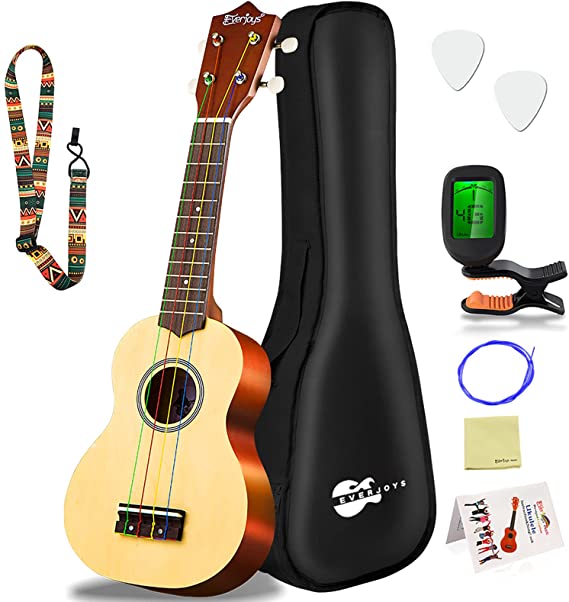
Yes, the add-on I’m referring to here is that gig bag. But, it’s not just a typical gigbag I’m talking about, it’s a padded one that brings extra protection to the table for your musical buddy, viz. uke.
So, even if someone sits on top of the uke—while it’s protected with the padded gigbag—there’s nothing really to be afraid of.
But, that’s not all you get in this kit (bundle), there is more to this kit than just a piece of a padded gig bag. Yes, you right that right—the bundle includes two picks, a capo-cum-tuner, cleaning cloth, extra strings, and a beautiful strap to hang the uke from the shoulder (or perhaps neck, as you would please).
The body of this cheap ukulele has been designed using basswood while the Blackwood and solid wood have been put to good use for fingerboard and neck respectively. It also uses Maple Bridge.
With the help of the digital tuner, you can effortlessly tune your uke. The tuner will display on the screen which note you’re trying to tune in to.
I suggest you start with the C note, then G-E-A.
Pros
- Made of basswood; long-lasting uke
- Boasts nylon strings for next-level comfort
- Packed with all the must-have accessories
- Bridge made of maple; strong enough to hold strings
- Produces very clear and sweet sounds
- Includes free ukulele lessons for beginners
- How-to-play songbook also included
- Comes with a lifetime free string replace
Cons
- Everything seems great
7. Kmise Soprano Ukulele for Beginners (Starter Kit)
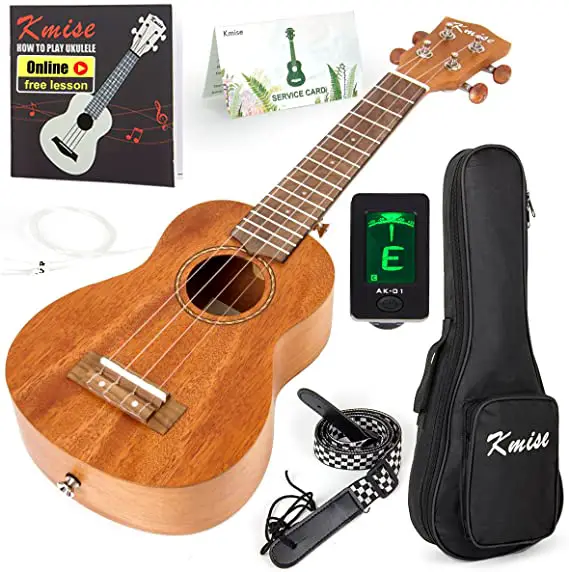
Don’t just pay attention to the strings and body, also think about the nut and saddle to get next-level comfort while experimenting with those strumming pattern ideas.
This kit has all the add-ons beginners might ever need to kickstart their musical adventure, such as extra strings, a gig bag, strap, and strap-on digital tuner to always keep the uke in tune. Not just, they even offer the uke players free online lessons so newbies can learn without going anywhere.
Equipped with 18:1 gear tuning pegs, this uke will have your heart the moment you hear the first notes come out of it. Yes, the accuracy in tuning is up to the mark, hands down!
Kmise has been a runner-up in the race of good uke brands, and I’ve always admired its body construction, the material used in the making, and those carbon nylon strings that cause no harm to the fingers or hands while the uke is held up.
Now, before you say it’s almost priced at $50, I’d like to have your attention towards the coupon that will let you save $8.00extra after you apply the coupon in the checkout.
Although this is a single unit of ukulele that is affordably priced, if you would like to go for a bundle, I’d suggest you consider this package that comprises both soprano and concert ukuleles. And, guess what—both are up for grabs under $120 only.
What’s more, if you’re not satisfied with this purchase, you could even return it. You’ll have 30 days to return it from the date of purchase, in case you’re not happy with it.
Looking for a concert uke from Kmise?
You’ll find this one eye-catching.
Pros
- Designed using A-one mahogany
- Features soft nylon string for comfort
- Includes all the accessories a novice needs
- One of the smoothest walnut fretboard
- Offers accuracy; 18:1 tuning pegs
- Sports a cupronickel fretwire
- 30-day money-back guarantee
- Free online lessons
Cons
- There’s no pick included
6. Deviser 21-inch Soprano Sapele Ukulele for Starters (Bundle)
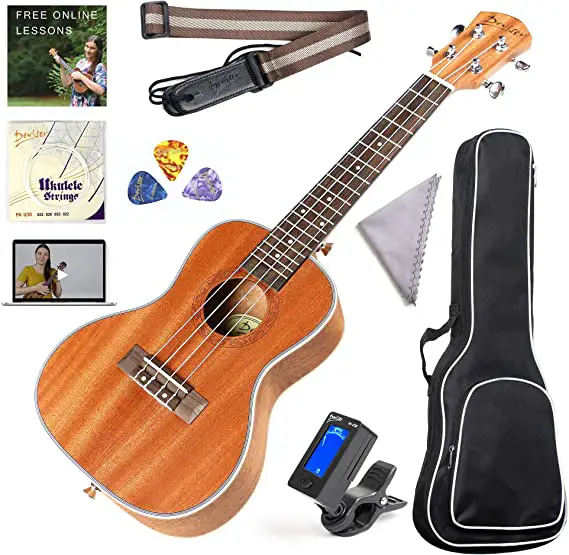
If you believe that this inexpensive ukulele looks familiar, this one looks very much similar to that of Lohanu’s tenor ukulele. The only difference is that this one is a soprano while that is a tenor.
If you’re lost somewhere in between sizes of ukuleles, make sure you understand how they are different in sizes, and if you’re not, you’re missing out on ukulele sizes, for sure.
This isn’t the first time I’ve reviewed one like this budget uke—I got the opportunity to touch upon many of its counterparts in one of our earlier posts. So, it’s okay to stumble upon this low-priced uke.
Okay, enough of the stories. Let’s get back to the specifications, shall we?
Let’s talk about the strings first. It boasts Nylgut strings that feel super smooth to hands and, therefore, don’t cause any kind of injury or rash while you’re upstroking or downstroking.
Its top, back, and sides are made of Sapele while the material used in the fingerboard (fretboard) comes from rosewood, which is also nice to have in a ukulele, especially the budget one. Also, the neck has been beautifully designed using only mahogany.
Uke experts say that tuning is something every ukulist has to face when their purchase a new one. That is because it takes some time for the new string to stretch. But, don’t worry—there are free online lessons with this bundle that’ll allow you to learn the nuts and bolts of playing a uke, including how to hold and play it.
Coming to the price segment, although it’s not as cheap as a 20-dollar ukulele, it has been listed around $45.95 and still gets a rating of 4.7 out of 5 which clearly demonstrates that it’s won the hearts of uke players.
How about the protection or safety of this ukulele? You won’t be playing it all day long, right?
Well, as far as the safety of this cheap uke is concerned, you can rest assured because there’s a gig bag in the bundle.
In fact, both nut and saddle have been smoothened so your hands don’t get stretches while slapping it.
Pros
- Made of A-one woods; Mahogany, laminated Sapele, and Rosewood
- Boasts one-of-a-kind Aquila nylon strings
- Comes with a digital clip-on tuner; easy tuning
- 3 picks included in the pack
- Free online lessons included with the kit
- Safety for your uke; comes with a gig bag
- Keeps your uke clean; has a cleaning cloth
- Leather strap helps maintain balance
- Giftable and bang for bucks; affordable
- Top-notch die-cast tuning pegs; great accuracy
- 30-day money-back guarantee
Cons
- May require tuning every time before playing (in the beginning)
5. Donner Soprano Ukulele Beginner Kit for Beginner Ukulists
Would you like to shop for around $50 or maybe $40?
What if you could save some more bucks on the deal?
It’s time for you to be acquainted with this soprano ukulele. It is a perfect-fit stringed instrument for the newbies who are willing to begin their musical journey. Plus, this model has a coupon ready for you, which will allow you to save $4.00 during the final checkout.
Packed with 4 strings, you can play any songs you have in mind whether it is “Love Yourself” by Justin Bieber, “Just the Way You Are” by Bruno, or James Blunt’s “You’re Beautiful”. You won’t even realize when you’ll have mastered the art of uke playing.
I’m not saying that you must learn to play the aforementioned songs after this piece of craftsmanship reaches you, but just stick to the songs that are easier to learn.
Let’s talk about the material.
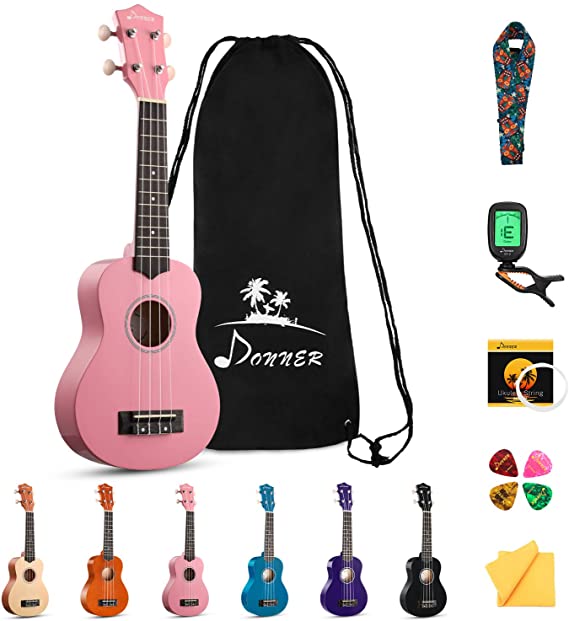
Maple is what lives in this uke (in most parts, except the neck that is made of Natowood). It’s has been designed with all the science in mind and that’s the reason it lasts for years.
Need a cheap uke for your small hands (fingers)?
Say ‘Hi’ to this soprano uke and get peace of mind.
While this ukulele has been made up for grabs at an affordable price, you won’t have to miss out on the high-quality tones because it’s packed with nylon strings that are proved to harm your fingers or hands, despite being little.
But, I don’t suggest this uke to anyone who’s having large hands because this won’t just fit those fingers.
The overall weight of a low-priced ukulele is 830g only, meaning you won’t have to stress your shoulders or elbows while holding it up.
Its construction is smooth and accurate and there are even 12 silver nickel frets that easily make this uke stand out.
Not just that, you’ll get your hands on add-ons to get a smooth music experience while learning or playing the ukulele. Yes, it does come with a strap, tuner-cum-capo, gigbag, 4 colorful picks, and a cleaning cloth that will offer you satisfaction while cleaning the ukulele after it has attracted some dust.
Still can’t make up your mind?
Let’s shed some light on the plus and minus points.
Pros
- Made of Maplewood; designed to last longer
- Making learning easy and fun; free online lessons
- Packed with all accessories beginners need
- Smooth and accurate string-tuning peg
- An ideal choice to gift someone special
- Boasts top-notch nylon string
- Comfortably awesome; inhabits
- Perfectly suitable for music lovers of all ages
- Available in various colors
Cons
- Gigbag is just okay
Still can’t decide?

4. Soprano 21-Inch Ukulele Beginner Kit for Kids, Adults
There’s no denying that pink is the favorite color of most girls. I know some girls may disagree with me, and it’s totally fine.
What I’m trying to say here is that if you’re a girl or someone who needs to gift someone (particularly a girl), this ukulele kit would be the best bet, in my opinion.
Now, you would say that looks are not everything.
I say why only care about the looks when you also get the extras packed with this bundle?
Unlike old-fashioned ukes, this kit consists of a capo-cum-tuner that you don’t need to carry as two separate things. Just mount the capo and you’re good to go.
Why invest in an expensive guitar when you can get the best deal without breaking the bank? It’s said the resonance box is what defines the sound of the uke in the end.
Said that, this uke has been designed with craftsmanship in mind so you don’t miss a note while slapping.
Not only is it value for money but also it is super easy to play and clean, and I’ve seen the newbies find this model very pleasing, except the part where they have to tune it—however, that’s something you’d normally see in almost all cheap ukulele models.
Now, let’s get our head around the plusses and minuses:
Pros
- Boasts greatly desired nylon strings
- Offers influence; has nickel silver frets
- Features maple bridge; delivers stability
- Comes with two picks; entry-level friendly
- Helps with tuning; packed with a tuner
- Safety on the go; comes with a gigbag
- No chances of dust; cleaning cloth included
Cons
- May require a little tweaking for tuning every time you play it
3. Everjoys 21-Inch Soprano Ukulele for Beginners
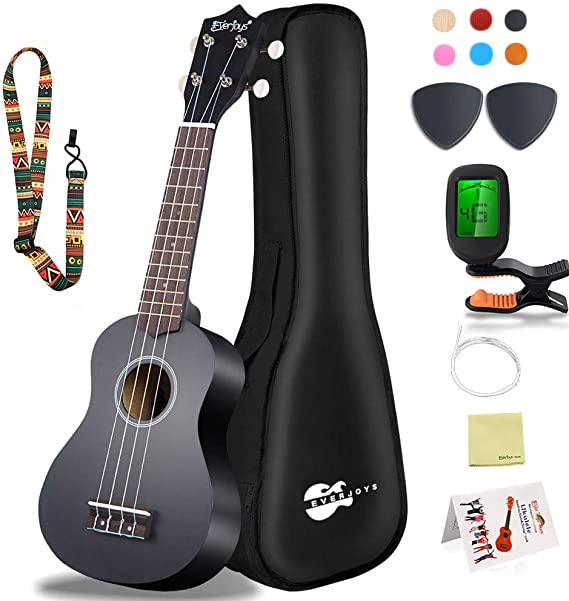
You must be thinking “How can you miss out on the #1 Bestseller?”, right?
Well, the truth is…I’m not.
That’s why I couldn’t take my eyes off of this one of the cheapest ukuleles. What even makes this one special is that it is well-priced and highly rated by the customers.
Its design is what catches the attention of the uke player. I think that’s what keeps them going. It features an out-of-this-world, neat finishing and that’s why most ukulists fall head over heels in love with this model.
From Blackwood Fingerboard to neck, to Maple Bridge, to Nylon Strings, this uke has got everything you need in the first place.
As for the material used in this one, in some parts (like fretboard and back), you will find basswood, whereas, other parts are mahogany-rich. Coming to the strings, there are 4 strings, as usual.
Why buy it?
Apart from ultimate craftsmanship and great sound production, there’s something unique about this model—yes, it includes all the accessories you need to get started with your musical journey.
That includes a capo, a tuner, two picks, a cleaning cloth, a gigbag, a strap, and extra strings. Not just that, you’ll also get a free how-to-play songbook.
That means every time you think there are smudges or dust on your uke, that microfiber polishing cloth will be a saver, and so will be those picks when you’re afraid of hurting your fingertips while trying to slap like a pro.
Pros
- Includes all the accessories for learners
- Eco-friendly design; sleek appearance
- Made of using basswood and blackwood
- Delivers cool, vibrant, melodic sounds
- Boasts most sought-after Nylon strings
- Promotion available; offers extra savings
Cons
- Strings need some stretching for the uke to always be in tune
2. Huawind 21 Inch Soprano Ukulele for Beginners
Is it imaginable to go even below $50 for real, viz. get a good-looking and great-sounding uke at an affordable price?
You want it, you got it.
Meet Huawind ukulele that comes with a lightning deal which means that the quicker you make up your mind for it, the better.
In fact, you’d be astounded to know that this one is listed at 3rd position on the ukuleles list.
This one is a go-to choice for the little to young uke masters, especially for those who are having little hands or fingers because as we know it, Soprano is the smallest instrument in the uke family.
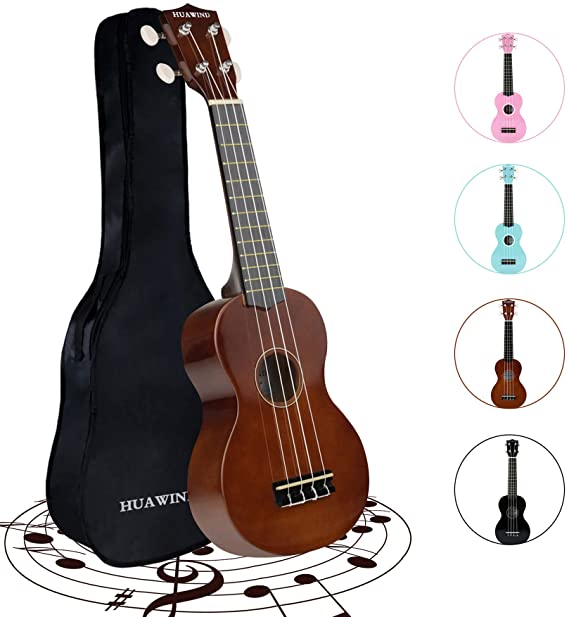
What you’re looking at is a piece of ultimate craftsmanship. Yes, this uke is made of basswood and that’s the reason why it is capable of delivering a pleasant and crisp sound that feels good to the ears. The strings are made of nylon, leaving no sign of scratch on your fingers as you strum through them, another good reason to invest in it.
Speaking of the frets, there are 12 (or 4 strings) that would allow you to play any song on it like a charm.
Newbies, particularly the kids find it enchanting to have the freedom to choose their favorite color when deciding on something. Luckily, this uke is up for grabs in 4 different colors: light blue, pink, black, and brown.
Some people like glossy while others prefer the matte one. If you’re someone who is in love with the former one, this piece of art is definitely for you because it has a glossy finish.
Although you won’t get the picks with this package, it’s worth it considering the pricing model. Plus, this uke gets a 4.4 rating out of 5 which depicts that users are very much satisfied with the sound quality and design of this uke.
As you browse through the page I’ve added above, you’ll also get to learn how to tune your uke properly when setting it up for the first time. The reason why ukes go out of tune has something to do with the stretching of the strings and that happens when they are new.
That means your uke will highly likely deliver better sound production as time passes by.
But, to take it even further, you could download an app on your smartphone to get your uke in tune and make sure that the strings are neither too loose nor too tight.
Pros
- Made of fine-quality basswood
- Neck is made of Maplewood
- One of the cheapest ukuleles for beginners
- Features good-quality nylon strings
- Perfect for gifting someone
- Highly recommended for beginners
Cons
- Difficulty when installing new strings (not pre-included ones)
- No accessories included
1. Hola! Music HM-21NT Soprano Ukulele Bundle
Is it possible to invest in a stringed instrument without having to break the bank? I’m glad you asked that—in fact, if you think you’re the first person to think like that, you’re not alone.
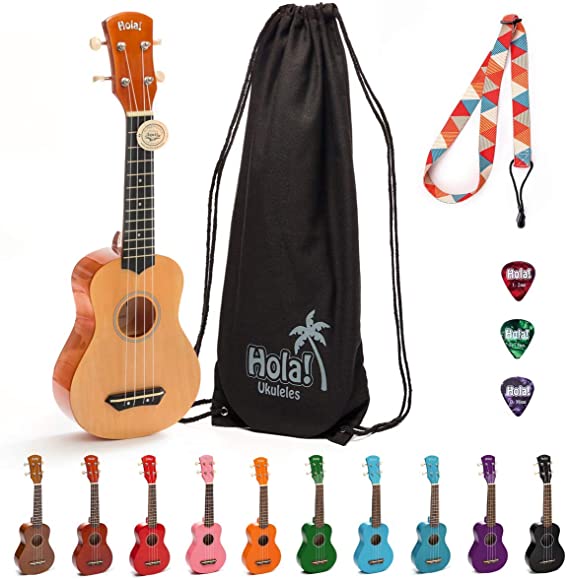
Meet Hola—one of the cheapest ukuleles you’ve ever stumble across online. What’s even surprising is that this isn’t the uke itself you’ll get, you’ll have a complete bundle.
The kit includes some basic accessories a uke player, especially a beginner, needs to get started with strumming. Anyway, the bundle comes with three colorful picks, a gigbag, and a strap. Although pro players may not use these extras, you don’t want to miss out on them as a newbie.
Come to the sound, this uke is packed with Aquila Nylgut strings—one of the most sought-after strings.
But, as a beginner, you’d need some lessons to practice, right?
Well, lucky you—you’ll receive free lessons for two months from “Hola Music”.
Tip: If this is your first time playing a uke, you may feel a little bit of difficulty tuning it. Put differently, you may have to tune it every time you play it. But, don’t worry because this is very common and will be okay once the strings have reached a certain amount of stretching.
Pros
- Boasts Aquila Strings
- Features maple construction
- 2 months free live uke classes
- Offers warm, pitch-perfect tones
- Giftable; a great gift for your loved ones
- Highly affordable; offers bang for bucks
Cons
- Tuning will improve with time
FAQs
Q.1: What’s the best temperature to store the ukulele at?
The best temperature to store the ukulele at is 25℃ or room temperature would be just fine.
Bottom Line!
Hunting for the cheap ukulele isn’t as same as finding the top-of-the-line uke because cheap isn’t always best and, therefore, the process could be tricky. You could be fooled or lured in to buy something you never wanted.
I know you’re here for the cheap uke, but what I’d suggest you is don’t go for a ukulele that is priced less than $30 because, that way, you’ll be looking at a piece of garbage. Having said that, it’s good to invest in a uke that’s priced around $50 or maybe more (if you can afford that).
Anyway, what do think of this list?
Do you think this list deserves some other cheap ukes?
Well, how about you browse through the bestsellers? I’m pretty sure, you’ll come up with a perfect-fit uke—one that’s right within your means (budget).
Also, if you haven’t yet tried one of Kala’s ukes, you’re definitely missing out on a lot. If you have no idea about how to choose a ukulele as a beginner, this beginner’s guide would be a lifesaver.
Want to stay in the know?
Keep an eye on the blog segment.
Recommended reads:
- Best Ukes for Beginners
- Best Tenor Ukuleles
- Best Kala Ukes for Beginners
- Concert vs Tenor Ukuleles
- Best Ukulele Artists
Get the Best UKE and Strum Like a Pro!
Don’t miss out on the best Ukulele; rather, stay one step ahead and steal the deal. Also, keep in mind all the things we’ve mentioned above so you don’t end up buying a piece of junk.
