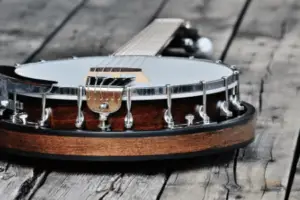
Looking for the best intermediate banjo? When you are in search of truly getting the best banjo that will act as a catalyst in order to boost your playing performance to an amazingly superior level, then the truth is that you will be deeply impressed with the banjos that we mention here.
This review will present five of the best banjos to help you narrow down your selection. Then you will have the peace of mind that whichever one you choose will truly be top quality.
Table of Contents
- Top 5 Intermediate Banjos
- Things You Should Know About Choosing an Intermediate Banjo
- Final Thoughts
Top 5 Intermediate Banjos
#1 Deering Goodtime 2 5-String Banjo


The Deering Goodtime 2 5-String Banjo really is considered as the best intermediate banjo. The slender neck that is crafted of rock maple is designed to make the banjo comfortable to hold for long periods of music enjoyment.
The geared tuners are sealed for extra protection and a higher level of functionality to ensure the better quality of tuning, so that the music you produce has the exact sound that you desire. The rim is fabricated of three plies of maple for extra durability.
The tailpiece is adjustable for added comfort and stability during playing. This device comes with a single bound resonator that is crafted of fine quality maple that enables you to achieve a great volume in regard to the music that you are playing for maximum enjoyment.
If you do not wish to play music on your banjo with the inclusion of the resonator, the good news is that you can indeed remove the resonator. It really is not difficult to remove the resonator if you desire to do so, as it can be simply removed with the usage of a screw driver.
You will also be delighted to know that this banjo comes with the provision of an armrest to ensure your optimal comfort during long sessions of playing your favorite music on this top quality banjo.
#2 Washburn Americana B9 Resonator Banjo


When you are looking for a classy banjo that comes with a top of the line resonator, then you will the Washburn Americana B9 Resonator Banjo is the right choice indeed. This banjo has five strings and the rim is made of high quality aluminum that adds to the overall appeal of this banjo that will perform well for you every time.
The tension hoop is truly impressive with a measurement of eleven inches and it is grooved for better quality performance that you can depend on when you pick up this beloved banjo to play your favorite tunes.
This banjo comes with the inclusion of a planetary tuner that is grooved in regard to the fifth string. Also, there are other tuners that are die cast, which provide buttons that are covered with pearloid in order to allow you to achieve smoother tuning for the best quality of music tone possible.
When you want music that is undeniably clear, then you will be pleased with the maple bridge that is tipped with fine quality ebony. Also, you will benefit from the armrest that is made of chrome that will extend your comfort during playing.
#3 Deering Goodtime 5-String Banjo


The Deering Goodtime 5-String Banjo provides you with twenty-two frets. The neck is fabricated with classy top quality maple that makes this banjo beautiful. There are also bowtie inlays that are crafted of fine hardwood. There are geared tuning buttons, even for the fifth string. They are sealed for added protection and higher performance. The rim is eleven inches and is crafted of three plies of maple that add to the quality of this great performing banjo.
The bridge is formed of a combination of elegant maple and impressive ebony with a measurement of five eighths of an inch. Also, there is the provision of a tailpiece that is adjustable that ensures an even higher elevated performance during music playing.
This banjo provides you with a tension hoop that is crafted of steel and a crown head that is placed high. These elements add to the great sound that you will achieve when you play this amazing banjo.
#4 Gold Tone CC-50 Cripple Creek Banjo


The Gold Tone CC-50 Cripple Creek Banjo is made with real distinctive craftsmanship that is evident at first glance. The fingerboard is made of gorgeous rosewood. When such fine quality elements are put into this type of banjo, this makes the banjo more exciting to play.
The tuners are top quality and will work well each time you need to tune the banjo to ensure that the music you play will be exactly right in each situation. The tuners are done in guitar style to ensure the optimal easiness of the tuning of this banjo. The tailpiece is in a straight line formation to ensure better performance for this banjo in various musical settings.
This banjo will allow much enjoyment, as it is easy to play. You will be pleased with the wonderful quality of sound that this awesome banjo produces. The neck is made of hard maple for added durability. The tone ring is made of brass that adds to the wonderful sound of the music that you play on this prestigious instrument.
#5 The Oscar Schmidt OB3 Open-Back 5-String Banjo


The fret board of the Oscar Schmidt OB3 Open-Back 5-String Banjo is amazingly gorgeous due to being crafted of fine quality rosewood. This banjo will play impressive quality music as a result of having an open back that enhances the tone of the music. There is the provision of a decent remo head. The tone ring has eighteen brackets.
This banjo is finished with a gloss finish that contributes to the nice appeal of this banjo. This banjo is light in weight, so that there is no discomfort during playing. The strings are ultra strong, so that they do not easily break during usage. This banjo truly is made with impeccable quality to allow many years of playing enjoyment.
This banjo puts forth a top quality sound that is easy to hear, which makes the music enjoyable. You will be plesed that this banjo does not sound tinny during usage, but produces a professional quality tone of music during playing.
Things You Should Know About Choosing an Intermediate Banjo
If you are considering playing banjo at an intermediate level with a team or want to improve your banjo skills, it is best to choose the right banjo for you as an intermediate player.
Today there are different types of banjo on the market. They include classical banjo, jazz, and bluegrass banjo. Choosing the best model can be difficult, but it is possible if you know the basics of the different functions available.
Here’s what you should look for when choosing a banjo for intermediate players:
Strings
Why should you consider this option compared to others as a Banjo with six chains? You can find the Banjo Series 6/7, but technically they are Banjo / Guitar hybrids. If you want a real banjo, you should consider a 4/5 string instrument.
Another problem to solve when choosing a banjo is the type of music it will play. For example, a 5-string banjo is a good choice for popular music. There are other styles, like the bluegrass banjo, that give you the option of adding a resonator.
Since the banjo with five strings is longer, it also produces less melody. You can operate it with a pick or two metal fingers.
The big advantage of the five string Banjo Squad is that it is the most popular on the market. Therefore, it is easier to find it in online music stores and retailers.
You can play many types of music with five stings banjos. The unique plug type makes it a good choice. If you want to play raw music, a 5-string banjo is a good choice.
Sealed Gear Mechanics
Sealed mechanics help prevent corrosion like this, which can negatively impact the performance of the banjo. It is easier to keep the tuner open. However, since they are more sensitive to dirt and grime, this is a major drawback.
Sealed tuners are often smoother. The main difference between the two types of tuners is the pattern. Therefore, this must be taken into consideration when choosing one.
Budget
You should look for good quality at reasonable prices. That was the reason for the original design of the Banjo. Banjos are not cheap but it finding a great quality banjo for intermediates can come anywhere between $500 to $700, which makes it more affordable than many other models.
You can obviously go crazy and get into the thousands of dollars but it’s not necessary at this point in your career.
Tailpiece
The quality pangs have this characteristic, except for many old school banjos on the market. These units have a small fixed tail to provide a traditional sound.
When choosing an adjustable tail, make sure it doesn’t ring. It is better not to interfere with the ringing. This generally includes non-resonant alloys.
Tone
When choosing a banjo, the tone is easily one of the most important characteristics to consider when choosing a model. This unit has a polished brass ring. This stock option is due to the incredible golden look.
The ringing changes the personality of the basic banjo. If the banjo has a “correct” ringing, it produces a warm sound that pleases the ear. Certainly, the materials used to produce the ringtone are a major factor.
Banjo extensions
This feature of a banjo is sometimes included with additional attachments. This is an advantage because it adds value to the purchase. Often, these are the duplicates that you usually buy anyway, so it is a bonus to include in the unit, so you get more value. This can reduce the total cost of the banjo and accessories.
Beaded placeholders: placeholders are vaccinations like dots that act as benchmarks on the Banjo key to inform the player where there are specific notes.
Point fortifications have the same function. They are simply different in the aesthetics they offer. The points are basic vaccinations, while others are more elegant.
The pearl is a type of plastic designed to resemble mother-of-pearl. It is often used to produce musical instruments such as the banjo and electric guitars.
Final Thoughts
Finding the middle ground between a beginner and professional level banjo is somewhat hard and it requires thorough research for your specific budget and requirements.
We hope this article has given immense value for you deciding which intermediate banjo you should get.
