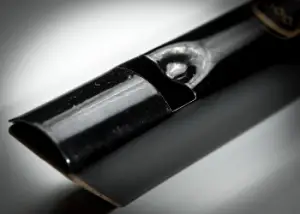
A low D whistle uses the same six holes and the same fingering chart as the tin whistle you can buy for twenty dollars. Almost nothing else about it is the same. It is nearly two feet long, it sounds an octave lower, it takes noticeably more air, and the holes are far enough apart that a lot of people cannot cover them with their fingertips at all.
So the buying decision splits in two: which one, and can you play one. The second question is the expensive one to get wrong.
mk Kelpie Low D
Machined from a single billet of aluminum in Glasgow by a workshop that has made nothing but low whistles for over twenty-five years. It is their entry model, which on this instrument means the cheapest properly made one rather than a compromise — the bore, the airway and the hole positions are the same job as their professional whistles, done without the hand-finishing time.
It is not a big tin whistle
Cover all six holes on a standard D whistle and the note is D5, the second D above middle C. Cover all six on a low D and it is D4, an octave underneath. That octave is the whole point — it is the register the Irish flute lives in, and it is the sound most people are chasing when they go looking for one.
| Standard D whistle | Low D whistle | |
|---|---|---|
| Lowest note | D5 | D4, an octave lower |
| Length | About 12 inches | About 22 inches |
| Bore | Around 12 mm | Around 25 mm |
| Fingering | Identical — one chart works for both | |
| How you cover the holes | Fingertips | Flat pads and middle joints, for most hands |
| Air | Very little | Considerably more, and the second octave needs real pressure |
| Who makes them | Factories, in the hundreds of thousands | Small workshops, one at a time |
| What a good one costs | $14–70 | $250 and up |
The price gap is not a margin story. Nobody mass-produces a low D. The instrument as we know it dates to late 1971, when the English flute maker Bernard Overton built a metal replacement for Finbar Furey’s bamboo whistle after it was destroyed on tour; the first attempt was copper pipe with a wooden plug, and the aluminum version that followed is the ancestor of every low whistle sold today. Fifty years on it is still made by a handful of small workshops, and the price reflects the machining rather than the material.
Will your hands reach?
This is the question to settle before you spend anything, and it is the one the instrument’s reputation is built on. Fingering a low D is not a matter of technique you can acquire in a fortnight — either the holes fall under your fingers or they do not.
Carbony publishes the hole dimensions for their low Ds, which makes a real measurement possible. On their standard-spaced instrument the top hand’s three holes sit about 39 mm and 38 mm apart, center to center — a span of a little over three inches across three fingers. Their close-spaced model, built specifically to shorten that reach, brings the same two gaps down to about 31 mm and 30 mm.
Mark three points on a sheet of paper 39 mm apart, lay your left index, middle and ring fingers across them, and try to cover all three at once with a relaxed hand. Many hands cannot do it with the fingertips at all, and few can do it and still move. The answer is the piper’s grip borrowed from the uilleann pipes: the fingers lie flat across the tube and the holes are sealed with the pads and middle joints rather than the tips. It feels wrong for about a week and then stops being a problem for most players — but for genuinely small hands it does not become possible, and there is no version of the instrument in D that fixes it.
If the reach defeats you, the honest answer is a low whistle in a higher key. Low F and low G are shorter instruments with proportionally closer holes, they keep most of the dark tone, and they are what a lot of small-handed players end up on permanently.
One piece, or tunable
A one-piece whistle is a single tube with the mouthpiece machined into it. A tunable one separates into a head and a body, and sliding them changes the pitch by a few cents either way. There is a real argument on both sides and it is worth understanding before you choose.
The case for one piece is that there is no joint to leak, nothing to loosen, and nothing to lose. It is also lighter, which matters more on an instrument this size than it sounds.
The case against is temperature. Every whistle plays sharp as it warms up, because warm air carries sound faster, and a metal low D holds a lot more material than a tin whistle does. Tony Dixon, who has been building whistles in England for decades, will only make metal low Ds as tunables for exactly this reason: the greater mass takes longer to come up to playing pitch, which they say is a problem on a one-piece instrument. Play alone or in a session where everyone drifts together and you will never notice. Play along with a recording, a piano or a fixed-pitch instrument in the first ten minutes and you will.
The two worth buying
mk Kelpie Low D Whistle
- Key of low D, A=440
- 565 mm long, 25 mm bore
- 210 g
- One-piece 6000-series anodised aluminum
- Non-tunable
- Wool-felt sleeve included
- ~$250
mk have been making low whistles in Scotland since the 1990s and the Kelpie is the model they built to get people into the instrument. It is CNC-machined from one piece of aerospace-grade aluminum and hand-finished in their Glasgow workshop, which is why every one plays the same — there is no rolled seam, no glued fipple and no molded plastic anywhere in it.
What you are actually buying at this price is the airway. mk taper it so that the back pressure balances against the amount of air the tube wants, and the practical effect is that the bottom octave speaks without being coaxed and the top one arrives without shrieking. That is the part cheap low whistles get wrong, and it is not something a player can fix afterward.
It is not tunable, and mk are open about that being a design choice rather than a saving — the one-piece body is what makes it robust enough to live in a bag. At 210 g it is light for its size, which helps a hand that is already working hard to reach. It comes in polished aluminum or black anodised, the same instrument either way, with the black costing a little more.
- A properly made low whistle at the bottom of what one costs
- One-piece body with nothing to leak, loosen or lose
- Light enough that the stretch is the only thing your hands are fighting
- Hole positions cut to ease the finger stretch as far as the key allows
- Fixed pitch, so it plays sharp until it has warmed through
- Aluminum is brighter than a polymer low D — less of the breathy sound some people are after
- Still $250 for an instrument you may find you cannot reach
Carbony Tuneable Low Whistle in D
- Key of low D
- Hand-laid carbon fiber body
- Tunable head
- Machined anodised aluminum mouthpiece, ebonite tip
- Conical bore
- Lifetime structural warranty
- ~$600
Carbony builds in Oregon, and they are the only maker doing this instrument in carbon fiber. Each body is laid up by hand around a precision-ground mandrel, which is how they get identical dimensions from one to the next, and the layup mimics the fiber direction of wood — so the tone sits closer to a wooden flute than an aluminum tube does, without a wooden instrument’s habit of cracking when the weather changes.
The bore is conical rather than straight, which is the harder thing to make and the reason the intonation holds across all three registers instead of just the two you normally get. The head is tunable, which removes the warm-up problem entirely, and the whole instrument carries a lifetime structural warranty.
Two and a half times the price of the Kelpie is a lot of money for a second whistle in the same key, and this is not the one to learn on. It earns its place if you already play, you know the reach is not a problem for you, and you want an instrument that will sit in a case for twenty years and still be in tune.
- Tunable, so it plays with fixed-pitch instruments from cold
- Carbon fiber does not care about heat, damp or a rough journey
- Conical bore holds intonation into the third register
- Lifetime structural warranty from the maker
- Around $600, against $250 for an instrument that plays the same tunes
- The tuning joint is one more thing to seat properly and keep clean
- Carbon fiber is a taste — some players want aluminum’s edge
If you have never played a whistle, start on a small one
Everything you learn on a standard D whistle transfers to the low D unchanged — the same six holes, the same fingering, the same key, the same tunes. What does not transfer is the reach and the breath, and those are the two things that decide whether you keep the low D. Twenty dollars and a fortnight tells you whether you like whistle fingering at all, before $250 tells you whether your hands fit.
| Clarke Sweetone D | Tony Dixon tunable high D | |
|---|---|---|
| Body | Tapered rolled tinplate | Two-piece polymer |
| Tunable | No | Yes |
| Tone | Soft, breathy, quiet | Rounder and stronger, closer to the low D’s family |
| Best for | Finding out whether you like it | Playing with other people |
| Price | ~$21 | ~$40 |
The Clarke is the cheapest whistle worth owning and the gentlest to blow, which makes it the better test instrument. The Dixon is made by the same firm that builds low whistles, it comes apart to tune, and it is the one to buy if there is any chance you will play with somebody else inside the first year.
The book that actually covers this instrument
The Low Whistle Book — Hannigan & Ledsam
- 114 pages, paperback
- Soar Valley Music
- Tutor plus tunes, with recorded examples
- ~$40
Whistle tutors are almost all written for the standard D, and they skip the two things a low whistle player needs: how to move enough air without pushing the note sharp, and how ornaments have to change when the fingers are lying flat. Hannigan and Ledsam wrote the one that is about the low whistle itself — a tutor section that starts from nothing, Irish ornamentation explained properly rather than listed, a chapter of history, and a set of tunes chosen for the register.
It works from a standing start if you have never played, and it is still useful if you already play the small whistle, which is unusual for a method book.
Looking after it
The one maintenance problem a low whistle has is condensation. You are pushing a lot of warm breath through a cold metal tube, and the water that forms in the windway will eventually choke the note into a hiss. Warming the instrument in your hands or under your arm before you start is most of the cure; the rest is blowing the windway clear or wiping it out between sets. A whistle that clogs in the first minute of every session is cold, not faulty.
Beyond that, a machined aluminum tube asks for nothing. Keep it out of the boot of a car in summer, do not leave it standing where it can fall, and use the sleeve it came with.
Common questions
What is a low D whistle?
A six-holed whistle pitched an octave below the standard D tin whistle, so its lowest note is D4 rather than D5. It is about twice as long, roughly twice the bore, and fingered identically.
Is a low D whistle harder to play?
Not musically — the fingering is the same and the tunes are the same. Physically, yes: the reach demands a flat-fingered grip and the instrument takes noticeably more breath, so phrases you could hold on a small whistle will need breaking up until your lungs catch up.
Can a complete beginner start on a low D?
Yes, if your hands cover the holes. Nothing about the instrument requires prior whistle experience. But a $20 high D answers the “do I enjoy this” question for a twelfth of the money, and the fingering you learn on it is the fingering you will use.
Do I have to use piper’s grip?
Most players do. If you can seal 39 mm hole spacing with your fingertips and still move your fingers freely, there is no reason to change — but that is a wide span to hold, and the flat grip is what the majority end up using.
Tunable or non-tunable?
Non-tunable is simpler, lighter and cheaper, and it is fine for playing alone or in a session. Tunable earns its money the moment you have to match a piano, a recording, or a fixed-pitch instrument before the whistle has warmed through.
Is a low D whistle the same as an Irish flute?
They sound in the same register and share a fingering system, but the flute has no mouthpiece to make the note for you — you form the airstream with your lips across an open hole. That is a fortnight of work before the first reliable note. The full comparison is here.
Why are low whistles so expensive?
Because no factory makes one. Every low D on sale comes from a small workshop machining or laying up tubes in small batches, and the hole positions on an instrument this size have to be cut precisely or the octaves will not agree. There is no economy of scale to pass on.
Related reading
- Irish flute vs. tin whistle — the same register, a very different mouthpiece
- Penny whistle vs. recorder — six holes against eight, and why the fingering does not transfer
- Best bagpipes for beginners — where piper’s grip comes from
- Woodwind instruments — the whole family, and where whistles sit in it