
You’ve got the great-sounding ukulele, a tuner to keep the uke in tune, a capo to get the most out of pitch effectively. You even got a cleaning cloth to always keep your ukulele as fresh as new, and some extra picks to avoid the risk of having calluses on fingers.
Despite all aforesaid items, there’s still something that is missing from the accessories you got in the package.
Yes, I’m talking about the ukulele strap—an accessory without which your ukulele feels incomplete.
But, do you actually need a strap to hang the uke around your neck or shoulder while you’re busy strumming it?
Well, the short answer is “Yes”.
When you hold up something in your hands, whether it is a ukulele, a guitar, or any other string instrument, your hands get tired. Holding a uke for long hours also puts a burden or strain on your shoulders.
Now, picture yourself holding that beautiful ukulele continuously.
Can you imagine how badly your hands will hurt?
I know that a ukulele isn’t as heavy as a guitar is, but it still does weigh and that’s something you need to keep in mind, especially if you spend hours with your musical buddy—the ukulele.
Table of Contents
- Why Use a Ukulele Strap?
- List of 7 Best Ukulele Straps in 2022
- 1. M33 Ukulele Strap with Double J Hooks (No-Drill Uke Belt)
- 2. Sofiey Ukulele Strap with Double J Hooks
- 3. Music First’s Ukulele Strap with Vintage Lace
- 4. Eyeshot Ukulele Strap with J Hooks (No Drill)
- 5. Eyeshot Ukulele Adjustable Strap (Free Picks)
- 6. Rinastore Ukulele Genuine Leather Strap
- 7. Lohanu Clip-on Ukulele Strap (No-Drill Uke Belt)
- FAQs: Ukulele Straps Buying Guide
Why Use a Ukulele Strap?
What are the benefits of using a ukulele strap?
There’s not only a single benefit of using a strap with a ukulele, you’ll be amazed to see how beneficial it could be, especially for the beginners who are just getting started with their strumming patterns.

Anyway, let’s get our head around the benefits of having a uke strap:
- A ukulele strap is useful to hang from your shoulder freely so that your hands could do the magic.
- You could use the ukulele strap to hang it on the wall easily (or if you would like to use the hook, that’d do just fine).
- A strap also complements a ukulele or the place where you have placed the uke. This will add a next-level look to the surroundings.
There lie some other advantages that are indirectly related to the aforesaid plusses, for example, if you hang it from a hook, it will stay safe than when you just put it anywhere in your room.
List of 7 Best Ukulele Straps in 2022
As you’ve figured out what role a ukulele strap plays when you’re holding up your uke in your right or left (if you’re left-handed), it’s time for you to cherry-pick one of the best ukulele straps we’ve laid out on this page for you.
Okay, let’s skip the whys and jump to whats to see which ukulele strap you should try with the one you own.
Starting with the first one…
1. M33 Ukulele Strap with Double J Hooks (No-Drill Uke Belt)
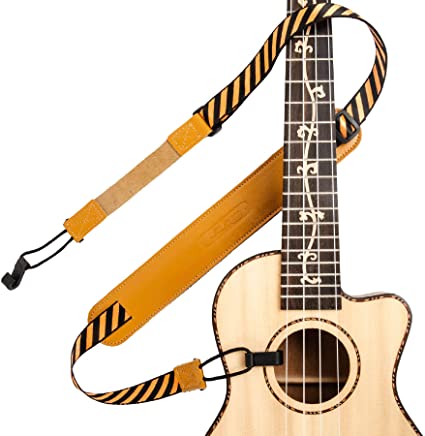
Is there any way to get your hands on a ukulele strap that doesn’t require you to drill the hole?
Well, this uke strap from M33 couldn’t get any better.
Drilling a hole in the uke for strap support is always a daunting task, plus, there is an increased risk of damaging the uke because not everyone has the technical details of how carpentry works.
If drilling a hole into your uke has always given you a heart attack, it’s about time you make up your mind towards this uke belt.
I can guarantee that you won’t regret this purchase.
And, it’s not just the drilling that this strap keeps you away from—it’s convenient, comfy, and most importantly, you will be able to adjust the length of this strap—right based on the type of uke you prefer to play with in your spare time, be it tenor ukulele or soprano.
Said that, if you gifted a ukulele to your kid earlier, they can make the most out of it, too.
This is one of the best no-drill ukulele straps you’ll ever come across in the future—I mean, it’s perfect in all areas, from offering great playability to comfort to handiness to adjustability.
Available in 7 unique patterns, ukulele lovers, especially the girls, will float on cloud seven after getting this model—undoubtedly.
In a hookless ukulele strap, people usually have to struggle with the drilling problem, however, this one—on the other hand—will keep you satisfied to the fullest.
Not just that, a hookless strap is also time-consuming because you’ll need to install and remove the nail again and again.
So, I think this one is a perfect ukulele strap if you want to use it right out of the box—without having to worry about the installation whatsoever.
Pros
- Helps you dispense with drilling a hole in your uke
- No need to depend on the buttons or pegs anymore
- Premium material; ends made of genuine leather (with silky smooth polyester strap)
- Super easy to use—right out of the box; easy setting up
- Adjustable length; from 33 to 47 inches
- Up for grabs in different colors and striking patterns
- Package includes 2 hooks and a carabiner
Cons
- None
2. Sofiey Ukulele Strap with Double J Hooks
Are you fed up with the ukulele straps scratching your neck?
I get it—strap stretching the neck sucks, and so does drilling a hole in the uke.
But, that’s something you won’t have to cope with anymore.
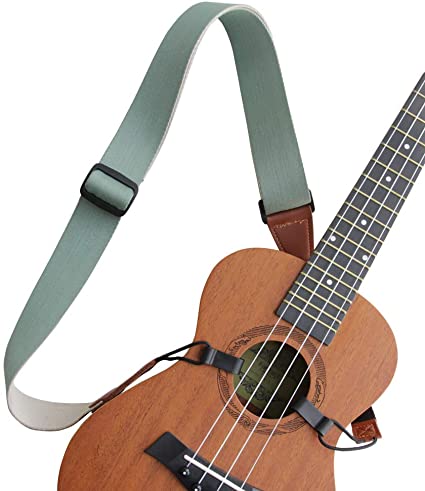
Meet Sofiey uke strap—a ukulele belt with hooks that will leave you stunned for sure. It’s made of high-quality close-grained woven and you’ll experience top-notch leather at the ends of this strap.
It’s available in so many colors that will give you the freedom to choose your favorite one. Speaking of favorites, I love “Matcha Green” because it will make a great pair when combined with a uke of any color.
Do you have to drill a hole in your ukulele to use this strap?
Of course, not—and, that’s the beauty of this uke strap.
There’s nothing you need to rely on, such as pegs, buttons, or a drilling machine. All you need is two hooks and you’re good to go.
Since you don’t have to use any drilling machine to make a hole in your ukulele, the installation process is pretty easy. It’s ready to fit all standard-size ukulele.
It’d be a perfect gift for your 3 to 15 years old kid and I believe they will love it in the blink of an eye.
As you know that you have to attach both straps to the soundhole of the ukulele, if you don’t like doing that, you could make use of a piece of yarn to attach one hook up above between the tuners.
In addition to aforesaid benefits, this one looks also fashionable and offers versatility as far as different patterns or colors are concerned.
Would you like to use it with other stringed instruments than just the ukulele?
Well, you’re in luck— Sofiey uke strap is compatible with most string instruments, namely guitar, mandolin, etc. Also, what people have been loving about this strap is the quality. It’ll cause no rashes on your skin and will not cause any sort of irritation either.
So, if you’re concerned about your safety, you can rest assured.
Pros
- Made of close-grained woven, premium leather ends
- Cool and eye-catching design; easily stands out
- Boasts no-drilling mechanism; easy installation
- Features adjustable length; adjust up to max 59.8 inches
- Available in 10 different colors
Cons
- Includes no add-ons, such as picks
3. Music First’s Ukulele Strap with Vintage Lace
Do you want to step up your uke playing experience for real?
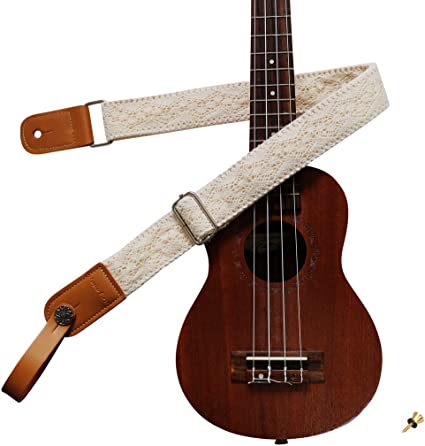
If affirmative, you can’t miss out on this strap. It boasts a graceful and vintage lace that will feel buttery smooth on your skin. It ranked at #1 position in the new release in the ukulele accessories category and receive player’s appreciation from around the world.
Although this strap is new in the market, it has received applauds from its admirers (ratings couldn’t get any better).
This strap may look a bit overpriced, but considering the top-of-the-line fabric used in it, beautiful design, and genuine leather on both ends, it’s totally worth your money. Not only will it feel softer on your hands and other parts of the skin but also it will last longer than you could imagine.
It doesn’t matter what ukulele you’re using, whether you got one from Kmise or you own an Enya or any of the best ukuleles, it’ll go well with all kinds of ukes out there—no matter the size.
Although it doesn’t feature any hook mechanism, it’s still a go-to strap of many ukulists out there because it looks fancier than most ukes. And, of course—you can choose whichever color you prefer, white or cream. If you still can’t decide the color, I think you should go with cream because that looks warm.
If you’re having second thoughts, I believe you this uke won’t disappoint. But don’t just take my word for it—see what the users (who also bought it) are saying about its features, looks, longevity.
Pros
- One-of-a-kind look; attractive and comfortable
- Adjustable length; compatible with almost all types of ukuleles
- A-one material; uses soft graceful & vintage lace
- Boasts genuine leather ends; offers durability
- Complements all the places you put it
Cons
- Requires drilling
BEST Ukulele for Beginners?
I believe you will love Kala’s Ukuleles.
4. Eyeshot Ukulele Strap with J Hooks (No Drill)
Eyeshot has been a game-changer in the past few years. It’s been making one-of-a-kind and feature-rich ukulele accessories that win people’s hearts.
If you paid close attention while reading this article, you would have come across its ukulele strap at 3rd position on this list. Although that strap requires drilling a hole, I’m surprised that people are still vouching for it. That’s because—to some people—drilling may seem like a nightmare, however, others are completely fine with that.
But, it’s all kind of personal perspective.
Some people like a uke strap (belt) with hooks while others don’t feel like embracing such bands.
The question is: do you love J hooks and don’t want to get in the middle of making a hole in your beautiful ukulele?
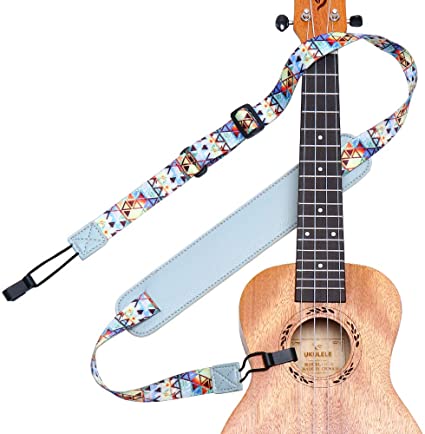
If that’s what you’re after, this strap would be a dream come true for it comes packed with two J hooks, and there’s not much of a difference in the pricing model when compared with the one reviewed above.
As soon as it arrives at the destination, all you need to do is open the package and attach the two J-hooks to your uke (one to the one side of the soundhole and the second hook to another). It’s as simple as that. If you have trouble installing it, you can refer to the images shown on the product page.
Is it compatible with all uke types?
Yes.
Is it waterproof?
No, there’s no such thing offered by the brand yet.
How about holding the ukulele in one position? Can this no-drill ukulele strap help you achieve that?
If you always wanted to get your hands on one of the best no-drill uke straps, you can’t underestimate this uke’s capabilities because it offers the same thing.
And, it’s not just the no-drilling that catches the eye, there’s more to this strap, such as unique artistic patterns on the strap, first-class material, length adjustability, etc.
Yes, if you feel like your hands can’t reach the ukulele because it is way too far, you can adjust the length of the strap without any difficulty. Also, no matter if you’re a newbie or you’ve been slapping on the uke for years, you won’t have a hard time installing or using this belt.
Also, the shoulder pad is made of genuine leather and the layer of the pad is wide so the strap doesn’t put stress on your shoulder while you’re using it.
As for the construction of hooks, they are made of premium ABS.
Does ABS ring any bell?
Well, it’s the same material the Kala Waterman Ukulele is made of.
Now, if you don’t have time to get to know all the features of this ukulele strap that works without drilling, let’s skip to the pros and cons of the same for your peace of mind.
Pros
- Made of first-class leather (ABS in hooks)
- Adjustable length; adjustable to up to 51.2 inches
- Wide shoulder pad to offer more comfort to shoulders
- Doesn’t involve drilling a hole in the ukulele
- Suitable for all types of players: kids to grown-ups
- Comes with premium J hooks; no uke damaging risk
- Features a premium buckle for adjustability
Cons
- None
5. Eyeshot Ukulele Adjustable Strap (Free Picks)
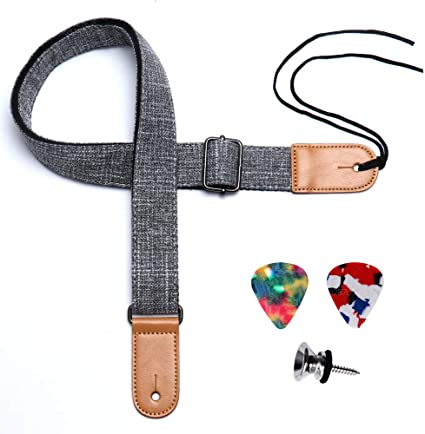
Is it possible to get your first ukulele strap that doesn’t suck?
Can you really get your hands on one of the best, sturdy, and elegant ukuleles out there without breaking the bank?
Meet Eyeshot’s uke strap that will win your heart the moment you take a look at this, and you’ll keep gazing at it once you do that. Its design is artistic, the material is premium, and the length is adjustable to however long you want the strap to be—based on the type of ukulele you wish to use it with, be it a concert, soprano, or tenor, or others.
Made of 100% pure cotton, you’ll get to lay your eyes on the real craftsmanship. It’ll let you feel those beautiful Hawaiian vibes while you use the ukulele and it does the magic for you. The ends are made of premium-quality genuine leather.
Available in 11 colors, it offers you the freedom to choose your favorite one. If I had to gift this strap to a girl, I’d choose “Colorful butterfly”. But you can choose any color you prefer.
The buckle is smoothly adjustable from 28.7 to 51.2 inches so you don’t have to strain your shoulders or hands while using it. If you don’t want to damage your uke by drilling a hole, you could use a command hook that works for your ukulele.
What’s more, people seem very much satisfied with their purchase on this one.
I mean, people don’t just give 4.8 ratings out of 5 for no reason. There’s something about this well-designed and long-lasting uke strap that is making uke lovers go crazy about it.
Pros
- Genuine leather ends; offers rigidity and durability
- Unique design; stands out from the crowd
- Boasts an artistic design; eye-catching construction
- Truly adjustable; can be used with any ukulele
- Comes with add-ons; the pack includes 2 picks, 1 nail
- Soft and comfortable; made of 100% cotton
Cons
- You’ll need to drill a hole into your uke (or you can use a command hook)
6. Rinastore Ukulele Genuine Leather Strap
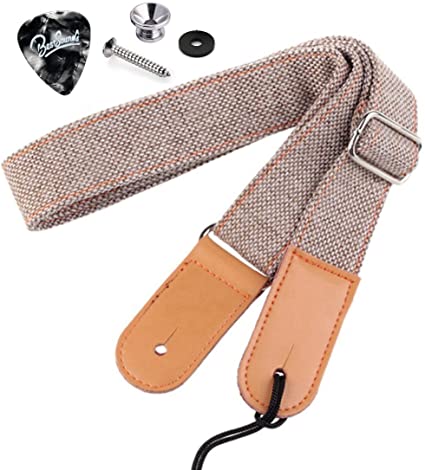
Do you need a ukulele strap that not only looks great but also is made of genuine leather?
Look no further—this uke strap from Rinastore is your dream come true.
The problem that most beginner ukulele players face when looking for the best uke strap is that they end up buying a strap that’s been designed only for a specific uke—not for every type.
Need a strap that works best with all types of ukulele, be it soprano, tenor, concert, or baritone?
Lucky you—this strap is for you.
This strap works like a charm with all kinds of ukulele out there—no matter what their size is, thanks to the adjustable length. In fact, in addition to using it with a uke, you could also put this one to good use by utilizing it with other stringed instruments like banjo and mandolin.
This strap is made of 100% cotton linen, which will ensure the safety of the ukulele and will good for your skin. Unlike other cheap ukulele straps, this one won’t slide either—hands down.
Since its ends are made of genuine leather, you can count on its longevity.
You shouldn’t have any problem cherry-picking this one since it also includes a pick in the package that should get you started with your strumming lessons.
To make the installation super smooth, Rinastore has also provided a strap button.
Confused about if you can wash it or not?
Well, this strap has got your back—you can wash it and it doesn’t even fade.
Pros
- Great-looking yet robust uke strap
- Leather ends offer elegance and ensure longevity
- Up for grabs in 5 different colors
- Well-suited with all types of ukulele out there
- Free pick included in the package
Cons
- Requires drilling a hole in the strap for installation
7. Lohanu Clip-on Ukulele Strap (No-Drill Uke Belt)
Can you REALLY get an unconditional lifetime warranty with a ukulele strap or it is just one of the things uke brands say to lure their customers into buying their products?
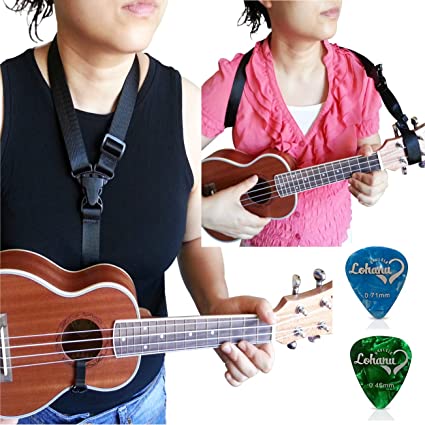
Although this one may look just like the one reviewed on top of this list, this one uses a different approach. What I mean by that is that there are two ways to use this strap; you can wrap itaround your neck or shoulders.
It’ll keep your ukulele steady while you’re busying strumming.
Lohanu is known for its excellent customer service. They always prioritize their customer over other things. You’ll also get two picks as a bonus in this pack that will allow you to learn all the patterns easily without hurting your fingers.
No matter what type of ukulele you’re having, you’ll have no problem with the attachment. It’s been designed with different sizes of ukulele in mind.
Yes, it’s true. You can effortlessly adjust its length from 34 inches to 51.5 inches like a charm. That means your kiddo can also take advantage of this no-drill strap—there’s no need to buy a separate one for them.
Although look-wise it may not as impressive as you’ve been wishing, it’d exceed your expectations for sure when you receive it. It’s durable and value for money.
However, what I’ve realized is that it’s not as comfortable as the one from MM3 above. So, you need to think about the ease of use and coziness, as well.
Pros
- Doesn’t require drilling a hole in the ukulele
- Helps keep the ukulele steady while you play
- Reasonably priced; doesn’t break the bank
- Suitable for all types of ukulele out there
- Offers adjustable length—from 86-131 cm
- Comes with an unconditional lifetime warranty
- Add-ons in the package; includes 2 picks
Cons
- Only available in a single color
- Not as comfortable as its counterparts
FAQs: Ukulele Straps Buying Guide
Q.1:
What’s a Ukulele Strap?
First things first—what exactly is a ukulele strap?Well, a ukulele strap or uke strap is a strap usually made of leather, or some other cloth. It may come with a hook or without one
Q.2:
How to Choose a Ukulele Strap?
Although to some of you choosing a uke strap may seem like child’s play, it is not. There are certainly some things you need to keep in mind while looking for a uke strap.
Material:
What’s the material the strap is made of?
Is it comfortable? Is it long-lasting?
These are the questions you should ask yourself first. Depending on the type of ukulele strap you are considering, you may see different types of materials, namely genuine leather, nylon, cotton, suede, graceful & vintage lace, and so on.
I strongly suggest you choose the one of which ends are made of genuine leather. And, as far as the construction of strap matters, you can go with any fabric you like, be it cotton or suede leather.
Also, think about the shoulder strap—is it widened or does it have the same width as the rest of the strap?
If you need a soft and comfortable uke strap, I’d suggest you go with this one because it’s elegant, comfy, and designed to last longer.
Adjustability:
Does the ukulele strap you are looking forward to buying have an adjustable length feature?
This is important because you don’t want to purchase individual straps for all the stringed instruments you’re having (if you have more than one). The length adjustability features allow you to adjust the length of the strap depending on the size of the ukulele you’re using.
Type:
You also have to understand what type of ukulele strap you actually need. I’ve already broken down this one below for your better understanding.
Q.3:
How to Install a Ukulele Strap?
Installing a ukulele strap is not rocket science.
The process differs from uke to uke, depending on their type (model).
No-drill Strap (Hook Strap):
If you’re making up your mind for a no-drill ukulele strap, it’s obvious that there’s no hardly anything that you will need to do—apart from inserting those J hooks into the soundhole of your uke.
If you have chosen a uke strap that comes with a nail, then you’ll need to make (drill) a hole in your ukulele. And, you already know making a hole comes with a risk of damaging your ukulele or yourself. Plus, you must have a drill machine to do that.
One-button Strap:
If you would like to grab a one-button strap for your ukulele, you will have to connect one end to the knob and another end to either headstock or soundhole. Again, this could vary depending on various strap models. So, check out how your strap has been designed to work.
Two-button Strap:
This one is very much similar to the one-button strap, except for the fact typing mechanism gets replaced by another connecting hole. This one offers the most stable experience to the ukulist. However, this one also requires drilling a hole in the ukulele—which not everybody likes.
So, if you don’t want to make a hole at the bottom of our uke, you certainly don’t want to pick this one.
Leash Strap:
The leash or leash half strap follows a unique approach to keeping the ukulele steady while you’re busy downstroking your uke.
What’s good about this strap is that you don’t have to rely on any hook or button system.
All you have to do is put your arm through the loop, then lift the strap over your head (or behind your neck). However, you will need to support the ukulele lightly using your strumming arm.
Q.4:
Which Ukulele Strap do You Recommend?
Well, my favorite one is a no-drill ukulele strap. A no-drill uke strap is not time-consuming, requires no drilling machine for installation, and super easy and fun to use at different places.
Q.5:
Do I Need a Strap for my Ukulele?
Well, it’s no easy to answer this in “Yes” and “No” because only you know where you stand with your ukulele playing levels. However, most ukulele players, especially beginners, need a ukulele strap to get started.
Below are the reasons why it’s good to have a ukulele strap:
- It allows you to keep the uke stable
- You don’t have to try to squeeze the uke in one place
- It will help take away all the stress your hands suffer from
- Works great with all stringed instruments
If you look at some professional ukulele players closely, you’ll notice that they also use the strap regularly because that’s how you can easily focus on the chords or tunes you’re trying to create.
So, yes!—you do need a ukulele strap.
Q.6:
Can I use these Ukulele Straps with my Guitar?
Of course, you can! And, to make sure that you will be able to use a ukulele strap with your guitar is to look at the length adjustability feature. If the strap is adjustable, then you’re good to go.
How to Choose a Ukulele?
If you have no idea about how to choose ukulele as a beginner, you should check out our beginners’ guide.
Get a Strap and Step Up your Game!
If you REALLY want to step up your mind of ukulele playing with hassle, you can’t miss out on aforesaid best ukulele straps. Yes, it is totally up to you what type of strap you’d prefer, no-drill or two-button strap, but it’s highly recommended that you get one of these. Also, keep in mind all the things we’ve mentioned above so you don’t end up buying a piece of junk.
