Donner DML-1 Mandolin Review: The Cheapest Way to Find Out

Pro Music Vault Home Reviews Mandolin Reviews Donner DML-1 Mandolin Review: The Cheapest Way to Find Out

The Donner DML-1 is a hundred-dollar A-style mandolin that arrives with a gig bag, a clip-on tuner, a spare set of strings and a handful of picks. That bundle is most of why it sells, and it is a better reason than it sounds: the accessories a beginner forgets to buy are the ones that decide whether the instrument gets played.

What it is not is a mandolin you keep. The top is mahogany rather than spruce, the bridge is floating and arrives roughly placed, and the action is usually higher than it should be. None of that is a scandal at this price. It just means the DML-1 answers one question — do you actually want to play the mandolin — and hands you over to something better once you know.

The short version

Buy it to find out, and expect to spend a little more making it play

Nothing else at a hundred dollars puts a working mandolin, a tuner and a bag in the same box, and the tuner matters more than a beginner expects — a mandolin has eight strings in four pairs and goes out of tune faster than anything else you have owned. The catch is the last hour of the build, which is missing. The bridge is not glued down, nothing has located it, and the strings sit high until somebody fixes that.

Around $100 Check current price
The one to keep: Ibanez M510, around $200 Buy once: Kentucky KM-150, around $595 Budget for: a setup, $60–125 Change first: the strings, about $10

DML-1 and DML-100B are the same mandolin

Worth settling before anything else, because the two names are used interchangeably and it looks like a choice. Donner’s own product record carries the model as the DML-1 and the part number as DML-100B, in two finishes — sunburst and black. One instrument, two colors, one specification. If you have been comparing a DML-1 against a DML-100B you have been comparing a mandolin against itself.

The specification, from Donner

ModelDML-1, part number DML-100B
BodyA-style, f-holes
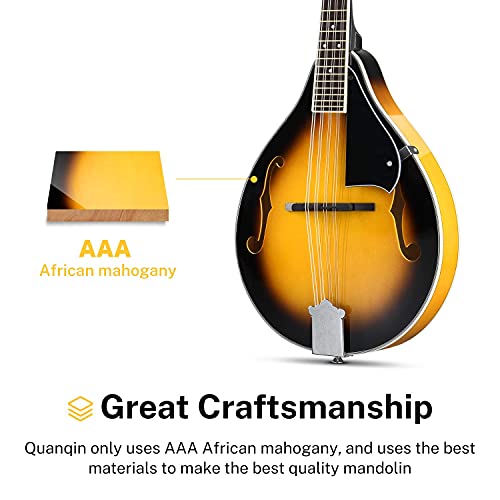
TopAAA African mahogany, pressed — not spruce, not carved
Back & sidesAAA African mahogany
NeckAAA African mahogany, “C” profile
FingerboardNot stated by Donner
Frets20 brass, markers at the 3rd, 5th, 7th, 9th, 12th, 15th and 17th
InlaysDots
BridgeCompensated, height-adjustable on two thumbwheels, floating
Truss rodYes, adjustable
TunersChrome open-gear, four a side
PickguardPVC, raised on a bracket
Overall length28″
TuningG D A E, the same as a fiddle
FinishesSunburst, black
Donner’s list price$159.99

Two gaps in that table are worth naming. Donner does not publish a fingerboard material for this mandolin, and they do not publish a weight. The fingerboard is a dark hardwood of some description and behaves like one; the weight will be in the ordinary two-and-a-bit pounds a mandolin of this size weighs, whatever the shipping figures say, because those are measured with the bag and the tuner and the box.

The truss rod is real, which is not something to take for granted at this money — plenty of hundred-dollar mandolins have a fixed neck and no way to correct it when the relief goes. Owners have photographed the access point on this one.

A mahogany top is the compromise, and the marketing calls it a feature

“AAA grade African mahogany” appears in the first line of every description of this instrument, and it reads like a premium specification. It is worth knowing what those words mean before they do any persuading.

Mandolins are built with spruce tops. Every rung above this one — the Ibanez at $200, the Loar at $400, the Kentucky at $595 — is spruce, pressed at the bottom of the range and carved at the top, and the reason is that spruce is stiff for its weight and gives a mandolin the bark it is supposed to have. Mahogany is a legitimate tonewood with a real character of its own: drier, warmer, more midrange, less top-end sparkle and less headroom when you dig in. On a mandolin, whose whole job in a group is to cut through, that character works against the instrument.

“AAA” is a grading term for how the wood looks — figure, color, consistency of grain. It says nothing about stiffness and nothing about tone, and it is applied here to the wood that was chosen because it costs less than the wood the instrument wants.

Nor is it solid. Donner never uses the word anywhere in their catalogue for an acoustic top, so the omission is not the usual tell it would be with another maker — but a pressed arched top at a hundred dollars is laminate, because a solid one bent into that arch would crack. The practical consequence is the one that matters: a laminate top does not open up. Carved spruce instruments sound better after five years of playing. This one will sound in 2031 exactly as it sounds the week it arrives.

That is the ceiling, and it is a real one. It is also not a reason to avoid the instrument, because you will hear the ceiling long before it stops you learning anything.

The bundle is the actual product

Bought separately, the accessories in this box come to a meaningful fraction of the price of the mandolin. What arrives:

Gig bagPadded, zipped, with a front pocket. Not a case — it will not survive being sat on — but it keeps dust off and makes the thing portable.
Donner DT-2 clip-on tunerA real chromatic clip-on with an LCD display, not an app and not a voucher. This is the piece that earns the bundle its keep.
Spare string setA full second set. You will want it: a first-timer breaks strings while learning how much tension is enough.
PicksTwo celluloid picks. Thin ones. A mandolin wants something stiffer, and they cost almost nothing.
Polishing clothA cloth.

The tuner is the one to notice. A mandolin has eight strings tuned in four pairs, and both strings in a pair have to agree with each other as well as with the tuner, which is twice the tuning work of a guitar and considerably less forgiving. Handing a beginner a mandolin without a tuner is handing them an instrument that sounds wrong for reasons they cannot diagnose. Our guide to tuning a mandolin covers the pairs properly.

What owners actually run into

Across nearly a thousand ratings the DML-1 averages 4.2 out of 5, and the shape of that is more useful than the number: two thirds give it five stars, and a little over one in five gives it three or fewer. That spread is the honest summary of a hundred-dollar instrument. Most arrive fine. Enough arrive needing work that you should plan for it rather than be surprised by it.

The complaint that recurs is the bridge. It is not glued or pinned — it is held in place by nothing but string tension, which is how almost every mandolin works — and it leaves the factory sitting wherever it landed. If it is in the wrong place the instrument plays in tune with itself at the open strings and progressively out of tune as you go up the neck, which is maddening and very easy to mistake for your own bad fretting.

The other two that come up often: the action is high out of the box on a good proportion of them, and the instrument arrives badly out of tune after a spell in a warehouse and a lorry, sometimes by most of an octave. The second is not a fault. The first is the setup problem below.

The setup, and the arithmetic it creates

A setup is a repair shop putting the parts where they should have been: the bridge located and its feet fitted to the curve of the top, the action dropped at the twelfth fret, the nut slots cut to depth, the neck relief set, the fret ends dressed. On a mandolin it runs $60 to $125 — a little above the guitar rate at most shops, because the floating bridge is fiddly work. Our cost breakdown goes through where the rest of the money goes.

See also  Best Mandolins for Beginners: 7 Picks, Honestly Compared

On an instrument like this a setup does more for how it plays than another hundred dollars of budget would. It is also the thing that makes the sums awkward, and it would be dishonest not to say so: a $100 mandolin plus a $90 setup is $190, and at $190 the Ibanez M510 is sitting right there, better built in every respect, and needing the same setup on top.

Which way that cuts depends on one thing only, and it is not a question about mandolins. If you are reasonably sure you will still be playing in a year, the Ibanez is the cheaper instrument, because it is the one you will not replace. If you genuinely do not know — and most people buying a first mandolin genuinely do not know — then a hundred dollars is the right amount to risk, and you can put off the setup until you have decided the instrument is worth it. Plenty of people learn their first chords on an unset-up DML-1 perfectly happily.

Where it sits

MandolinStyleTopPrice bandWhat the money buys
Donner DML-1ALaminate mahogany~$100Finding out, with the accessories included
Ibanez M510ALaminate spruce~$200Factory consistency and the right wood
The Loar LM-110-BRBAHand-carved solid spruce~$400A top that was carved rather than pressed
Kentucky KM-150ASolid spruce, solid maple~$595Buying once

All four are A-styles. The scroll on an F-style costs several hundred dollars and changes nothing about the sound, which is worth knowing before you spend it — our A-style versus F-style comparison goes through what it does and does not do.

If the DML-1 is not the right one

If you already know it will stick

Ibanez M510

  • A-style, f-holes
  • Spruce top, sapele back and sides
  • Purpleheart fingerboard, 20 frets
  • ~$200

Twice the money and the best-built mandolin at anything near it. The frets are level, the neck is straight, the nut is cut to the right depth, and the top is the wood a mandolin is supposed to be made of. It is still a laminate and it still needs the same setup, so it is not a shortcut past the shop — it is simply a better instrument to have that work done to.

Against the Donner it arrives with nothing in the box, so add a tuner and a bag to the price when you compare them. Our full M510 review has the detail.

Pros
  • Spruce top rather than mahogany
  • Noticeably more consistent unit to unit
  • The one you are least likely to replace
Cons
  • No tuner, bag or strings included
  • Still a laminate top, so still a ceiling
  • Twice the outlay on something you may not stick with
If you would rather buy once

Kentucky KM-150

  • A-style, f-holes
  • Solid German spruce top
  • Solid alpine maple back and sides
  • ~$595

The rung where a mandolin stops being a compromise. Solid spruce over solid maple, which means the instrument gets better as it is played rather than staying where it started, and enough volume and bite to hold its own in a room full of other players. This is the standard answer to “what should I buy if I am not going to do this twice”.

It is six times the price of the Donner, and worth it only if the honest answer is that you are serious. Bought at the start it saves you the Donner and the Ibanez both.

Pros
  • Solid top and solid back, so it improves with age
  • Loud enough to play with other people
  • Holds its value
Cons
  • Six times the outlay
  • Plain appointments for the money
  • Wants a setup like everything else

The first thing to change

Ten dollars, and the biggest single improvement

D’Addario EJ74 phosphor bronze, 11–40

  • Medium gauge
  • Phosphor bronze wound
  • One full set, eight strings
  • ~$10

Factory strings on a cheap instrument have usually been on it for months before it reaches you, and they sound dull and feel stiff long before they break. The EJ74 is the set most mandolins leave a decent factory wearing, and putting one on a DML-1 does more for the tone than anything else you can do for the money.

Change them one at a time rather than taking all eight off at once. The bridge is held on by string tension alone, and if you remove every string it falls over and you lose whatever position it was in.

Frequently asked questions

Is the Donner DML-1 a good mandolin for a complete beginner?

Yes, with one caveat. It is playable, it is cheap enough that abandoning it costs nothing much, and the tuner and bag remove two of the excuses people use to stop practicing. The caveat is that a proportion of them arrive with the action too high and the bridge in the wrong place, and a beginner cannot tell the difference between a badly set-up instrument and their own lack of progress. If it feels unreasonably hard, that is worth checking before you conclude anything about yourself.

Does it need an amplifier?

No. It is a fully acoustic instrument with f-holes and no pickup, no jack and no electronics of any kind. It makes its noise on its own and it is louder than people expect.

Does it have a truss rod?

It does, and it is adjustable. That matters more than it sounds: it means a neck that develops too much or too little relief can be corrected rather than lived with, which is not true of every mandolin at this price.

What tuning does it use?

G D A E, low to high, in four pairs — identical to a violin. If you play the fiddle, every note is already where you expect it. If you play the guitar, almost nothing transfers except your sense of rhythm.

Is the sunburst or the black one better?

They are the same instrument to the same specification, so pick the one you would rather look at. Gloss black shows fingerprints in a way the sunburst does not.

How long will I want to keep it?

Longer than a year if you play casually, and less than that if you get serious, because a laminate mahogany top has a ceiling you will hear once your right hand knows what it is doing. That is the instrument working as intended rather than failing — it is there to get you to the point where you can tell what you want next.

So, should you buy it?

Buy the DML-1 if you want to find out whether the mandolin suits you and would rather risk a hundred dollars than four hundred. It plays, it comes with the things you would otherwise have to go back and buy, and if it turns out the instrument is not for you the experiment cost about the same as two lessons.

Buy the Ibanez M510 instead if you already know this is going to stick, and the Kentucky KM-150 if you would rather do it once and properly. Either way put $60 to $125 aside for a setup and treat it as part of the price rather than an upgrade — it is the difference between an instrument you pick up every evening and one that sits in the corner reproaching you.

Still deciding? Our beginner mandolin guide covers the cheap end properly, best mandolin for the money goes further up the ladder, and how hard the mandolin is to play is the honest answer to the question underneath all of this.

Leave a Comment