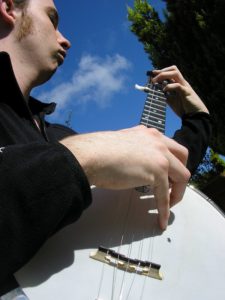
Half an hour a day gets you one tune played from memory in about ten weeks. Six months in you can hold your end up at a slow jam. Somewhere past fifteen hundred hours — four years at an hour a day — you stop planning what to play and just play it.
Those are real numbers from people who teach this and from players who counted their own hours. They are not the same as the number you want, which is how long until the banjo sounds like the record. But they are checkable, and the gap between them is where most people quit.
A first tune in about ten weeks. A slow jam at six months. Fluent somewhere past four years.
The one thing that reliably compresses all three is having a single method to follow instead of forty YouTube videos that each start over. Bill Evans covers both clawhammer and Scruggs-style picking in one book, with the audio and video online, so you can pick a direction after you have tried each rather than before.
The milestones, and roughly when they arrive
These are half an hour a day, most days — the figure banjo teachers keep landing on. Frequency matters more than the total: three hours on Sunday is worth noticeably less than half an hour on six days, because most of what you are building in the first year is muscle memory, and muscle memory decays between sessions.
| What you can do | How long | What is actually holding you up |
|---|---|---|
| Tune it, and get a clean chord out of it | First week | Almost nothing. Standard gDGBD tuning is an open G chord, so the banjo hands you one note-perfect chord before you have fretted anything |
| G, C and D, and change between them in time | 3 to 6 weeks | The left hand. Not the shapes — the changes. Getting to the C without the music stopping is the actual skill |
| One whole tune, from memory, slowly | About 10 weeks | Getting the two hands to agree. One teacher’s breakdown puts it at roughly 35 hours of practice, most of it spent on the right hand alone |
| Play along at a beginners’ slow jam | 4 to 6 months | Time, not technique. Four chords is enough to join in — staying in the groove when nobody slows down for you is not |
| Clean rolls at speed, or a break of your own | 1 to 2 years | Right-hand accuracy at tempo. This is the stretch where progress stops feeling like progress |
| Play most of what you hear, and back up other people | 1,500 to 2,000 hours | Nothing technical. Hours. About four years at an hour a day, and players who have tracked it report the pieces snapping together somewhere in there rather than gradually |
Two of those rows are worth reading twice. The first one is the banjo’s genuine head start over the guitar — an open tuning means your very first sound is a chord in tune with itself, and a handful of old-time tunes need barely any left hand at all. The second-to-last is where people give up. Around a year in, the tunes you can play have stopped getting harder and the ones you want to play have not got any closer, and nothing about that stretch feels like it is working.
Clawhammer arrives sooner. Bluegrass goes further.
The single biggest fork in your first six months is which right hand you learn, and it is worth understanding before you start rather than after.
Clawhammer: a tune in weeks
The frailing stroke is one downward motion of the hand — nail on the string, thumb on the fifth — repeated. There are no picks to fit, no roll patterns to memorize, and the rhythm carries the tune. Beginners get a recognisable old-time piece out of clawhammer in a few weeks, which is a real advantage when the thing most likely to stop you is losing interest.
The hard part arrives later, and it is the left hand: hammer-ons, pull-offs and slides doing the melodic work while the right hand keeps its metronomic thump. Getting past competent-at-parties into drop-thumb and melodic playing takes as long as anything in bluegrass does. Ken Perlman’s tutor is the standard book for that whole arc — it starts at the bare strum and ends somewhere most players never reach.
Clawhammer Style Banjo — Ken Perlman
- 208 pages, tablature throughout, over 40 tunes
- Basic strum and brush stroke through drop-thumb, harmonics and improvisation
- In print since 1989 and still the book most clawhammer teachers point at
- Takes you from the first stroke to melodic clawhammer without needing a second book
- Tune-led rather than exercise-led, so you are playing music from early on
- Print only — no audio, so you need a recording to hear how a tune should go
- Denser than a beginner’s book has to be; the later chapters are years away
Bluegrass: slower to start, and the rolls are the first year
Scruggs style is three fingers in fixed eight-note patterns, and the patterns have to be automatic before any melody can sit on top of them. That is why the first month feels like homework rather than music, and why a bluegrass beginner is often still on exercises when the clawhammer player next to them is playing a tune.
What you get for the wait is that the rolls transfer. Once forward, backward and forward-reverse are in the hands, new songs stop being new techniques and start being rearrangements of things you can already do, and the curve bends the other way. If Scruggs style is already what you are after, Bill Evans has a bluegrass-only book that goes deeper into roll patterns and backup than the general one does.
Bluegrass Banjo For Dummies
- Roll patterns, backup and Scruggs-style technique only
- Over 100 audio files and 35 video lessons online
- Tablature throughout, so it works with no teacher
- Goes further into backup playing than any general beginner book
- The audio is at multiple speeds, which is what makes tab usable alone
- Assumes you have committed to three-finger picking
- Costs more than the general volume and covers less ground
If you genuinely do not know which one you want, learn clawhammer first. It gets you playing sooner, and almost nothing about it makes Scruggs style harder later — whereas a year of frustrated rolls has ended a lot of banjo careers. Our guides to the best banjos for clawhammer and the best banjos for bluegrass cover the instrument side of the same decision.
Four things that change the number more than talent does
How often you pick it up, not how long for
Fifteen minutes every day beats two hours on Saturday, and it is not close. Teachers set fifteen minutes as the floor and thirty as the target for exactly this reason. The corollary is worth acting on: leave the banjo out on a stand where you can reach it, because the single largest cause of a skipped practice is a case with clasps on it.
Whether the thing is in tune
A banjo drifts. Five strings under tension on a skin-tension head move with the weather, and the fifth string in particular goes sharp for no reason you will be able to identify in your first year. A beginner practicing on an out-of-tune banjo learns nothing, because the ear has nothing correct to lock onto — and cannot yet tell that is what is happening.
A clip-on tuner reads the vibration through the headstock rather than the sound in the room, so it works with the television on and it works before your ear is any good. At around $20 it is the cheapest thing on this page and the one that changes the most.
KLIQ UberTuner
- Clip-on, chromatic, reads vibration not sound
- Bright display that stays readable outdoors
- Settles fast enough to keep up with a fifth string being tweaked
- Chromatic, so it handles double C and sawmill tunings as well as standard G
- Nothing to learn — clip it on and turn the peg until it turns green
- Not accurate enough to set intonation, which is a job for a shop anyway
- The clamp will mark a high-gloss headstock over years of use
The other half of this is the setup. A cheap banjo shipped in a box usually has the action high enough to hurt and a bridge sitting where the packer left it, and a beginner blames their hands. Fifty to a hundred dollars at a shop that knows banjos buys lower action, a bridge in the right place and a properly seated head, and it does more for how fast you learn than the next two hundred dollars of instrument would. Our guide to tuning a banjo covers the part you can do yourself.
Picks, if you are going the bluegrass route
Fingerpicks feel wrong for about two weeks and then stop. Learning rolls bare-fingered and adding picks afterward means relearning the right hand rather than adding to it — the attack is harder, the contact point moves off the fingertip, and the angle of approach changes with it. Start in picks. A plastic set is about ten dollars and forgiving while you work out how tight to bend them; metal fingerpicks come later, when you want the volume.
Dunlop Shell Fingerpicks and Thumbpick, Medium
- Three fingerpicks and one thumbpick, plastic, medium
- Softer attack than metal, and gentler on a new head
- Bend to fit — plastic reshapes in warm water without cracking
- Cheap enough to lose, which you will
- Plastic forgives a beginner’s over-tight grip in a way metal does not
- Quieter than metal, so you will replace the fingerpicks eventually
- Medium fits most adults, but not everyone — small hands may need to reshape them
Whether anybody is watching your right hand
The habits that cost people years are all right-hand habits — anchoring wrong, curling the fingers in, moving the whole arm instead of the fingers — and they are invisible from the inside. A handful of lessons in the first three months, or a video of yourself played back, catches things a book cannot. This is the difference the research on skill acquisition actually keeps finding: hours only pay when something is correcting the execution, which is why two players with the same practice log end up in very different places.
If you already play guitar
You are ahead, but by less than you expect, and the part that transfers is not the part you think.
What comes with you: fretting cleanly, calluses, reading a chord shape, keeping time, and a general ear for whether a note belongs. That is genuinely a head start, and it is why a guitarist is usually weeks ahead through the first chord changes.
What does not come with you is the entire right hand. Strumming is not rolling, and Scruggs patterns bear no relation to anything a guitarist does — a flatpicker often finds this harder than a complete beginner, because there is a reflex to unlearn. The tuning is open G rather than standard, so every shape you know is in the wrong place. And there is a fifth string that starts at the fifth fret and is played by the thumb, which has no guitar equivalent at all. Expect to be fast through the first two months and then to arrive at the same wall as everybody else.
Where the 10,000 hours came from
The figure comes from Anders Ericsson’s study of violin students at a Berlin music academy, in which the best group had accumulated around ten thousand hours by age twenty. Ericsson spent the rest of his career objecting to what was done with it. His finding was about deliberate practice — effortful work aimed at a specific weakness, with feedback — among people already at the top of a conservatoire, and it was never a threshold that anybody crosses into mastery by clocking up time.
For the banjo it is the wrong yardstick twice over. Ten thousand hours is twenty-seven years at an hour a day, which describes nobody’s question. And the number that players who have actually tracked their own practice report is closer to fifteen hundred, at which point backup, improvising and working out breaks stop being separate problems. That is a long time. It is not twenty-seven years.
If you have not bought the banjo yet
The instrument affects the timeline in exactly one way: a banjo that will not stay in tune, or that hurts to fret, gets practiced less. Beyond that, nothing under a thousand dollars is going to hold back a first-year player.
The usual starting point is a five-string with a removable resonator at around $175, which lets you take the back off for old-time and put it on for bluegrass while you work out which one you are. Budget for the setup on top — that is the part that decides whether it gets picked up.
Jameson 5-String
- 24 brackets, removable resonator, geared fifth-string tuner
- Remo head, mahogany-finish rim
- Right-handed as standard; a six-string version shares the listing
- Geared fifth-string tuner, which is what makes the drifting string tunable
- More than a decade of buyers behind it, so the failure modes are known
- Arrives needing setup, like everything at this price
- Heavy for clawhammer with the resonator on — take it off
If you want the full field rather than one answer, our beginner banjo guide compares the six that are actually worth buying, and what a banjo costs explains what each price band buys.
Common questions
Can I learn the banjo in a month?
You can play something recognisable in a month, particularly in clawhammer, and you can certainly get three chords changing in time. You will not be playing a tune up to speed. A month is enough to find out whether you like it, which is the only decision that matters at that stage.
Is the banjo harder than the guitar?
Easier to start, harder to get good at. The open tuning hands you chords a guitarist has to earn, and the first tune comes sooner. But the right hand is a far more precise mechanism than strumming, and there is no banjo equivalent of getting by on four chords forever. Our how hard is the banjo guide goes into the specific difficulties.
How much should I practice a day?
Thirty minutes, most days. Fifteen works if that is what is realistic, and daily fifteen beats occasional ninety every time. Once you are past the first year, longer sessions start to pay because you can spend them on something specific rather than on getting your hands back.
Do I need a teacher?
Not to start, and books with audio at multiple speeds have made self-teaching genuinely viable. But a few lessons early on are the highest-value money on this page, because right-hand faults are cheap to fix in month two and expensive in year two.
Am I too old to start?
No. An adult learner has advantages a child does not: they can practice deliberately rather than by repetition, they already know what they want to sound like, and nobody has to make them do it. What does decline with age is raw speed at the very top end, and that is a concert-banjoist’s problem rather than a ten-week one.
Does the number of strings change how long it takes?
A six-string banjo tuned like a guitar is much faster if you already play guitar, because you are learning a new sound rather than a new instrument. A four-string tenor or plectrum is a different job again, played with a flatpick and usually chordal. Every timing on this page is for the five-string. Our guide to types of banjos covers the differences.
The honest version
Ten weeks to a tune, six months to a jam, four years to fluency — if you play most days and somebody occasionally tells you what your right hand is doing wrong. Miss those two conditions and the numbers do not stretch so much as stall — irregular practice on uncorrected technique builds the wrong habit deeper rather than building the right one slower.
The good news is at the front of the table. The banjo gives up a chord and a first tune faster than almost any other stringed instrument, and there is a lot of playable old-time music available to somebody ten weeks in. You do not have to be good at this to enjoy it, which is fortunate, because you will not be good at it for a while.