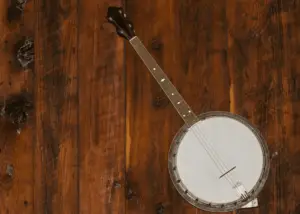
How Much Does a Banjo Weigh? Real Weights, Model by Model

Pro Music Vault Home Instruments Banjo How Much Does a Banjo Weigh? Real Weights, Model by Model

An open back five-string banjo weighs about four and a half pounds. A bluegrass banjo with a resonator, a one-piece flange and a cast bell bronze tone ring weighs about eleven. Those are the same instrument — same rim diameter, same scale length, often the same neck — separated by roughly six pounds of metal.

So the answer depends on almost nothing except what is inside the pot. The resonator, which gets the blame, accounts for about a pound and a half of it.

The short answer

Open back, 4 to 6 pounds. Bluegrass resonator, 8 to 13. The tone ring and the flange are the difference, and they are about three pounds each.

If you already own the heavy one and it is hurting after an hour, the fix is almost never a different banjo. A two-inch cradle strap threads through four bracket hooks instead of hanging the whole instrument off two points, which spreads eleven pounds across your shoulder and stops the neck diving toward the floor. It costs about a fortieth of what a lighter banjo costs.

Around $40 Check current price
Buying the lightest full-size banjo there is: the Gold Tone AC-1 at 3.75 lb Worried a heavy banjo means a better banjo: it does not, and the arithmetic below shows why Flying with it, or carrying it far: add the case — that is five to eight pounds nobody counts Still choosing: open back vs resonator settles the weight and the volume together

What a banjo weighs, model by model

Every figure below is the maker’s own published weight for the instrument itself, not a shipping weight. Deering and Gold Tone both put weight on their spec sheets, and between them they build most of what a beginner or intermediate player is choosing between.

BanjoPotTone ringWeight
Gold Tone AC-1Composite, open backNone3.75 lb
Deering Goodtime PlectrumOpen back, 11″None4 lb
Deering GoodtimeOpen back, 11″None4.5 lb
Deering Goodtime AmericanaOpen back, 12″None4.5 lb
Deering Goodtime 19-Fret TenorOpen back, 11″None4.5 lb
Deering Goodtime Six-RResonator, 11″None5.5 lb
Gold Tone CC-Carlin12Open back, 12″Rolled brass5.8 lb
Deering Goodtime TwoResonator, 11″None6 lb
Gold Tone CC-PlectrumRemovable resonatorRolled brass6.3 lb
Gold Tone CC-100R+Removable resonatorRolled brass6.5 lb
Gold Tone BG-150FResonator with flangeRolled brass8.5 lb
Deering Goodtime SpecialResonator, 11″Steel8.75 lb
Deering SierraResonator with flangeCast bell bronze11 lb
Gold Tone PS-250Resonator with flange, 14″Bell brass12 lb

Read down the tone ring column and the weight column together and the pattern is hard to miss. Nothing without a tone ring gets past six and a half pounds. Nothing with a cast ring and a flange comes in under eight and a half.

The heaviest production banjos land around twelve to fourteen pounds. That is the top of the range.

The weight is in the tone ring and the flange

Deering publishes the component weights, and they are worth knowing because they account for nearly the whole spread:

  • A cast bell bronze tone ring is about 3 lb. This is the heavy one — the Mastertone-style hoop that gives bluegrass its bark.
  • A one-piece cast zinc flange is about 3 lb. The ring of metal that seals the resonator to the pot and carries the bracket hooks.
  • A tube-style ring, like a Vega Tubaphone, is nearer 2 lb.
  • A wooden tone ring is about a pound, maybe a pound and a quarter.
  • The resonator itself is about a pound and a half.

That last figure is easy to check, because Deering builds the Goodtime both ways from identical parts. Open back, 4.5 lb. Bolt on the resonator and it is a Goodtime Two at 6 lb. A pound and a half is the entire cost of closing the back.

Keep going up the same line and the arithmetic holds. Add a steel tone ring to that resonator banjo and you get a Goodtime Special at 8.75 lb. Swap in a cast bell bronze ring and a one-piece flange and you are at a Sierra’s eleven pounds — same 11″ three-ply maple rim, same 26 1/4″ scale, six and a half pounds heavier than the open back it started as.

Cheap resonator banjos are heavy for the opposite reason

A budget import with a resonator will often weigh eight to ten pounds, and it will not have a tone ring in it at all. The weight is in cast pot-metal hardware, a thick heavy rim and a plywood resonator — mass that arrives as a consequence of cheap manufacturing rather than as a design decision.

This is the case that breaks any rule of thumb linking weight to quality. A $180 banjo can outweigh a $1,000 one and sound worse in every respect that matters. If you are shopping at that end, the best banjos under $200 covers what the money actually buys.

Does a heavier banjo sound better?

No — though the correlation is real, so it is worth being precise about which way the causation runs.

A cast bell bronze tone ring makes a banjo louder, brighter and longer-sustaining. It also happens to weigh three pounds. The weight is a side effect of the metal, not the mechanism — the ring works because of how a dense casting couples to the head and the rim, not because the instrument is hard to hold. Nobody has ever improved a banjo by making it heavier without changing anything else, and the budget imports above are the proof: eight pounds of nothing in particular.

Plenty of first-rate banjos are light on purpose. A wooden-ring open back is around five pounds and is exactly the right instrument for old-time and clawhammer, where a bell bronze ring would be actively wrong. Clawhammer players spend real money going lighter, not heavier.

What you actually carry: add the case

Anyone asking this question because they have to get a banjo onto a bus, up three flights of stairs or through an airport is asking about the wrong number. The instrument is the smaller half of the problem.

  • A hardshell banjo case adds 5 to 8 lb. The lightweight molded ones sit at the bottom of that; a traditional plywood-and-tolex case sits at the top.
  • A padded gig bag adds 2 to 3 lb and almost no protection against anything being dropped on it.

So an eleven-pound bluegrass banjo in a traditional hard case is a nineteen-pound object, carried one-handed, in a shape that does not balance. A four-and-a-half-pound open back in a gig bag is under seven. That gap decides how often the banjo actually leaves the house, and it is a bigger practical difference than the six pounds of tone ring that caused it.

See also  How Hard Is It To Learn the Banjo? What's Easy and What Isn't

It is also why weights quoted secondhand are so often too high — a figure lifted off a shipping carton includes the case and the packaging, and sometimes it is a dimensional weight that was never a measurement of anything at all.

If a banjo is too heavy to play, fix the strap first

Eleven pounds is not much to lift and it is a great deal to hang off one shoulder for two hours. A heavy banjo on a bad strap is a different problem from a heavy banjo, and it is much cheaper to solve. Two things matter: how the strap attaches, and how wide it is.

A cradle strap threads through four of the bracket hooks around the rim, so the load spreads around the pot and the banjo sits at a stable angle on its own. A two-point strap hangs the instrument from two hooks, which is fine on a light open back and lets a heavy resonator banjo rotate and nose-dive, so you end up holding it up with your fretting hand. Width does the rest: two inches across the shoulder is roughly twice the contact area of a one-inch strap carrying the same weight.

№ 1 · For a heavy resonator banjo

D’Addario Leather Cradle Banjo Strap

  • Cradle style, threads through the bracket hooks
  • 2″ wide
  • Leather
  • Adjustable length
  • ~$40

The default answer for anything with a resonator on it. Two inches of leather across the shoulder and four attachment points around the rim is the combination that makes an eleven-pound banjo feel like it is sitting on you rather than pulling on you, and leather stops sliding around on a shirt in a way woven nylon never quite manages.

It needs a few minutes with the bracket hooks the first time, and leather takes a week or two of playing to soften and take a shape. Neither is a reason to buy something else.

Pros
  • Cradle attachment keeps the neck from diving
  • 2″ wide, so the weight spreads
  • Leather grips rather than slips
Cons
  • Fiddly to fit the first time
  • Stiff until it breaks in
№ 2 · For a shoulder that already hurts

Neotech Super Banjo Strap

  • Padded neoprene with a stretch section
  • Loops thread through the brackets
  • Side-release buckles for taking it off
  • Made in USA
  • ~$40

Neoprene padding and a deliberate bit of stretch built into the shoulder section, so the strap absorbs the small shocks of moving around instead of transmitting them into your neck. If the complaint is a specific sore spot rather than general fatigue, this is the one that addresses it directly.

The stretch is a genuine trade-off — the banjo moves a little more than it does on a fixed leather strap, which some players dislike for precise right-hand work. Try it before a gig rather than at one.

Pros
  • Real padding, not just extra width
  • Stretch section takes the shock out
  • Quick to take off between sets
Cons
  • The banjo shifts more than on a rigid strap
  • Neoprene is warm against a shirt
№ 3 · For a light open back

Levy’s Hootenanny Woven Banjo Strap

  • 2″ jacquard weave cotton
  • Two-point attachment
  • Tri-glide height adjustment
  • Several patterns
  • ~$25

Four and a half pounds does not need engineering. A two-inch woven strap holds an open back at the height you set it and costs a good deal less than the cradle straps above, which are solving a problem a light banjo does not have.

Do not put this on a bluegrass banjo and expect the shoulder ache to go away — two attachment points and no padding is exactly the setup that makes eleven pounds unpleasant.

Pros
  • Right tool for anything under about six pounds
  • 2″ wide despite the price
  • Height stays where you set it
Cons
  • Two-point, so wrong for a heavy resonator banjo
  • No padding at all

If you are buying on weight

Buying light is a legitimate priority, and not only for players with a bad shoulder. It is the right call for a child, for anyone who plays standing, and for anyone whose banjo has to travel — an instrument that stays in its case because carrying it is a chore makes no sound at all.

The lightest full-size banjo worth owning

Gold Tone AC-1

  • Composite rim, open back
  • No tone ring
  • Nato neck, 22 frets, 26 3/16″ scale
  • 3.75 lb
  • Gig bag included
  • ~$315

Three-quarters of a pound lighter than a Goodtime and around two-thirds the price, because the rim is a composite molding rather than three plies of violin-grade maple. That is a real compromise in tone and it is the whole reason the number is what it is. What you get for it is a full-scale banjo — not a short-scale travel instrument — that a small player can hold up indefinitely.

It is a first banjo and an around-the-house banjo rather than a lifetime one, and it will not keep up in a bluegrass jam. Set against that, it is built by a company that draws its own banjos, it is set up in Florida before it ships, and a gig bag is in the box.

Pros
  • 3.75 lb — the lightest full-size banjo there is
  • Full 26″ scale, so technique transfers
  • Set up before shipping, gig bag included
  • Light enough for a child to hold up
Cons
  • Composite rim, so a thinner voice than a wooden one
  • No projection for playing with others

Spending more buys weight back in the form of wood rather than metal. A Deering Goodtime open back is 4.5 lb with a three-ply maple rim and a considerably rounder tone, and a Goodtime Americana is the same 4.5 lb with a 12″ pot built for old-time. Both are covered in the best banjos under $1,000. If the reason for buying light is portability rather than comfort, travel banjos go smaller still, at the cost of the scale length.

Weights for the other banjos

The four-string banjos are built on the same pots as the five-strings and weigh accordingly. An open back plectrum or tenor is around four to four and a half pounds; a tenor with a resonator, a flange and a cast ring — the classic trad-jazz setup — runs nine to twelve, the heaviest thing in the family for its size. Tenor and plectrum banjos have their own guides.

Six-string banjos are lighter than their size suggests: a Goodtime Six-R is 5.5 lb with a resonator on it, because there is no tone ring and the extra hardware is two tuners and a wider neck. A banjolele is the featherweight of the family at two to three pounds, being an eight-inch pot and a ukulele neck.

For how these instruments differ in everything other than weight, the types of banjos lays them out side by side, and what a banjo costs covers the other number worth knowing before you buy.

Leave a Comment