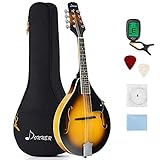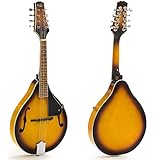
A full-size acoustic mandolin weighs about two and a half pounds. Every maker’s published figure sits between 1.8 and 2.8 lb, and most land within a few ounces of 2.3 — roughly half the weight of a dreadnought guitar, and a quarter of a bluegrass banjo.
Figures of three, four and five pounds get quoted a great deal, and those are shipping weights: the instrument plus a bag, a box and some cardboard.
About 2½ pounds, for a $200 beginner instrument and a $5,000 one alike. The case decides what you actually carry, and it can weigh twice as much as the mandolin in it.
A wooden hard case is four and a half to five pounds, so a mandolin in one is a seven-pound object. The same mandolin in a padded backpack bag is under three and a half, which is the difference between an instrument that travels and one that stays on its stand.
What a mandolin weighs, model by model
Every figure here is the maker’s own published weight for the instrument itself. Gold Tone puts a weight row on every spec sheet, which is why so much of the table is theirs — most makers do not. Eastman, Kentucky, The Loar and Collings all publish full specifications for their mandolins, down to the fret wire and the nut width, and none of them lists a weight.
| Mandolin | Body | Weight |
|---|---|---|
| Gold Tone GM-10 Frypan | Flat body, round hole | 1.8 lb |
| Gold Tone GM-70+ | F-style, carved | 2.1 lb |
| Gold Tone GM-80 | F-style, carved | 2.1 lb |
| Northfield F5 | F-style, carved | 2.2 lb |
| Gold Tone GM-50+ | A-style, carved | 2.4 lb |
| Gold Tone GM-55 | A-style, carved | 2.4 lb |
| Gold Tone GM-35 | F-style, carved | 2.8 lb |
That is the whole range: a pound of spread across everything from a budget instrument to a professional one. Nothing built as a standard mandolin comes in under a pound and a half or over three pounds.
Which is worth sitting with for a moment, because it means weight is not a specification you can shop on. Two mandolins four ounces apart feel identical in the hands. The differences that matter — the top, the graduation, the scale, the setup — do not show up in this column at all, and what a mandolin costs tracks them far more closely.
Why the figure you found was too high
A weight quoted alongside a price is nearly always a shipping weight. It is measured for the courier rather than the player, and it counts whatever else is in the carton — which for a beginner mandolin is usually a gig bag, a tuner, a spare set of strings and a handful of picks.
That is where three, four and five-pound mandolins come from. A carton holding a two-and-a-quarter-pound instrument, a pound-and-a-half padded bag and the box itself lands near five pounds, and five pounds is then copied onward as the weight of the mandolin. Sometimes the figure is not a measurement at all: couriers bill on dimensional weight, so a long thin box can be assigned a weight worked out from its size.
The tell is a bundle. If the instrument comes with accessories and the quoted weight is over three pounds, the accessories are in the number.
The shape does not decide the weight
An F-style has a carved scroll at the upper bout and two points, all of it solid wood, so the reasonable expectation is that it weighs more than the plain teardrop of an A-style. The published figures say otherwise.
Within one maker’s own catalogue, built in one factory to one set of drawings, the F-styles come in at 2.1, 2.1 and 2.8 lb and the A-styles at 2.4 and 2.4. The heaviest instrument is an F and so are the two lightest. The spread among the F-styles alone is seven ounces, which is larger than any gap between the shapes.
The scroll is worth an ounce or two. How thin the top has been carved, how much wood is left in the neck and the blocks, and whether the tailpiece is stamped or cast are each worth more than that, and they vary model by model rather than shape by shape. So if you are choosing between the two outlines, weight is not one of the reasons — the price is, and the way an F-style sits against your ribs is. Both are in the A-style versus F-style comparison.
Does a heavier mandolin sound better?
No, and on the part that produces the sound the relationship runs the other way.
A carved-top mandolin has its top graduated — thinned by hand to different thicknesses across its area, thicker under the bridge and thinner toward the edges. That is the most skilled operation in building one, it is most of what separates a $400 instrument from a $4,000 one, and doing it well removes wood. A top that has been graduated properly is lighter than one pressed to a uniform thickness, and it moves more freely under the strings, which is the entire point.
The figures bear it out. The most expensive instrument above weighs 2.2 lb, six ounces less than one of the cheapest, and the very lightest is an all-solid flat-body at 1.8. Heft in the hand tells you a mandolin has wood in it somewhere. It does not tell you the wood is anywhere useful.
Nor is a heavier neck a better one. A wide, deep neck profile suits some hands and not others, and it adds a couple of ounces at the end of a lever, which makes the instrument feel neck-heavy rather than better-sounding. Fitting the neck to your hand is a real consideration; learning the instrument is hard enough without fighting the one you bought.
What you actually carry: add the case
Anyone asking this question because the mandolin has to go somewhere is asking about the smaller half of the load. The instrument is two and a half pounds. The case is the decision.
- A wooden hard case is about 4½ lb — plywood shell, vinyl outside, plush inside. Nearly double the instrument.
- A molded ABS or fiberglass case runs to 6 lb or more, particularly in F-shape, where the case has to be cut around the scroll.
- A padded gig bag is about a pound, and a thickly padded backpack bag a little over.
So the same mandolin is a seven-pound object or a three-and-a-half-pound one depending on nothing but what it travels in. On a bus, up stairs, or across an airport, that is the whole difference — and a bag you can wear on your back changes the arithmetic again, because two hands stay free.
The trade is protection. Nothing soft will survive something heavy landing on it, and a mandolin’s most vulnerable part is a headstock that snaps at the nut if the instrument goes over. If it lives at home and travels to a lesson, a bag is right. If it goes in a car boot with other things, or under a bus, it needs a shell.
Crossrock CRSG107MAFDG Padded Backpack Bag
- 10mm foam padding
- Fits A-style and F-style
- Backpack straps and a padded handle
- Water-resistant exterior, accessory pocket
- Around a pound
- ~$45
Ten millimeters of rigid foam is a great deal more than the thin quilting most bags at this price use, and it is enough to stop a knock in a car or a doorway becoming a dent. The reinforced bottom is where the endpin sits, which is the corner that takes the impact every time a mandolin is stood down carelessly.
The backpack straps are the real reason to choose it over something cheaper. Three and a half pounds on your shoulders disappears entirely, and it is the configuration that gets an instrument out of the house on a bicycle or a train. It fits both body shapes, so it survives changing your mind about the scroll.
- Real padding, not token quilting
- Backpack straps leave both hands free
- Takes an A-style or an F-style
- Reinforced where the endpin sits
- Foam will not stop a crushing impact
- Costs about twice what a plain padded bag does
Ktaxon Hard-Shell Mandolin Case
- Wooden shell with a leather-look covering
- Plush lining with neck support block
- Locking latch, accessory compartment
- About 4.5 lb
- Made in an A-style and an F-style version
- ~$60
A wooden case is what the instrument wants if it is going to be handled by anyone other than you. The shaped neck block is the part that matters — it holds the headstock off the shell so a knock to the outside is not transmitted to the join above the nut, which is where mandolins break.
Buy the version that matches your body shape. An F-style will not go into an A-style case, and an A-style rattles around inside an F-shaped one, which defeats the object. Four and a half pounds is the price of the protection, and it is worth being honest that it nearly triples what you are carrying.
- Wooden shell, not molded plastic, at a low price
- Neck block supports the weak point
- Lockable, with room for picks and strings
- A-style and F-style versions
- 4.5 lb, so the load nearly triples
- Handle only — no strap or backpack option
- Shape-specific, so it does not follow you to a different mandolin
If weight is the reason you are asking
Two questions bring most people here, and the answer to both is better than they expect.
For a child, the weight is not a constraint at all. Two and a half pounds is less than a full water bottle, and a mandolin is played resting on the thigh rather than held up. What limits a young player is the reach: a 13⅞-inch scale with eight strings on it needs a hand that can stretch a fret span and enough finger strength to press two strings at once. That is why children who bounce off a mandolin usually do so in week two rather than minute one, and it is a matter of hand size and string tension, not mass.
For traveling, a mandolin in a gig bag is the easiest instrument in the string family to take anywhere. It is under three and a half pounds all in, it goes in an overhead bin without argument, and it is short enough to sit across the top of a rucksack. Nothing about a mandolin needs a travel version of itself.
If either of those is why you are here and you have not bought the instrument yet, the cheap end is genuinely good now.
Ibanez M510
- A-style, spruce laminate top
- Sapele back and sides, okoume neck
- Purpleheart fingerboard
- 13.8″ scale
- ~$200
The best-made cheap mandolin going, and a useful demonstration that the cheap end costs nothing in portability: it is a full-size instrument in the same two-to-three-pound band as everything above it. Ibanez builds to a price with machine precision rather than hand work, so the top is pressed to an even thickness rather than graduated — a real limit on the tone, and the reason it costs what it does.
What you get for the money is consistency. The frets are level, the nut is cut properly and the neck is straight, which is not true of everything at this price and is what actually decides whether a beginner keeps going. It is a first mandolin rather than a last one, and there is nothing about it that will hold anyone back for a year or two.
- Full 13.8″ scale, so technique transfers
- No weight penalty for buying at the bottom of the market
- Consistently built, with far fewer duds than the field
- Purpleheart board and a proper nut at the price
- Laminate top, pressed rather than carved
- Will not keep up with carved-top instruments in a group
- Usually needs a setup to play its best
Spending more buys a carved top rather than a lighter instrument — the weight barely moves between $200 and $2,000. The beginner guide covers what each step up actually changes.
The rest of the family is where the weight is
Go up in size from the mandolin and the numbers move properly, because the body and the scale both grow.
| Instrument | Scale | Weight |
|---|---|---|
| Mandolin | 13¾–14″ | 1.8–2.8 lb |
| Mandola | 17″ | About 3 lb |
| Solidbody electric mandolin | 13⅞–14″ | 3.4–4.5 lb |
| Octave mandolin | 22½” | About 4.5 lb |
The electric is the odd one. It has a mandolin’s scale and a mandolin’s string count and weighs what an octave mandolin does, because a slab of alder or basswood with no cavity in it is simply much denser than a carved box full of air. If you have only ever picked up acoustics, the first solidbody feels wrong in the hands before it makes a sound.
A bowlback — the old Neapolitan shape, built from a couple of dozen thin ribs bent over a mold — is the lightest thing in the family. There is no carved plate in it and no truss rod, and the ribs are thinner than anything on a modern instrument, so an antique one can feel almost hollow in the hands. The types of mandolins lays out the shapes and what each is for.
For context outside the family: a concert ukulele is about a pound and a half, an acoustic guitar four and a half to five, and a bluegrass banjo eleven. The mandolin is at the bottom of that list and the banjo player is carrying four of them.
Frequently asked questions
How much does a mandolin weigh in kg?
About 1.1 kg. The published range across makers is 0.8 to 1.3 kg, and most instruments are within a hundred grams of a kilogram.
Is a mandolin heavier than a ukulele?
Slightly. A concert ukulele is around a pound and a half against a mandolin’s two and a half, the difference being a carved top, eight steel strings and the harder-built neck they require. What you notice holding them is not the pound — it is the 181 pounds of string tension on the mandolin against 33 on the ukulele.
Why is my mandolin heavier than that?
Weigh it out of the case on a kitchen scale before assuming anything, because almost every reported figure includes a case. If it genuinely is over three pounds it will be a pressed-top instrument with a thick body and heavy hardware, or an electric. Neither is a fault, and neither is worth doing anything about.
Do players remove weight from a mandolin?
Builders do, and not for the sake of the weight. Graduating the top and hollowing the neck and tail blocks are done to control how the instrument responds, and losing a few ounces is a side effect. It is work done inside the box before it is closed, not a modification anyone makes to a finished mandolin.
The mandolin belongs to the lute family and is one of the smallest members of the string instruments. If the weight question was really a portability question, the answer is that this is about as portable as a fretted instrument gets — and that what it costs is the number worth researching properly instead.