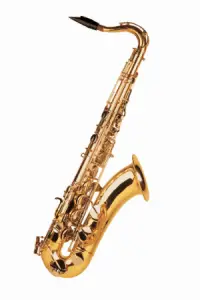
A saxophone has more than six hundred parts and about two dozen leather pads, and every one of those pads has to seal against its tone hole or the notes underneath it stop working. That is the fact the price of a saxophone is really about. The brass is cheap. Making two dozen pads sit flat, and keeping them flat, is not.
So there are two numbers, and most people only ask about the first one. There is what the instrument costs, and there is what it costs to keep it playing — and on a saxophone the second number can be larger than the first.
Around $650–900 buys a new student saxophone worth repairing. Under about $300 buys one that is not
An alto — the size school bands start on — runs about $675 new from a maker that publishes a warranty and sells spare parts. A tenor is roughly $900. The cheap end of the market starts at about $200, and a full repad costs more than a thousand, which is the whole problem: the first serious repair on a $200 saxophone costs five times what the saxophone did.
Saxophone prices by size and level
Most makers of serious saxophones — Yamaha, Conn-Selmer, Jupiter — sell through dealers and publish no prices at all, which makes a straight comparison hard to come by. Jean Paul is the exception: they list every model on their own site, from student to professional, in all four common sizes. One maker, one price list, so the steps between the tiers mean something.
| Size | Student | Intermediate | Professional |
|---|---|---|---|
| Alto (E♭) | ~$675 | ~$1,080 | ~$1,800 |
| Tenor (B♭) | ~$900 | ~$1,500 | ~$2,070 |
| Soprano (B♭) | ~$650 (curved) | — | ~$1,620 |
| Baritone (E♭) | none made | ~$3,150 | — |
Two things in that table are worth more than the numbers themselves.
The first is that there is no student baritone. The cheapest bari from a maker with a proper range is an intermediate instrument at around $3,150, and that is not an accident of marketing. Henri Selmer Paris describe their own process: alto and tenor bells are pressed as two halves and argon welded together, but “for the larger sizes like the baritone, the bell is hand-shaped using only one piece, then welded.” More metal, more hand work, no shortcut. Baritone is a school-owned instrument almost everywhere for exactly this reason.
The second is that the size moves the price more than the level does. A student tenor costs more than an intermediate alto. If budget is the constraint and the size is genuinely open, alto is the cheap answer twice over — cheaper to buy, and cheaper to feed, because tenor reeds cost roughly double alto reeds for the rest of the instrument’s life.
Above all of this sits the professional market proper. Selmer Paris, whose horns are the reference point most players measure others against, list their entry professional Axos alto at about €3,075 and their top Supreme tenor at over €9,000. That is the ceiling worth knowing about, and it is nowhere near a first instrument.
What the extra money actually buys
Here is where a cost page normally waves at “better materials”. Yamaha publishes full specifications for their student and intermediate altos, and the two spec sheets disagree in five rows out of twenty.
| Specification | YAS-26 (student) | YAS-480 (intermediate) |
|---|---|---|
| Body, bell, key material | Yellow brass | Yellow brass |
| Tone holes | Drawn | Drawn |
| Pads | Leather and wool felt | Leather and wool felt |
| Springs | Stainless steel | Stainless steel |
| Mouthpiece supplied | Yamaha 4C | Yamaha AS-4C |
| Neck | Standard | Annealed, YAS-62 design |
| High F# key | No — front F only | Yes |
| Bell decoration | Stamped | Hand engraved |
| Pivot screws | Headless | With head, adjustable |
| Finish | Nickel-plated keys | Full gold lacquer |
The brass is the same. The tone holes are drawn the same way. The pads and springs are the same. Yamaha fits the same 4C mouthpiece to their student alto, their intermediate alto and their professional YAS-62III — a $40 part on a $2,900 instrument.
What the step up buys is a redesigned neck, one extra key, engraving done by a person rather than a press, and screws that a technician can adjust. That last one matters more than it reads: the professional models go further again, adding separate key guards with screw-cap stoppers and an F key adjustable to the player’s hand. The money buys adjustability — the ability to have the instrument set up to you, and set up again after it moves. It does not buy different metal.
Which is why the honest advice for a first saxophone is to buy at the bottom of the supported market and spend nothing else on the instrument until you know you are staying.
Why a $200 saxophone is the expensive option
Saxophones under about $250 exist, they arrive in a case with reeds and a strap, and they will make a saxophone noise. The problem is not the first week. It is what happens when a pad goes.
Repair shops that publish their rates are consistent about the numbers. Labor runs about $85–100 an hour with a minimum charge around $50. Individual pads are roughly $15–25 each, parts and labor together. Getting a neglected instrument back into playing condition is commonly quoted from about $250. A clean, oil and adjust — keys off, body washed, pads cleaned, everything re-oiled and reseated — runs somewhere between $250 and $650. And a full repad starts at around $1,050, with a proper overhaul from about $1,550.
Put those next to the price list above. A full repad on a saxophone costs more than a new student alto and roughly what a new student tenor costs. That single comparison decides most of the questions people actually have:
- A $200 saxophone is worth nothing the day it needs real work, because nobody sensibly spends $1,050 on it. It is a consumable, priced like an instrument.
- A $675 saxophone is worth a $250 setup and, eventually, worth a repad. That is the line, and it is a long way below the price of a good instrument.
- A cheap used saxophone is priced by what it needs, not by what it is. More on that below.
The same logic runs through the budget end of the brass market, but it bites harder on a saxophone, because a trumpet has three moving parts and a saxophone has two dozen sealed ones.
What a first saxophone actually costs
The two instruments below are the cheapest saxophones from a maker that publishes a dated warranty, sells individual replacement parts — springs, pads, pearls, key guards, a whole neck — and has named service centers. That combination is what makes an instrument worth repairing later, and almost nothing under $500 has it.
Jean Paul AS-400 Student Alto Saxophone
- E♭ alto, yellow brass, gold lacquer
- High F# key
- Play-tested and set up before shipping
- Mouthpiece, ligature, reed, strap, case included
- Individual spare parts available from the maker
- ~$675
This is the price a real beginner saxophone costs, and it is the number to argue with everything else against. It arrives already set up, which on a saxophone is not a courtesy — an instrument that has never had its pads seated will have dead notes in the low register and the player will assume it is their fault.
It is a student horn and it plays like one. The intonation needs managing at the extremes, and a player who is still going in three years will want an intermediate neck and a High F# they can rely on. That is the normal arc of a first saxophone, and it ends with an instrument still worth selling.
- Cheapest alto here with parts, a warranty and a repair route behind it
- Set up before it ships, so it plays out of the case
- High F# key, which Yamaha’s student alto does not have
- Case and mouthpiece are both usable rather than placeholders
- Roughly three times the price of the cheapest saxophones sold
- Outgrown within a few years by anyone who keeps at it
- Warranty runs to the original buyer with proof of purchase
Jean Paul TS-400 Student Tenor Saxophone
- B♭ tenor, yellow brass, gold lacquer
- High F# key
- Play-tested and set up before shipping
- Mouthpiece, ligature, reed, strap, case included
- Individual spare parts available from the maker
- ~$900
The same instrument one size up, and about $225 more. That gap is the honest cost of choosing tenor, and it does not stop at the purchase: tenor reeds run roughly double alto reeds, the case is heavier to carry to school, and the neck strap becomes something you notice.
Tenor is worth it when the player wants it specifically — it is the jazz sound most people are actually picturing — and a poor answer when it is chosen because it looks more impressive. A child who is not yet big enough to hold one comfortably will play less, which costs more than the $225 does.
- Same warranty, parts and setup as the alto, one size up
- The sound most beginners have in mind
- Easier to pitch at the very bottom of the range than an alto
- Costs more to buy and more to feed than the alto
- Heavy enough to be a real consideration for a younger player
- Harder to place in a school ensemble, which mostly wants altos
The running costs nobody quotes
Reeds are the recurring one. A reed lasts a few weeks of regular playing and then goes soft and stops speaking cleanly, and beginners get through them faster because a new player chips them. A box of ten at around $29 is roughly a term. Call it $60–90 a year on alto, double that on tenor.
Everything else is a one-off, and the total is smaller than people fear: a swab and care kit at around $25, and a decent mouthpiece if the supplied one is poor. On a saxophone from a real maker, it will not be.
| Item | Cost | How often |
|---|---|---|
| Reeds (box of 10) | ~$29 alto, ~$30–60 tenor | Every term or so |
| Care kit and swab | ~$25 | Once, then odd replacements |
| Mouthpiece, if needed | ~$40 | Once |
| Neck cork replacement | ~$30 | Every few years |
| Setup / play condition | ~$100–300 | On a used instrument, or after neglect |
| Clean, oil and adjust | ~$250–650 | Every few years of hard use |
Vandoren JUNO Alto Saxophone Reeds, 2½, Box of 10
- Model JSR6125 — strength 2½, box of ten
- Also made in 1½, 2 and 3
- Each reed individually sealed
- ~$29
Vandoren says they made the JUNO “specially designed for those musicians starting to play the clarinet or saxophone”, cut in their own factory in France from the same cane as the rest of their line. It is the beginner reed from the maker most professionals use, which is a rarer combination than it sounds.
Strength 2½ is the usual starting point on alto. A player who cannot get a note out at all is better served by a 2, and a player whose sound is thin and squeaky after a few months is ready for a 3. Buy one box and one strength; buying a variety pack before you have an embouchure tells you nothing.
Yamaha 4C Alto Saxophone Mouthpiece
- Phenol resin, standard series
- Fits any standard alto saxophone
- The mouthpiece Yamaha supplies with the YAS-26, YAS-480 and YAS-62III
- ~$40
This is the single cheapest way to fix a saxophone that will not speak. Budget instruments are frequently let down by the mouthpiece in the box rather than by the horn, and the 4C is the piece Yamaha themselves fit to everything from their student alto to their professional one.
It is also the reason to ignore mouthpiece upgrades for the first couple of years. A player who has not yet built an embouchure will not hear what a $220 jazz piece does, and the harder facings that come with those pieces make the early months worse rather than better.
Yamaha Alto/Tenor Saxophone Maintenance Kit
- Body swab, mouthpiece brush, polishing cloth and key oil
- Fits any alto or tenor saxophone
- ~$25
Twenty-five dollars, and it is the item on this page with the best return. Pads are leather. Left wet after every session, they harden, curl and stop sealing, and the repair that follows is the thousand-dollar one. Swabbing the body out takes about fifteen seconds.
Nothing here is exotic and any equivalent set does the same job. The point is having one in the case rather than meaning to buy one.
How much does it cost to rent a saxophone?
Rental programs advertise alto saxophones at roughly $25 to $55 a month and tenors a few dollars higher, with the spread depending on whether the instrument is new or a returned one. Paying a year up front is usually cheaper — one program charges $25 monthly or $190 for the year, which works out at under $16 a month. A maintenance or repair plan is almost always extra, at around $5 to $7 a month.
At $40 a month, a year of renting an alto is about $480 and two years is close to $1,000. Set against roughly $675 to buy one outright, plain rental loses badly over any real length of time. But most programs are not plain rental, and this is the part that decides it:
- Ask what proportion of the rent applies to a purchase, and for how long. Some apply 100% of everything paid in the first twelve months and nothing after that. Others apply it over twenty-four or thirty-six months. The difference between those two terms is several hundred dollars.
- Ask whether the credit is against the instrument you are renting or against retail price on a new one. These are not the same offer.
- Take the repair plan. On a saxophone it covers precisely the failure that is otherwise unaffordable, and at $5–7 a month it is the cheapest insurance available on a saxophone.
Renting is the right answer for a beginner under about twelve, for a player who has not chosen the instrument yet, and for anyone whose school specifies what it wants. It stops being the right answer at roughly the point the accumulated rent passes what a supported student instrument costs, unless the credit is still converting. Our guide to school band and orchestra covers the rest of what a first year costs.
How much does a used saxophone cost?
Used student saxophones from the recognized makers turn up constantly, and they are frequently the best value on this page — but the price you see is not the price you pay. A used saxophone costs its asking price plus whatever it needs, and what it needs is invisible in a photograph.
Work the arithmetic in this order:
- Assume a setup. Anything that has sat in a loft needs one, at roughly $100–300. Budget it as part of the price rather than as a surprise.
- Find out when it was last repadded. Pads fail on condition rather than on a schedule — a few years under daily use, fifteen or twenty on a lightly played horn that was dried out after every session. An instrument still on its original pads after two decades is a repad waiting to happen, and that is $1,050 upward.
- Check for leaks yourself. The test the factory uses is a light: Selmer’s final quality check shines a lamp down the bore and looks for light escaping between a pad and its tone hole. You can do a rough version with a phone flashlight in a dark room. Light at the edge of a closed pad is a pad that is not sealing.
- Then compare against new. A $350 used student alto needing a $250 setup is $600, which is close enough to a new one that the warranty and the known history decide it.
Where used genuinely wins is a step up. An intermediate or professional horn that has been looked after holds its value and does not become disposable, which is why second-hand professional saxophones from the 1960s and 70s still change hands for thousands. Nothing in the budget tier behaves that way.
Why are saxophones so expensive?
Because of the part count and the fact that most of the work at the end cannot be automated away.
Henri Selmer Paris publish an account of how theirs are built, and the numbers are the argument on their own: a saxophone is “made up of more than 600 parts”, and “its production requires more than 2,000 operations.”
The body starts as a brass sheet six or seven tenths of a millimeter thick, cut as a trapezoid, rolled, welded and drawn out over a conical chuck. The tone holes are not soldered on — they are drawn out of the body itself from oblong holes cut into it. The bow is pressed as two half-shells, brazed together and then sized by injecting liquid into it under pressure inside a mold. The bell halves are argon welded, a method chosen because it keeps the metal uniform, and a brass wire is set into the bell’s edge to let it vibrate.
Then the part that costs: the keywork goes on, and each key is individually adjusted and checked for leakage, one at a time, with a light shone down the bore. Bell engraving is cut by hand with a tool half a millimeter wide. Every finished instrument is played and tested in a soundproofed booth.
Stamping a key out of brass gets cheaper the more you make. A person seating two dozen pads and looking for light does not. That is why a saxophone costs what it does at the factory, and it is the same reason the repair bill later is what it is — a repad is that final stage of manufacture, done again, one pad at a time, at $85 to $100 an hour.
It also explains the shape of the market. The saxophones that cost $200 have skipped that stage, not found a cheaper way through it.
So what should you spend?
- A child starting in school band: rent, take the repair plan, and ask about the purchase credit before signing. Roughly $30–60 a month all in.
- An adult beginner who knows they will stick at it: buy a supported student alto at around $675, add reeds and a care kit, and stop. About $730 gets you playing with nothing else to buy for a year.
- A player two or three years in: an intermediate horn at $1,000–1,500 buys a better neck, a reliable High F# and screws a technician can work with. It is the step that lasts longest.
- Anyone considering a saxophone under $300: rent instead. The rental will be a better instrument and somebody else carries the repair.
If you are still choosing between instruments entirely, our comparison of the trumpet and the saxophone covers which is actually easier to start on, and the woodwind family guide puts the saxophone in context alongside the clarinet and flute. For the reed question in more depth, we cover choosing a beginner reed strength and what filed and unfiled actually mean. Prices for the neighboring instruments are in our guides to clarinet costs and flute costs.