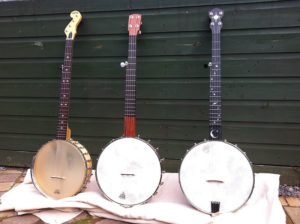
This article explains every type of banjo, as well as other types of differences between each type.


Table of Contents
- How many types of banjos are there?
- All The Different Types Of Banjos
- What are the types of accessories for Banjos?
- History of Banjos
- How To Choose The Right Type of Banjo?
- Types of material in banjos
- Types of Music That You Can Play With The Banjo
- Ways you can learn the banjo
- Conclusion
How many types of banjos are there?
There are mainly two types of banjos, Open Back and Resonator Banjos but there are many other criteria for different banjos such as:
- Open Back & Resonator
- Number Of Strings
- Sound
- Material
- Music
Let’s dive deep into many different types of banjos.
All The Different Types Of Banjos
Open Back Banjos and Resonator Banjos
The open back banjos and the Resonator equipped banjos are different from each other by the position of the Resonator.
Today’s Banjos are of two types, which are mainly open-back banjos and resonator banjos. When you are going to the Banjo, for quieter and mellow music, then choosing the open-back types of Banjos will be perfect for you.
On the other hand, the Resonator equipped Banjos are having a metal plate, which is directly attached to the pot. It produces the forward acoustically sound, and the impact of its composed music is fantastic.
But we talk about the price, then the cost of the resonator Banjos, are more than that of the Resonator equipped Banjo. The biggest reason behind that, it is made from bluegrass, and it is the best choice for those who want to create a high impact on music sound.
So, from the above discussion, we hope that you have cleared with the types of Banjos, and now it is the time to discuss the strings of the Banjos.
Four Strings Banjos
When you are a beginner, and you are looking for the Banjo, then opting for the four strings Banjos will be the excellent choice for you. The four lines Banjos are of further two types, which are the Tenor and the Plectrum.
The significant advantage behind choosing the four-string banjo is their usage. It can be used in a number of ways like in the form of the four strings of guitar or EBGD, used like a Ukulele or GCEA, or even fiddle or mandolin.
Six String Banjos
The six-string Banjos are very much popular since the 9th century. But today, you can find out a lot of variations within the six-string Banjos, and the significant variation into the six-string banjo is the guitar Tuned Banjo. Most of the young musicians, always like to play music along with the six-string banjo.
Five String Banjos
The five-string Banjos have recently come into existence, and they are used for creating music in multiple genres. It is the best choice for all those who are beginners and those who are making other people learn about musical instruments.
The pattern on which the five-string Banjos are attached is fourth, third, second, first, and then fifth. The fifth string is known by various names like thumb string, odd string, and it produces the sound like a drone.
Twelve String Banjo
While you are looking for the Banjo, then you may feel that the twelve-string Banjo is very much rare. Such banjos produce sound, which is loaded with fun, and it is very much light as well.
Tenor Banjo
The Tenor Banjo is the most popular form of Banjo, and it is also used by traditional musicians, who are having a shorter scale. The neck length of such banjos is around 17 to 19 fret.
Plectrum Banjos
The plectrum Banjos are quite the same as that of the five string Banjos, and they are called as five string banjos as well. The most significant difference between Plectrum banjos and the five-string banjo is it has a drone string. The plectrum banjos are mainly used by Dixieland enthusiasts.
Hybrid Banjos
Hybrid Banjos are the most popular form of Banjos, which are available these days. It is the best choice for all those who want to create music in multiple genres and contexts. These are also known as the six-string banjos are the same as that of the guitar, and their neck is also the same as that of the guitar, but the rest of their body is the same as that of the Banjo.
The other type of musical instrument, which is very common among the musicians is the banjolele. And it is the most significant combination of the Ukulele and the Banjos, and therefore, it gets a banjolele. It is very much small in size and low in weight, which makes this type of Banjo very much comfortable to port from one place to the other. It is also very much comfortable to learn.
What are the types of accessories for Banjos?
If you choose the accessories of Banjos wisely, then only you can produce a fantastic level of sound from your selected Banjos. Here are some of the accessories, that you must keep in your mind before choosing your Banjo
Tuner: It is the accessory, which is responsible for tuning up the Banjo, and it is responsible for tuning the Banjo easily. There are several other models of Banjos, which make its tuning easy than that of the other models.
Banjo strings: The Banjo strings are made from various types of material, and you have to choose the content as per your need. While you are looking for the new series, then you will feel that they are not creating as much as an impactful sound.
While you are choosing the new series, then you must do experiments along with the different types of lines.
Banjo Capo: It is the accessory, which is responsible for adjusting the level of pitch within the Banjo. With its help, you can play songs with the help of keys. It is very important for all those singers, who have the song’s usual key, to lower than that of their vocal range.
Banjo Straps: The Banjo straps are very much useful for you when you want to play your Banjo in a standing position.
Banjo cases and Gig bags: As its name describes, these are the things that protect banjos from getting damaged. You must purchase a banjo case or a bag if you are planning to take Banjo along with you for a musical show or an event.
History of Banjos
When we go to the time, when the Banjos were created, and we have not found any evidence that when do the banjos created. The first created Banjo is the same as that of the kora and having a body like a gourd. But the difference between the Banjo and the kora is their metal loops and their stick neck.
Banjos were first created in America, and while making the first Banjos, the people of America used gourd for creating its body, and they have used the animal skin for creating its Resonator, and they have to make use of the stick to make its neck.
During the 17th century, the Banjos were seen in the region of the Caribbean as well. Such banjos were called as the modern form of Banjo. After this, the other version of Banjos was seen in the 1830 and the banjos, which were seen at that time had a full-length type of string, and they have a drone type of series.
How To Choose The Right Type of Banjo?
- Before having an idea about the types of Banjo, you must know about how to choose the right Banjo. If you choose the right Banjo, then only you can have the best sound produced by your Banjo. Here are some of the tips, which can help you out in choosing the perfect set of Banjo
- Learn about the strings settings before selecting any of the Banjo sets. You can check the string settings while pressing each of the strings while making use of your fingers. If your pressing does not make as much as an impact on your finger, then you must choose the particular Banjo.
- After this, strum all the strings collectively and learn about the sound produced by them. Ensure that the sound produced by them must not be buzzy or in the form of the rattle.
- Do check whether the Banjo has a tone ring or not. It is the only thing, which is responsible for a significant impact of sound within your selected Banjo.
- Learn whether all the tuners are performing well or not.
Types of material in banjos
Neck or Fingerboard: Made from Maple, and it is the material, which offers rigidity to the banjo set. If you are looking for quality banjo, then you must choose such Banjo, which is made from a single piece of wood.
Rim: It is the part that is responsible for covering the whole set of Banjo. It is entirely made from the wood of the same type. It is the part which is responsible for producing quality sound and the high volume of music as well.
Some of the other materials that you require to construct your Banjo
- Tuners or Peghead
- Tone Ring
- Resonator
- Head or Bridge
- Tailpiece
Types of Music That You Can Play With The Banjo
You can play many different types of music with the banjo such as:
- Country
- Folk
- Jazz
- Bluegrass
- Old Time
- Many More
Ways you can learn the banjo
Go for the Banjos Instructional books, tutorials, and CDs to learn how to play Banjo. It will be very beneficial for you to learn new skills.
Whether you are a beginner, intermediate, or expert, from the tutorials, you can find out everything you are looking for. You can also take help from Youtube for gaining new skills, and these days, there are a lot of people who learn Banjos from online mediums.
Opt for the Banjo songbooks or Chord Guides: From the internet, you can find out a lot of people who can make you learn banjos. Even though, from the internet, you can also find unlimited learning options and tips and tricks from the experts.
Conclusion
We hope that you have an idea about all the types of Banjos, and if you are going to purchase a new Banjo, then discussed information would be very beneficial for you in selecting the best one.
The primary thing that you must know about the Banjos is that they are a great musical instrument, and it is going to change from time to time. It is a rare form of music and the best choice of a musical instrument to create a sophisticated type of music.
The biggest thing that you must keep in your mind is the varieties of Banjos and what are the features of the particular Banjo before selecting it as your favorite one.
Image from flickr creative commons plenty.r.
