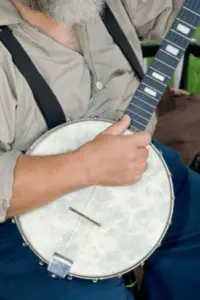
Old-time music is fiddle music, and the banjo’s job in it is to sit under a fiddle in the fiddle’s key. That single fact decides the instrument. Bluegrass players learn one tuning and reach for a capo; old-time players change tuning between tunes, so an old-time banjo is judged on how well it holds a pitch it was not built in, how easily the fifth string follows the other four, and whether the striking hand has somewhere to land. Open back is the starting point. After that it is the rim, the scoop and the fifth string.
Gold Tone CC-OT Cripple Creek Old-Time
The only banjo here that Gold Tone built for this music and nothing else: a scooped fingerboard to strike over, a Fiberskyn head that takes the glare off, planetary pegs that hold a tuning you changed ten minutes ago, and a fifth-string spike already fitted at the seventh fret. A maple pot and a rolled brass ring underneath, so it still has some cut when a fiddle gets loud.
The six at a glance
| Banjo | Rim | Head | Scoop | Tone ring | Tuners | Weight | Price band |
|---|---|---|---|---|---|---|---|
| Gold Tone CC-OT | 11″ maple | Fiberskyn | Yes | Rolled brass | Planetary | 5.5 lb | ~$700 |
| Gold Tone AC-12 | 12″ composite | Renaissance | Yes | None | Geared | 5 lb | ~$400 |
| Deering Goodtime Americana | 12″ maple | Renaissance | No | None | Geared | 4.5 lb | ~$750 |
| Deering Artisan Goodtime | 11″ maple | Frosted | No | None | Planetary | 4.5 lb | ~$950 |
| Gold Tone CC-Carlin12 | 12″ maple | Renaissance | Yes | Rolled brass | Planetary | 5.8 lb | ~$850 |
| Gold Tone AC-1FL | 11″ composite | Frosted | Fretless | None | Geared | 3.75 lb | ~$315 |
What old-time actually asks of a banjo
The tunings are the job
There is no single old-time banjo tuning. Standard G — gDGBD — covers tunes in G. Double C, gCGCD, covers tunes in C, and capoed up two frets it becomes double D for the enormous number of fiddle tunes in D. Sawmill, also called mountain minor, is gDGCD, and a large part of the Round Peak repertoire lives there. Open D is f#DF#AD. A jam works through tunes in D, A, G and C, and the banjo is expected to follow.
That is the difference from a bluegrass banjo, and it is why specifications that look like trim on a bluegrass instrument matter here. Pegs get turned several times an evening. Strings get slackened a whole tone and tightened back. The instrument has to arrive at the right pitch quickly and stay there while eight bars go past, and none of that is about tone.
Which is why the fifth string is the problem
The fifth string starts at the fifth fret and drones. Put a capo across the neck at the second fret for a tune in A and the other four strings move up; the drone does not, and it is now wrong against everything else. There are two answers. Spikes are small hooks set into the fingerboard, usually at the seventh, ninth and tenth frets, and you tuck the string under one to stop it at a fixed pitch — seventh for A, ninth for B, tenth for C. Or a sliding fifth-string capo clamps to the side of the neck and travels.
Spikes are the traditional answer, they are almost free as parts, and they never need adjusting. What they cost is a hole drilled in your fingerboard for each one, which is shop work rather than a kitchen-table job — budget around $25 to have a set fitted. Two banjos here save you that: the CC-OT arrives with a seventh-fret spike in place, and the Artisan Goodtime with all three. Planetary pegs help for the same reason a spike does — they hold, and they turn predictably — which is why the tuner column is in the table above at all.
Eleven inches or twelve
Eleven inches is the standard banjo pot and what most instruments of any kind use. Twelve is the older specification, common in the period this music was first recorded, and it drops the fundamental and thickens everything underneath. Deering is unusually direct about the trade in their own copy for the Americana: an eleven-inch banjo with a frosted head is far brighter and cuts more, while a twelve-inch pot with a Renaissance head gives a laid-back sound better suited to backing a singer or another instrument than to leading.
Which is the right answer depends on what you play with. Behind a fiddle, the twelve-inch voice sits underneath without competing, and that is most old-time playing. On your own, or in a room with a guitar and no fiddle, eleven inches gives you something with more definition to listen to. Eleven also resells to anybody; twelve resells to old-time players.
The scoop, and why the same model turns up described both ways
A scoop is a shallow ramp where the last few frets would be. Clawhammer is struck with the hand up over the head, and the scoop gives that hand a place to land without catching a fret edge; the note up there is softer and woodier than anything down by the bridge. It is the most style-specific thing you can buy, and it is permanent — the frets it removes are exactly the ones a melodic line above the twelfth fret needs, and cutting one into a finished fingerboard afterward is luthier work.
The confusing part is that a scoop is not always a fixed property of a model. Deering lists it as a build option on the Goodtime, the Americana and the Artisan Americana — the same model, about $59 apart, catalogued both ways — so you will find one description saying a Goodtime Americana is scooped and another saying it is not, and both are right about different builds. The ready-made ones carry the standard fingerboard, which is why the Americana shows up in the table above as a twelve-inch banjo without a scoop. Of the six here, the AC-12, the CC-OT and the CC-Carlin12 come scooped.
A tone ring is volume, and volume is a choice
A tone ring is a metal hoop sitting on the rim with the head stretched over it. It adds cut and sustain and takes away some of the dry thump that a bare wooden rim gives. Neither is better; they are different instruments for different rooms. A banjo with no ring is quiet — genuinely quiet, in a way no setup fixes — which is fine at home and behind one fiddle and a problem in a loud jam.
The CC-OT and the CC-Carlin12 have rolled brass. The White Ladye further down uses the Whyte Laydie pattern, which is the ring most associated with this music. The Goodtime, the Americana, the AC-12 and the AC-1FL have none at all, and the head does all the work — which is also why the choice of head is worth as much attention as the ring. A Fiberskyn or Renaissance head warms and thickens; a frosted top head is brighter and louder.
Fretless, if you mean it
The banjos this music was first played on had no frets, and a fretless neck gives a sliding, vocal quality that a fretted one cannot. It also means intonation is entirely your problem, and a lined fingerboard — position lines inlaid where frets would be — only tells you where to aim. Deering is refreshingly blunt about their own fretless: they say they would not recommend it to a player who has just taken up the banjo, which is the right advice and unusual to see from a maker. Gold Tone’s AC-1FL is the cheap way to find out whether you are that player.
The six picks
Gold Tone CC-OT Cripple Creek Old-Time
- Open back, 11″ multi-ply maple rim
- Rolled brass flat-bar tone ring
- Scooped rosewood fingerboard, 18 frets
- 11″ Remo Fiberskyn head
- Planetary tuners, geared fifth-string peg
- Fifth-string spike fitted at the seventh fret
- 26 3/16″ scale, 1 3/16″ nut, 5.5 lb
- Gig bag, strap, clip tuner and a clawhammer video included
- ~$700
Everything on the specification is pointed at one style. The scoop is there for the striking hand. The Fiberskyn head takes the edge off the brass ring and leaves a soft, thick note close to what a skin head does. The pegs are planetary, so a tuning you changed between tunes is still where you left it. And the seventh-fret spike is already in the fingerboard, which is the one thing on this list you would otherwise be paying a shop to do.
The specialization is the whole point and the whole risk. Eighteen frets means the top of the neck is gone for good, so if there is any chance your playing turns melodic or drifts toward bluegrass this is the wrong instrument. It is also the heavier end of the openbacks here at five and a half pounds. Buy it because you have decided, not to find out.
- Scoop, Fiberskyn head and a brass ring without going to four figures
- Planetary pegs and a spike already fitted
- The brass ring gives it cut when a jam gets loud
- Set up in Florida before it ships
- Eighteen frets, permanently
- Heaviest of the eleven-inch banjos here
- Only one spike, so ninth and tenth are still a shop job
- Commits you to old-time completely
Gold Tone AC-12
- Open back, 12″ composite rim
- No tone ring
- Frailing scoop, 18 frets
- 12″ Remo Renaissance head
- Mahogany neck, rosewood board, 26 3/16″ scale
- 1 7/16″ Zero Glide nut — the widest here
- 5 lb, gig bag included
- ~$400
A twelve-inch pot and a frailing scoop are the two things that cost money everywhere else on this page, and this has both for around $400. The Renaissance head is fitted as standard rather than as an upgrade. The nut is an inch and seven-sixteenths, which is three-sixteenths wider than the Deerings and gives the thumb somewhere to work — a genuine advantage for clawhammer that nothing else here at any price matches.
What you give up is the pot itself. A molded composite rim is drier and flatter than maple: the drop in pitch that twelve inches buys is there, the bloom underneath it is not, and with no tone ring either this is a quiet instrument in company. Treat it as the honest way to find out whether the twelve-inch scooped voice is the one you want, with the maple versions above and below it waiting if it turns out to be.
- Twelve-inch pot and a scoop for around $400
- Widest nut on this page by a clear margin
- Renaissance head as standard
- 5 lb for a twelve-inch banjo, and a bag in the box
- Composite rim — drier, with less bloom than maple
- No tone ring, so quiet alongside other instruments
- Eighteen frets and the scoop are permanent
- Geared pegs rather than planetary
Deering Goodtime Americana
- Open back, 12″ 3-ply violin-grade maple rim
- No tone ring
- 12″ Renaissance medium-crown head
- Rock maple neck, 22 frets, 26 1/4″ scale, 1 1/4″ nut
- 4.5 lb, 37 1/2″ overall
- Built in Spring Valley, California
- Eight-year warranty on registration
- ~$750
A twelve-inch maple pot with a Renaissance head, built in California, at four and a half pounds — no heavier than the eleven-inch Goodtime, which for a pot this size is the remarkable part. This is the deepest, most laid-back voice on the page and the one that sits under a fiddle most naturally. It is also the one that will still be worth money in ten years; Deering resale is in a different class from everything else here.
As sold ready-made it has twenty-two frets and no scoop, which is the odd thing about it — the twelve-inch old-time voice without the fingerboard feature most associated with the style. That is a build choice rather than an omission, since Deering catalogue the model both ways, but the one you can buy off the shelf is the plain-fingerboard version. If the scoop matters more to you than where the banjo was made, the AC-12 above has both for $350 less and the CC-Carlin12 below has both in maple for about $100 more.
- A genuine twelve-inch old-time voice, American built
- 4.5 lb — nothing here with a wooden pot is lighter
- Renaissance head fitted as standard
- Eight-year warranty and the strongest resale on the page
- Standard fingerboard, not scooped
- Quiet by design — not a band instrument
- No spikes fitted, and no case or bag in the box
- Twelve-inch cases are a smaller and dearer market
Deering Artisan Goodtime
- Open back, 11″ 3-ply violin-grade maple rim
- No tone ring, 11″ frosted high-crown head
- Rock maple neck, 22 frets, 26 1/4″ scale, 1 1/4″ nut
- Planetary tuners, geared fifth-string peg
- Spikes fitted at frets 7, 9 and 10
- 4.5 lb, built in Spring Valley, California
- Eight-year warranty on registration
- ~$950
Underneath, this is the $600 Goodtime — same rim, same neck wood, same head, same scale, same weight, same factory. What the Artisan badge adds is a dark stain, better inlays, planetary pegs and spikes at the seventh, ninth and tenth frets. Two of those four are cosmetic and two of them are the exact things this page has been arguing matter, fitted properly and covered by the warranty.
Whether that is worth $350 depends entirely on how you play. If double C and sawmill are part of your week, having pegs that hold and a fifth string that stops where you want it is worth real money, and both are awkward and irreversible to retrofit — reaming peg holes and drilling a fingerboard are not jobs to get wrong on a maple neck. If you play in G and stay there, this is $350 that belongs in a hard case and lessons. Our Artisan Goodtime review works through the arithmetic in detail.
- Spikes at 7, 9 and 10 fitted from new
- Planetary pegs, set up and under warranty
- 4.5 lb, American built, excellent resale
- The only banjo here ready for alternate tunings out of the box
- Same pot, scale and weight as the $600 model
- No scoop and no tone ring
- Eleven-inch frosted head is the bright end of old-time
- Poor value if you play in one tuning
Gold Tone CC-Carlin12
- Open back, 12″ multi-ply maple rim
- 12″ rolled brass flat-bar tone ring
- Scooped rosewood fingerboard, 18 frets
- 12″ Remo Renaissance head
- Planetary tuners, 24 brackets
- 1 3/8″ Zero Glide nut
- 5.8 lb, gig bag included
- ~$850
Bob Carlin’s specification in Gold Tone’s cheaper Cripple Creek trim, and the only twelve-inch banjo here with a ring under the head. Everything the style asks for is present at once: the big pot, the scoop, a Renaissance head, planetary pegs and a nut of an inch and three-eighths. If you were going to end up here anyway, it saves you buying twice.
The awkward comparison is directly above it. The AC-12 has the same pot diameter, the same scoop, the same head and a nut a sixteenth wider for $450 less, so what the extra money buys is a maple rim instead of a molded one, a brass ring instead of bare wood, and planetary pegs. That is a real difference in voice and a lot of money for it, and whether it is worth paying depends on whether you have heard the two. It is also the heaviest banjo on this page and the most committed — a twelve-inch scooped pot with a brass ring does nothing but old-time, and it resells into the smallest market of anything here.
- Twelve-inch maple pot, scoop and brass ring together
- Planetary pegs and a wide nut
- Renaissance head as standard, bag included
- Nothing else here needs less added to it
- 5.8 lb — the heaviest on this page
- $450 more than an AC-12 with much the same layout
- Eighteen frets and a permanent scoop
- Resells into a very narrow market
Gold Tone AC-1FL
- Open back, 11″ composite rim
- No tone ring, 11″ Remo frosted head
- Lined fretless fingerboard
- Mahogany neck, 26 3/16″ scale, 1 3/16″ nut
- 3.75 lb — the lightest here
- Gig bag included, set up in Florida
- ~$315
The AC-1 with the frets left out and lines inlaid where they would have been. That combination is the sensible way into fretless: the lines put your fingers roughly right while your ear learns the rest, and at three and three-quarter pounds on a molded pot there is nothing precious about it. The sound is the woody, sliding thump that fretless is for, and it is the cheapest instrument in the world that makes it honestly.
It is not a first banjo. Without frets, every note is your responsibility, and a beginner cannot yet tell a badly stopped string from a badly tuned one — which is exactly the confusion that makes people give up. If you already play, this is a cheap second instrument that will teach you things a fretted neck cannot. If you do not, buy something with frets and come back.
- Fretless for the price of a fretted beginner banjo
- Lined board, so you are not starting blind
- 3.75 lb, the lightest banjo here
- Bag included and set up before it ships
- A poor choice as a first instrument
- Composite rim and no tone ring — quiet and dry
- Intonation is entirely down to you
- Narrow nut compared with the twelve-inch banjos here
Also worth a look
| Banjo | Price band | Why you might pick it |
|---|---|---|
| Deering Goodtime | ~$600 | The cheapest American-built banjo there is, four and a half pounds, and nothing on it commits you to a style. Twenty-two frets, no scoop, no ring, geared pegs — the openback for someone who is not yet certain old-time is the destination. There is more on it in our Goodtime review. |
| Gold Tone WL-250 White Ladye | ~$1,250 | The top of this specification: a Whyte Laydie tone ring, a bound ebony fingerboard ending in a frailing scoop, a Fairbanks-style peghead, master planetary pegs, a Renaissance head and a hardshell case in the price. Eighteen frets and 6.7 lb. If you know this music is the rest of your life, this is where the ladder ends. |
What else to budget for
Two things are worth buying at the same time as the banjo, and one of them is not an accessory at all.
| What | Price band | Why |
|---|---|---|
| Brad Leftwich, Round Peak Style Clawhammer Banjo | ~$25 | Over seventy tunes in the Round Peak style, organized by the tuning each one uses rather than by difficulty — which is the right way round for this music and rare in print. Leftwich learned directly from the Round Peak players, and much of the commentary is aimed at the fretless banjo. Not a beginner’s first book, and it says so. |
| Sliding fifth-string capo | ~$59 | The alternative to spikes if you would rather not have holes drilled in a new fingerboard. It clamps to the side of the neck and slides, so it covers every position rather than three. Worth knowing that opinion on these is genuinely split — a fifth of the reviews are one or two stars, mostly about fit on particular necks — so it is the fix for someone who will not drill, not the better fix outright. |
Beyond that: a set of medium-gauge strings, because down-tuning to double C or open D on a light set goes slack and buzzes, and our banjo strings guide covers which. And a setup if the banjo did not come with one — everything on this page except the two cheapest arrives adjusted, which is a large part of what the money buys.
Questions that come up
Does old-time have to be played on an open back?
No, and plenty of people play it on a resonator banjo. But the resonator throws sound forward and adds several pounds, and old-time is music played in a circle rather than at an audience, so the open back suits it in both respects. If you already own a resonator banjo, most of them come apart — open back versus resonator goes through what removing it does and does not achieve.
Which tuning should I learn first?
Double C, gCGCD. Most beginner clawhammer material is written in it, capoing up two frets turns it into double D for the D tunes that dominate a session, and it makes the shapes for the common tunes fall under the hand more obviously than standard G does. Standard gDGBD is worth knowing next, and sawmill after that. How to tune a banjo covers getting there accurately.
Do I need a scoop?
Only if you are sure. It makes clawhammer more comfortable and it makes anything played above the twelfth fret impossible, and that trade cannot be undone later. If you are certain old-time is where you are staying, buy the scoop and never think about it again. If there is any doubt, buy an unscooped banjo — you lose nothing but a little comfort, and you keep the top of the neck.
Can I play old-time on a bluegrass banjo?
Yes, and it will sound like a bluegrass banjo playing old-time: brighter, longer-sustaining and louder than the music generally wants. The usual first step is a different head and a lighter touch rather than a different instrument. If you are choosing between the two styles rather than adding one, the bluegrass picks are a very different list.
So which one?
If old-time is decided and you want one banjo to be right, the Gold Tone CC-OT at around $700 has more of the specification in place, out of the box, than anything near it. If the budget is half that, the AC-12 gets you the twelve-inch pot and the scoop for around $400 and gives up only the wood. For the deep American twelve-inch voice, the Goodtime Americana; for that voice with a ring and a scoop as well, the CC-Carlin12.
And if you spend your evenings moving between double C, sawmill and open D, the Artisan Goodtime is the one that arrives ready for it. The players who made this music are worth an evening too — our list of clawhammer players starts with the Round Peak generation these tunings came from.