How Much Does a Clarinet Weigh? About a Pound and a Half

Pro Music Vault Home Instruments Clarinet How Much Does a Clarinet Weigh? About a Pound and a Half

A B♭ soprano clarinet weighs about a pound and a half — 740 grams assembled, without the mouthpiece. Fit a mouthpiece and ligature and you are holding a shade under two pounds.

That figure barely moves. A synthetic student instrument and a ten-thousand-dollar grenadilla one are separated by about seven ounces, and everything in between sits in a band two hundred grams wide.

What changes is the case. A clarinet in a light modern case is a four-pound object; the same clarinet in an older lockable hardshell is over five. And because the whole of that weight hangs off one thumb in one position, a pound and a half is enough to hurt.

The short answer

740 grams — about 1.6 pounds — for the instrument, and roughly four pounds for the clarinet, case and kit you actually carry.

The weight is not the problem. Where it lands is: a right thumb under a small metal rest takes all of it, for the whole rehearsal, in a fixed position. A neck strap moves that load onto your shoulders and costs about twenty dollars.

Around $20 Check current price
Buying for a nine-year-old: a pound and a half is not the obstacle — reaching the lower joint is Told plastic clarinets are heavy: it is the reverse, and the gap is about three ounces On bass clarinet: five and a half to ten pounds, and it rests on a peg rather than on you Marching with it: best clarinet for marching band covers what survives a field

What a clarinet weighs, model by model

Almost no clarinet maker publishes a weight. Buffet Crampon, Yamaha, Selmer and Jupiter all put out full specifications — bore, tone holes, key plating, pad material — with no weight row anywhere. Backun is the exception, and lists one for every clarinet they build, which is why the table below is theirs.

ClarinetBodyWeight
Alpha B♭Synthetic656 g · 1.45 lb
Alpha ASynthetic726 g · 1.60 lb
Protégé B♭Grenadilla741 g · 1.63 lb
Beta B♭Grenadilla743 g · 1.64 lb
Q Series B♭ and AGrenadilla or cocobolo744 g · 1.64 lb
Alpha Plus AGrenadilla754 g · 1.66 lb
Essence B♭ and AGrenadilla or cocobolo810 g · 1.79 lb
CG Carbon B♭ and ACarbon fiber over hardwood830 g · 1.83 lb
Lumière B♭ and AGrenadilla or cocobolo852 g · 1.88 lb
MoBa B♭ and AGrenadilla or cocobolo866 g · 1.91 lb

That is the entire range: 210 grams, or seven and a half ounces, between the cheapest instrument on the list and one costing more than a car. Nothing built as a standard B♭ clarinet comes in much under a pound and a half or much over two.

Two things in the table are worth reading twice. An A clarinet is heavier than the B♭ of the same model — 726 grams against 656 for the Alpha — because it is a longer instrument. And weight climbs with price rather than falling with it, because the expensive instruments carry more metal: extra keys, heavier posts, thicker plating.

None of these figures includes a mouthpiece. Professional clarinets are sold without one, and a mouthpiece and ligature add roughly 80 grams. That is where the difference between “740 grams” and “about two pounds in my hands” comes from.

Why the number you found was too big

Retail weight figures are shipping weights. They are measured for a courier, they include the case, the packaging and sometimes a carton holding several units, and couriers bill on volume as well as mass, so the figure is not always a measurement of anything at all.

Gator prints both numbers on the same page, which makes the gap easy to see. Their Largo clarinet case is listed at an exterior weight of 1.80 lb and a shipping weight of 12.68 lb — the same product, seven times apart, because the second figure is a box of them.

Weigh the instrument instead. Kitchen scales handle a clarinet comfortably, and a joint at a time is easier than balancing the whole thing.

Plastic is lighter than wood, not heavier

Backun builds two clarinets with the same keywork, the same adjustable thumb rest and the same bore treatment, one in a proprietary synthetic and one in grenadilla. The synthetic Alpha is 656 grams; the grenadilla Beta is 743. The wood adds about three ounces.

That is what you would expect from the materials. Grenadilla is one of the densest woods in commercial use — dense enough to sink — and the resins clarinets are molded from are appreciably lighter. A plastic clarinet is the lighter instrument, not the heavier one.

Carbon fiber does not behave the way the word suggests either. Backun’s carbon-bodied clarinet is 830 grams, heavier than their grenadilla one, because the carbon is wrapped around a hardwood core and the instrument carries professional keywork. Carbon buys stability in cold and damp, not lightness.

What you actually carry

Nobody carries a bare clarinet. The object that goes to school is the instrument, the mouthpiece, a case and whatever has accumulated in the accessory pocket, and the case is the biggest single component of it.

CaseConstructionWeight
Gator Largo GBB-CLARINETEPS hybrid, zip closure1.80 lb
Gator Pro GBPC-CLARINETPadded bag, backpack straps2.40 lb
Gator GC-CLARINETABS hardshell, lockable3.00 lb

Add it up. Instrument 1.6 lb, mouthpiece and ligature 0.2, case 1.8 to 3.0, and a quarter of a pound of reeds, swab, cork grease and a spare screwdriver: between about three and three-quarter pounds and five and a quarter, depending almost entirely on which case it lives in. Swapping a heavy hardshell for a light modern case takes a quarter of the total off.

It is a small object as well as a light one. Gator gives the interior of that Largo case as 11.5 by 7.5 by 2 inches — a disassembled clarinet packs into roughly the footprint of a laptop.

The weight lands on one thumb

A flute is held between three points, a saxophone hangs from the neck, a trumpet is cradled in a whole left hand. A clarinet rests on the top joint of the right thumb, against a metal bar an inch long, and stays there.

A pound and a half through that contact patch is a great deal of pressure, and the thumb cannot move, because moving it moves the instrument. That is why a clarinet can ache after twenty minutes when a heavier instrument held differently does not, and why the weight becomes a subject at forty when it never was at eighteen. Three things fix it, and they run from about six dollars to about fifty.

№ 1 · The six-dollar fix, and the one to try first

BG France A21 Thumb Rest Cushion

  • Molded flexible rubber, slips over the existing rest
  • A21 is the small size; A23 is the large
  • No tools, no modification, nothing to adjust
  • Around $6

It does not reduce the weight by a gram. It spreads it, turning a one-inch metal bar into a broad, slightly grippy pad, and it stops the instrument sliding forward so you grip less hard to hold it still. Most of what people call thumb pain is the edge of the bar and the gripping, not the mass above it.

Size is the only thing to get right, and it is worth two minutes with a ruler. The small A21 fits the narrow fixed metal rests on most student and older B♭ clarinets and on oboes. The large A23 fits the wider adjustable rests now standard on newer instruments — if your thumb rest slides up and down on a track, that is the one you want. Order the wrong size and it either will not go on or will not stay on. On the A21 listing, take the Classic version.

Pros
  • Cheapest useful thing you can do about clarinet weight
  • Fits in thirty seconds and comes off as fast
  • Reduces grip pressure as well as contact pressure
  • Nothing to break and nothing to set up
Cons
  • Two sizes, and the wrong one is useless
  • Rubber perishes eventually and needs replacing
  • Will not help a player whose hand is genuinely too small yet

Wider or adjustable thumb rest? The large A23 is here.

№ 2 · For taking the weight off the thumb entirely

Protec NCS2 Clarinet Neck Strap

  • Adjusts 17 to 22 inches, neck pad to hook
  • Neoprene pad with stitched trim so it does not stretch
  • Open metal hook and a one-hand slider
  • Leather tabs included for clarinets with no strap ring
  • Around $20
See also  How Hard Is Playing The Clarinet?

A neck strap moves the load from a thumb joint to the trapezius, which is built for it. For anyone playing more than half an hour at a stretch, or coming back to the instrument with a wrist that already complains, it is the difference between practicing and stopping early.

The detail that decides whether a strap works is the attachment. Many clarinets have a small ring on the thumb rest to hook onto; plenty do not, and the strap is then useless. Protec includes leather tabs that loop around a bare thumb rest and give the hook something to catch, which is why this is the one to buy if you do not know what your instrument has. The stitched trim matters more than it sounds — a neoprene pad that stretches under load lets the instrument creep downward, and your embouchure follows it.

Set the length so the mouthpiece arrives at your mouth with your head level. A strap adjusted to make you reach down is a neck problem swapped for a thumb one.

Pros
  • Removes essentially all the load from the right thumb
  • Works on clarinets with no strap ring, thanks to the tabs
  • Adjusts one-handed while playing
  • Rubber-free metal hook will not mark the key
Cons
  • Takes a week to stop feeling strange
  • Set too long or too short it causes its own problems
  • Some teachers want beginners to build the hand first
Around $20 Check current price

Prefer a fixed leather tab and a quick adjuster? The D’Addario Rico clarinet strap does the same job for about the same money.

№ 3 · For cutting the carry weight, not the playing weight

Gator Largo GBB-CLARINET Case

  • 1.80 lb, against 3.00 lb for a lockable ABS hardshell
  • Rigid EPS shell under a nylon exterior
  • Contoured plush-lined nest for the joints
  • Interior 11.5 × 7.5 × 2 in, shoulder strap included
  • Around $50

This is the one change that alters the number on the scale. A pound and a fifth off a four-pound load is more than a quarter of it, and it is the load a twelve-year-old carries between four classrooms and a bus.

Rigid expanded polystyrene under a fabric skin gives most of the crush resistance of a molded shell at roughly half the mass, and the molded nest stops the joints moving, which is what actually bends keys. It is not the case for an instrument that travels in a car boot under other luggage — foam will not survive being stood on — but for the trip a student clarinet actually makes it is a straight improvement over the box it came in.

Check the shoulder strap before the first walk with it. A strap worn across the body rather than on one shoulder stops the case swinging into a doorframe, which is how cases get dropped.

Pros
  • Genuinely lighter, with the maker’s own figure to prove it
  • Molded nest holds the joints still
  • Shoulder strap included
  • Small enough to go inside a backpack
Cons
  • Foam is crushable in a way ABS is not
  • No lock
  • Costs about what a cheap clarinet’s whole outfit does
Around $50 Check current price

The rest of the clarinet family

The B♭ soprano is the standard clarinet, and the rest of the family runs from a sopranino you could post in an envelope to instruments that need their own trolley.

The E♭ clarinet is the small one at the top of an orchestral clarinet section — roughly two-thirds the length of a B♭ and correspondingly lighter, with the same keywork condensed onto a shorter body. The A clarinet, the B♭’s twin in a slightly lower key, runs about 70 grams heavier than the B♭ of the same model.

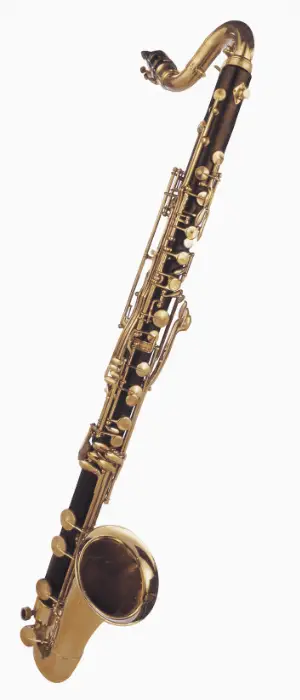
The bass clarinet is the one people get badly wrong. Makers put it at 2.5 to 4.5 kilograms — five and a half to ten pounds, with a plastic instrument that stops at low E♭ at the bottom of that range and a wooden one extended to low C at the top. It is heavy for something you hold; it is not heavy for something you own. Packed with its case you are lifting something in the region of fifteen to twenty pounds.

Seated, though, a bass clarinet is not held up at all. A metal peg screws into the bottom of the lower joint and takes the instrument’s weight onto the floor or the chair, exactly as a cello endpin does, and the player balances it rather than supporting it. Standing, or in a marching context, it goes on a neck strap or a shoulder harness instead. So the bass clarinet’s weight is a carrying problem rather than a playing one.

Below that, the alto clarinet, contra-alto and contrabass get progressively larger, and every one of them is played on a peg or a stand for the same reason. The published weights for these are scarce enough that any single figure is worth treating with suspicion, but the practical answer is consistent: nobody carries their weight while playing, and nobody carries them any distance without a case on wheels.

Does a heavier clarinet play better?

Not in any way you can act on. Within the two hundred grams the whole B♭ family occupies, the weight is a by-product of bore geometry, tone hole placement and how much key metal a maker fits — nobody designs to a weight, and no maker sells one clarinet as heavier than another.

The one place it shows up honestly is the wood-versus-synthetic question, and even there weight is the side effect and not the cause. Grenadilla is chosen because of what dense, oily, close-grained wood does to a bore and because it can be finished to a tolerance resin cannot hold; being heavier comes with that. Choosing a clarinet by mass is choosing by the least informative number on the instrument.

If you are deciding between materials for real reasons rather than weight ones, why marching bands play on plastic is the case for synthetic put plainly, and clarinet brands to avoid covers the instruments where the material is the least of the problems.

Frequently asked questions

How much does a clarinet weigh in kg?

A B♭ soprano clarinet is about 0.74 kg. The published range across an entire professional line runs from 0.656 kg for a synthetic body to 0.866 kg for the heaviest grenadilla model. With a mouthpiece and ligature fitted, add roughly another 0.08 kg.

How much does a clarinet and its case weigh together?

Between about 3¾ and 5¼ pounds, or 1.7 to 2.4 kg. The case is the variable: light modern cases are around 1.8 lb and a lockable ABS hardshell is 3 lb. A packed student outfit sits near four pounds.

How much does a bass clarinet weigh?

Between about 5½ and 10 pounds — 2.5 to 4.5 kg — with plastic low E♭ models at the light end and wooden low C models at the heavy end. Cased, expect something around fifteen to twenty pounds to carry. Seated, the instrument’s weight goes onto a peg rather than onto the player.

Is a plastic clarinet lighter than a wooden one?

Yes, by about three ounces. Comparing two instruments from one maker with identical keywork, the synthetic body is 656 g and the grenadilla 743 g. Grenadilla is dense enough to sink in water; clarinet resins are not.

Why does my clarinet feel heavy after ten minutes?

Because all of it is on one thumb, against a metal bar, in a position you cannot shift. It is a pressure problem rather than a mass problem, which is why a rubber cushion costing a few dollars helps so much more than it ought to, and why a neck strap ends the complaint entirely.

Is a clarinet too heavy for a young child?

Weight is rarely the limit. A pound and a half is less than a full lunchbox. What stops small children is reach — the stretch to the lower joint rings and the little finger keys — and hand strength for sealing tone holes, neither of which a lighter instrument solves. Is the clarinet hard to play goes through what actually decides readiness.

How much does a clarinet weigh for shipping?

Boxed with its case and packing, budget five to seven pounds for a B♭ clarinet, and get the dimensions as well as the mass — carriers price on volumetric weight, and a clarinet case in a padded outer box is bulky for what it weighs.

Where to go next

For what one costs rather than what it weighs, how much clarinets cost covers the bands from student to professional. Clarinet vs flute and oboe vs clarinet are the two comparisons people usually want next, and reeds for beginners is where the difference between a comfortable instrument and an exhausting one actually lives.

Leave a Comment