A-Style vs F-Style Mandolin: What the Scroll Actually Costs

Pro Music Vault Home Comparisons Mandolin Comparisons A-Style vs F-Style Mandolin: What the Scroll Actually Costs

The scroll and the two points on an F-style mandolin are solid wood. No air passes through them, they sit outside the sound chamber, and an instrument built without them would sound very much as it does now. What they change is the price — and how much they change it depends almost entirely on whether a machine cut them or a person did.

The other thing worth knowing before you spend anything: the choice between the two shapes is not the choice that alters the sound. The soundhole does that, and it is a separate decision that can go either way on either body.

If you want one answer

At around $400 the scroll is free — take whichever you prefer the look of

The Loar builds its Honey Creek mandolins two ways: the A-style LM-110 and the F-style LM-310F, same hand-carved solid spruce top, same maple body, same neck, same money. That parity does not exist anywhere else in the beginner range. Below it, an A-style is the better instrument at any given budget, because none of the money went into a shape. Above it, the scroll starts to cost a great deal.

Around $400 either way Check current price
Same money, more instrument: A-style, at every price below $400 What changes the sound: the soundhole, not the shape Where the scroll gets expensive: hand-carved lines — Kentucky’s A to F step is roughly double Bluegrass: F-style by tradition, not by tone

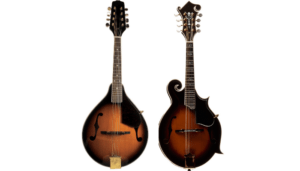
A-style and F-style, side by side

A-styleF-style
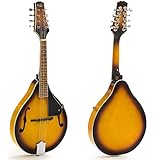
BodySymmetrical teardropTeardrop with a carved scroll at the upper bout and two points
SoundholeTwo f-holes or one oval — both are madeTwo f-holes or one oval — both are made
Sound chamberThe whole bodyThe same body. The scroll and points are solid blocks
Price at matched specThe baselineNear-identical on factory instruments; roughly double where the scroll is carved and bound by hand
StrapNeeds two attachment points, or a tie behind the nutOne end loops straight over the scroll
Held sitting downRests flat on the thighThe lower point acts as a fulcrum against the thigh and lifts the neck
CaseA-shaped onlyF-shaped only — the two are not interchangeable
WeightMuch the same — 2 to 2¾ lb either way, and the model decides it rather than the shape
ResaleSlower, and closer to what you paid at the budget endEasier to sell in bluegrass circles

The scroll is solid wood

Gibson introduced the Florentine scroll on the F-4 in 1902, and the shape has meant “serious mandolin” ever since. It is carved from the same block as the rim, and the cavity inside the instrument stops short of it. The points are the same: solid, decorative, and outside the part of the instrument that moves air.

There is one honest qualification. Weber, which builds both shapes in Montana and is unusually willing to talk about why, fits a maple head block to its F-styles and a mahogany one to its A-styles. The extra mass at the neck joint gives the F a little more midrange bark and sustain. That is a real difference, it is small, and it comes from the block rather than from the scroll — a maker who used the same block in both bodies would not get it.

What the scroll costs depends on who cut it

On a factory instrument the body is cut by machine, and a scroll is one more path in the program. The Loar’s Honey Creek pair is the clearest demonstration on the market: the LM-110 and the LM-310F share a hand-carved solid spruce top, maple back and sides, the same neck and the same hardware, and both sit at around $400.

The pair also shows where a real difference does live. The Loar’s own specifications give the F-style longitudinal tone bars and the A-style an X-brace, so the two do not sound quite the same — the tone bars leave the middle of the top freer to move and give a harder, shorter chop, and the X ties it together for a rounder, longer note. That is a genuine tonal choice, and it is under the top rather than around it. A maker who used the same bracing in both bodies would get the same sound out of both.

Move up to where a person carves and binds the scroll and the arithmetic changes completely. Kentucky’s Standard A-model, the KM-150, is around $595 for a hand-graduated solid German spruce top over solid Alpine maple. The Standard F-model, the KM-650, is the same construction with flamed maple and a hand-carved, hand-bound scroll, and it is around $1,200. The flamed wood accounts for part of that. The scroll accounts for most of it, and binding a curve that tight is some of the slowest work in the whole build.

So the F-style premium is not a fixed percentage. It is close to nothing at the bottom of the market and enormous in the middle of it, and the crossover is roughly where instruments stop being machine-finished. Our guide to what a mandolin costs maps the rest of that range, and types of mandolins covers the shapes beyond these two.

The soundhole is the decision that changes the sound

Two f-holes or one oval hole. F-holes are louder and punchier, with a tight treble attack that cuts through a band — this is where the bluegrass chop lives. An oval hole is sweeter and rounder, with more overtones and more sustain, which suits melody playing, Irish and old-time repertoire, and accompanying a singer.

This has nothing to do with the body shape, and the two get confused constantly because most cheap mandolins happen to be A-styles with f-holes. Gibson’s F-4, built from 1902 to 1934, was an F-style with an oval hole; the F-5 that Lloyd Loar designed in 1922 put f-holes into the same scrolled body. Kentucky sells both today on the plain body — the KM-150 with f-holes, the KM-270 Artist with an oval one at around $695.

And it is not only the hole. Weber tone-bar braces its f-hole mandolins and X-braces its oval-hole ones, so the structure under the top differs as much as the opening in it. That is why an oval-hole instrument does not simply sound like an f-hole one with the treble turned down.

At beginner prices this decision mostly makes itself: nearly everything under $600 has f-holes, and oval-hole models start further up the range. It matters when you buy your second mandolin, and it is worth knowing before you assume a higher model number is simply a better version of the one below it.

What the points are actually for

Calling the F-style shape pure decoration is not quite right either. It does nothing acoustically, but it does several things in your hands.

  • The lower point sits against the thigh when you play sitting down and acts as a fulcrum, lifting the neck to a better angle without a strap.
  • The upper point gives the left hand a landmark to find when it moves up past the body join.
  • The scroll takes a strap end directly. An A-style needs a button fitted at the heel, or a strap tied around the headstock behind the nut, which is the arrangement most players end up with and which nobody much likes.

None of that is worth doubling your budget for. It is worth knowing that the shape has reasons behind it beyond looking like Bill Monroe’s.

Two costs that arrive with the shape

A mandolin case is cut to the outline of the body. An A-style case will not close over an F-style at all, and an F-style case leaves an A-style rolling around inside it. Buying a case second-hand, or accepting one thrown in with a bundle, is where this catches people out — check the shape on the case as carefully as on the instrument.

Straps divide the same way. An F-style strap is a single length with a lace at one end for the scroll; an A-style strap needs two attachment points, and if the instrument only has one button at the tail you will be tying the other end to the headstock.

Bluegrass, and whether it has to be an F

Bill Monroe played a 1923 Gibson F-5, and the shape has been the uniform of the music ever since. The sound that made it famous came from f-holes, a hand-carved graduated top and the right hand — none of which requires a scroll. An A-style with f-holes and a carved top will chop just as hard, and at the beginner end it will do it with more of your money in the top and less in the outline.

See also  How To Tune A Mandolin (Easy Step-By-Step Guide)

The counter-argument is social rather than acoustic, and it is not nothing: if you intend to stand on a bluegrass stage, an F-style is what people expect to see, and it is easier to sell on. Our bluegrass mandolin guide goes further into chop and tone.

Six worth buying

MandolinStyleTopPrice bandBest for
The Loar LM-310F-BRBFHand-carved solid spruce~$400The scroll, at no extra cost
The Loar LM-110-BRBAHand-carved solid spruce~$400The same instrument, plain body
Ibanez M522SFSolid spruce~$350Cheapest F-style with a solid top
Ibanez M510ASpruce laminate~$200A well-built cheap one
Kentucky KM-150ASolid spruce, solid maple~$595Buying once
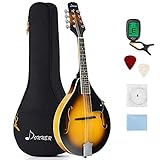
Donner DML-1ALaminate mahogany~$100Finding out whether you like it

The picks in detail

№ 1 · Best F-style

The Loar LM-310F-BRB Honey Creek

  • F-style
  • Hand-carved solid spruce top
  • Maple back & sides
  • f-holes
  • ~$400

The Loar exists to build 1920s-style carved instruments at prices that do not require a 1920s income, and the Honey Creek line is the entry point. The top is carved and graduated rather than pressed to a uniform thickness, which is the difference between a solid top that works and one that is merely solid. It gives the dry, barking chop that bluegrass rhythm is built on, and it opens up as it is played.

The reason it sits at the top of this particular page is the price tag beside its A-style twin. Everywhere else, wanting the scroll means giving something up elsewhere in the instrument. Here it does not.

Pros
  • Hand-carved solid top at a laminate-adjacent price
  • No premium at all for the F-style body
  • Real bluegrass chop rather than a polite strum
Cons
  • Plain satin finish and ordinary hardware
  • Padauk fingerboard rather than ebony
  • Wants a setup before it plays its best
№ 2 · The same instrument, A-style

The Loar LM-110-BRB Honey Creek

  • A-style
  • Hand-carved solid spruce top
  • X-brace
  • Maple back & sides
  • Ebony bridge, bone nut
  • ~$400

The same hand-carved top, the same maple body and the same money in the plain shape, and the direct comparison that makes the rest of this page checkable. The Loar does brace the two differently — an X under this one, tone bars under the F — which rounds the note off and lets it ring a little longer here. It sits more comfortably against the ribs and it is easier to play sitting on a sofa — which is where most mandolins get played, whatever anyone buys them imagining.

The ebony adjustable bridge and bone nut are worth noticing at this money. Both are parts that cheaper instruments fake in plastic, and both affect how cleanly notes come out.

Pros
  • Bone nut and ebony bridge at $400
  • No scroll or points digging in when you play sitting down
  • Same carved top as the pricier Loars
Cons
  • Needs a strap button fitted, or a headstock tie
  • Plain finish that will not turn heads
№ 3 · Cheapest F-style worth owning

Ibanez M522S

  • F-style
  • Solid spruce top
  • Rosewood fingerboard
  • f-holes
  • ~$350

The least you can spend and still get an F-style with a solid top. Ibanez builds to a price with machine precision rather than hand work, so the top is pressed to an even thickness instead of graduated by feel. The result is brighter and more consistent than the Loar, and less characterful.

Fifty dollars below the LM-310F, and the Loar is the better instrument for that fifty. The gap is small enough that liking the gloss finish is a defensible reason to choose this one instead.

Pros
  • Solid top for the price of a good laminate
  • Consistent build — fewer duds than the budget field
  • Bright and articulate in an ensemble
Cons
  • Pressed rather than hand-carved top
  • Less depth than the Loar sitting just above it
№ 4 · If you are buying once

Kentucky KM-150

  • A-style
  • Hand-graduated solid German spruce top
  • Solid Alpine maple back & sides
  • f-holes
  • ~$595

Solid wood all the way round, hand-graduated, and the instrument most players who stay with the mandolin end up at. It is also the clearest illustration of this page’s argument: Kentucky’s F-model equivalent costs roughly twice as much, and the difference in what reaches your ears is nowhere near twice.

Budget for a setup on top. Some shops include one along with a gig bag at the same headline price, so it is worth looking at what is in the box rather than only at the number.

Pros
  • All-solid construction at well under $600
  • Hand-graduated top rather than pressed
  • Holds its value and its tone for decades
Cons
  • Two hundred dollars more than the carved-top Loars
  • Plain appointments for the money

Below $350 the question answers itself, because a solid top is out of reach and the scroll would eat the whole budget. The Ibanez M510 at around $200 is the best-made cheap mandolin going, and the Donner DML-1 at around $100 arrives with a tuner and a bag and is enough to find out whether the instrument suits you. Both are A-styles, and at that money that is the right answer rather than a compromise. Our beginner mandolin guide covers the cheap end properly.

Frequently asked questions

What is the difference between an A-style and an F-style mandolin?

The body outline. An A-style is a symmetrical teardrop; an F-style adds a carved scroll at the upper bout and two points. Both are solid wood outside the sound chamber, so the difference is visual and ergonomic rather than acoustic.

Do A-style and F-style mandolins sound different?

Not because of the shape. The soundhole, the top and how the top has been graduated decide the sound. Some makers pair the F-style body with a heavier head block, which adds a little midrange and sustain, but that is a construction choice rather than a consequence of the outline.

Why are F-style mandolins more expensive?

Because carving and binding the scroll takes skilled hours. Where a machine does the cutting, those hours do not exist and the premium nearly vanishes — The Loar charges the same for its A and F Honey Creek models. Where a person does it, the premium is large: Kentucky’s Standard F-model is around double its Standard A-model.

Which is better for a beginner?

An A-style, unless you have found one of the pairs priced the same. It costs less or the same, it is more comfortable to hold sitting down, and every dollar of the price went into parts that make sound. The exception is if the look is what will get you to pick the instrument up, which is a better reason than it sounds.

Do I need an F-style for bluegrass?

No. You need f-holes and a carved top. The scroll is tradition, and a strong one — it is what a bluegrass audience expects to see, and F-styles change hands more easily second-hand.

Can an A-style mandolin have an oval hole?

Yes, and so can an F-style. Kentucky’s KM-270 is an oval-hole A-style; Gibson’s F-4 was an oval-hole F-style for thirty years. Body shape and soundhole are separate choices, and mixing them up is the most expensive mistake available on a mandolin spec sheet.

Will one case fit both?

No. Cases are cut to the body outline, so an A-style case will not close over an F-style and an F-style case leaves an A-style loose. Check the shape before buying, particularly on bundles and second-hand cases.

So which one?

If you want the scroll, buy the Loar LM-310F and take the one moment in the market where it costs nothing. If you do not, buy the LM-110, which is the same build in the plain body, and put the saved decision toward a setup instead.

Above that, the scroll stops being free and the honest advice reverses: at $600, at $1,200, at $3,000, an A-style is more instrument for the money every time, and the Kentucky KM-150 is where most players stop. See best mandolin for the money for the rest of that argument, and how to tune a mandolin once one arrives.

Leave a Comment