Don’t know which accordion to get or what to look for? We’re here to provide a great starting point with the wonderful selection of accordions that we review in this article.
You can then have the peace of mind that you are choosing a top of the line option for a beginner to learn how to play.
Whichever accordion you decide to get, you’ll be set up with an instrument that will live up to your expectations and will provide a comfortable experience for you as a beginner accordion player.
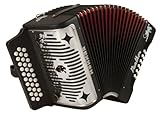
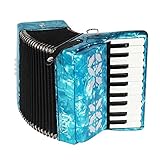

Table of Contents
- Best Beginner Accordions
- #1 Hohner Panther Accordion – Best Button Accordion
- #2 Trinity College AP-2248 Concertina – Best Concertina Accordion
- #3 Hohner Accordion 1304
- #4 Rossetti 31-Key Accordion ROS3112-GCG-MEX
- #5 Hohner D40 Concertina
- #6 Rossetti 34-Key Accordion ROS3412-FBE-BL
- #7 Wal Front 22-Key 8 Bass Piano Accordion
- #8 Montanari 3112 G FA Azul FBE Accordion
- Choosing An Accordion For Beginners – Buying Guide
- FAQ
Best Beginner Accordions
#1 Hohner Panther Accordion – Best Button Accordion


If you love the look of an accordion in the classy color of black, then the Hohner Panther G/C/F 3-Row Diatonic Accordion is the one you need to get. It looks super snazzy in the color black, which will elevate your joy and enthusiasm as you learn to play this fine quality accordion.
This accordion is furnished with the ability to play in the key of G, C, or F. It is designed to incorporate the usage of thirty-one buttons. It has twelve bass buttons as well as the implementation of double strap brackets. It comes with a cleaning cloth and straps for added convenience.
You’ll also be well on your way to learning how to use this fine quality instrument in the right way, due to the inclusion of the Hohner Diatonic Method Book.
This is really an accordion that offers so much value.
#2 Trinity College AP-2248 Concertina – Best Concertina Accordion


The Trinity College AP-2248 English Style Concertina is a wonderful quality accordion that allows for intuitive music playing. This instrument is so enjoyable that you will just want to pick it up and start pressing the buttons right away.
Once you get more comfortable with it, it will become an instrument that you will never want to put down. This accordion is well made and has terrific features that will allow you to make clear music that is fun and beautiful.
This is a great accordion to use when you want to create music for personal enjoyment or even to entertain crowds. Even if you are just a beginner accordion player, looking to level up your skills, crowds will enjoy listening to you play your favorite songs, as this accordion keeps up well with the pace of the song and provides notes that are clear.
The volume also is exceptional, so that it can be heard well even by large crowds. That being the case, you’ll be pleased with the consistency of tone across different volumes. Moreover, the notes do not fade away when you are playing this impressive accordion.
#3 Hohner Accordion 1304


The Hohner Accordion 1304 is a nifty accordion that has been designed both with high style and comfort in mind. Many new accordion players indicate that this accordion is their most preferred beginner accordion that is available on the market today.
If you’re interested in getting a good quality accordion that will offer an optimal experience for you as a beginner accordion player, then this is definitely the accordion that you should consider getting. You will appreciate the conveniences of the double strap brackets.
This accordion is easy to play due to the treble buttons, bass buttons, and chord buttons being easy to reach. As a result, it is easy for beginners to learn to play wonderful quality accordion music with this finely crafted instrument.
The body of the accordion moves with great agility, so that you do not have to worry about this accordion jamming up when you are in the middle of playing your favorite song.
#4 Rossetti 31-Key Accordion ROS3112-GCG-MEX


When the quality of the grill of the accordion is of prime importance to you, then you need to get the Rossetti 31-Key Accordion ROS3112-GCG-MEX. The grill of this impressive accordion is highly refined with the presence of four cutouts in the corners. This will help to amplify the volume of the music as well as add to the clarity of the tone of the music.
This accordion helps to make your songs have more of a professional resonance when you are playing this finely crafted instrument, whether for your own enjoyment or when you want to entertain a crowd.
This is a well proportioned accordion that does not seem too bulky, as the height and depth of this accordion are well coordinated with each other. You will be thrilled with how nice this instrument sounds overall. It does not have a grating or screeching sound that some other accordions can sometimes have.
Also, each note is carried out with full completion when you push the keys and buttons of this accordion. No notes ever drift off midway. Your music will sound exactly as it should every time you play this delightful accordion.
#5 Hohner D40 Concertina


The Hohner D40 Concertina is a wonderful accordion that has been crafted with an exquisite Anglo-German style. This fine quality accordion features twenty buttons along with forty reeds. Also, for your convenience, there is the inclusion of a gig bag.
Many consumers feel they are getting a great value when they get this accordion, as it performs ultra well for an advanced accordion, and it is reasonably priced. This is a high quality accordion that will provide many hours of pleasant usage. This accordion is equipped to live up to all your expectations.
When it comes to the world of accordions, concertinas have a powerful established presence. This is due to the fact that they are small in size and they are highly convenient as a result of being light in weight.
As a result, musicians who travel a lot enjoy this quality concertina accordion. This accordion is easy to play and submits to your commands with relative ease for a superior user experience every time.
#6 Rossetti 34-Key Accordion ROS3412-FBE-BL


If value is of prime importance for you when you are buying different kinds of musical instruments, and you want to add an advanced accordion to your repertoire of instruments, then you need to get the Rossetti 34-Key Accordion.
Indeed you do get terrific value when you invest in this instrument. This accordion is thrilling to use, and it features twenty buttons as well as forty reeds. This accordion produces a wonderful range of sounds.
This is a fun accordion for usage at home to enjoy with the family, or even to entertain groups, such as at weddings, parties, anniversaries, graduations, baby showers, and even concerts.
This is a great accordion in large part due to the fact that it is highly versatile for different types of music that you like to play, and it is super easy to transport due to being ideally light in weight, which many players appreciate.
#7 Wal Front 22-Key 8 Bass Piano Accordion


If you’ve been frustrated that the keys of other accordions that you have tried have stuck at inappropriate times, such as when you were in the middle of your performance, then it is understandable that you definitely want the reassurance that the new accordion that you are seeking will not do that ever again.
You can have that confidence when you get the Wal Front 22-Key 8 Bass Piano Accordion. The keys will not stick and you will, therefore, be able to complete your songs with finesse. As soon as you see and try this accordion for the very first time, you will realize just how high the quality of this finely crafted instrument really is.
It will provide many long hours of playing enjoyment for you, as well as anyone in the crowd that you’re entertaining with great accordion music. This instrument will surely make any party or celebration even more fun with the terrific sounding music that it produces every time. It comes with straps for extra convenience, which have been designed with your comfort in mind.
#8 Montanari 3112 G FA Azul FBE Accordion


Once you try the Montanari 3112 G FA Azul FBE Accordion, you will want to play it as much as possible. This is due to the fact that it is a pleasant sounding accordion that is comfortable to play. It is able to accommodate long playing sessions, which adds to the thrill of the user experience.
You will be pleased that the buttons do not stick when you are playing this accordion. Moreover, the bellows function superbly well, for the optimal enjoyment of music for yourself and those who love to listen to accordion music.
It plays the major and minor keys superbly well, so that your music always sounds full and beautiful – just the way that you expect it to be. This well constructed accordion will not falter, and will surely see you through all your accordion music adventures. Indeed, this is a strong and durable instrument, which will last for many years and will be up to regular usage for extended periods of time.
This accordion also makes a great gift for that special someone whom you realize is looking for a more advanced option that will benefit them and their intermediate-level skills.
Choosing An Accordion For Beginners – Buying Guide
Type Of Accordion
There are 3 main types of accordions that you should know about:
- Button
- Piano
- Concertina
Button accordions are a type of accordion that uses a button keyboard instead of piano keys. Also known as diatonic accordions or melodeons, button accordions are popular in many traditional music genres, including Celtic, Cajun, and Zydeco. Unlike piano accordions, which have a uniform layout of keys, button accordions have different notes on the push and pull of the bellows, which allows for more versatility in playing different keys. Button accordions come in various sizes, ranging from small models designed for children to larger models with up to four rows of buttons.
Button accordions are considered easier for beginners.
Piano accordions, also known as chromatic accordions, are the most popular type of accordion worldwide. They feature a keyboard similar to a piano, with buttons or keys that produce different notes when pressed. Piano accordions are versatile instruments that can be used in a wide range of musical styles, from folk and classical to pop and rock. They typically have a range of between 26 and 45 treble keys and 12 to 120 bass buttons, and they come in different sizes, ranging from small models that are easy to carry to larger models that are more suitable for professional use.
Concertina accordions, also known simply as concertinas, are a type of accordion that uses a unique bellows and button system. Unlike button and piano accordions, concertinas produce the same note regardless of whether the bellows are pushed or pulled, making them particularly suited to playing fast and complex melodies. Concertinas typically have a hexagonal or octagonal shape and can have between 20 and 60 buttons on the treble side and between 12 and 24 buttons on the bass side. They are popular in many folk and traditional music genres, particularly in Ireland and England, where they are used in dance music and pub sessions.
PRO TIP: When you’re getting your first accordion, pick up an instructional book that covers a wide variety of songs so that you can find your favorite style. This accordion book features 50 different songs ranging from standards to popular songs to folk music and showtunes.
Accordion Sound
The sound of an accordion can vary widely depending on a number of factors, including the type of accordion, the number and quality of reeds, and the materials used in construction. For example, a piano accordion with a larger number of reeds will generally produce a fuller and more complex sound than one with fewer reeds. Similarly, an accordion with higher-quality reeds made of materials such as steel or brass will typically have a richer and more vibrant sound than one with lower-quality reeds made of plastic or aluminum.
Another factor that can influence the sound of an accordion is the type of music it is used to play. Different types of accordions are often associated with specific musical genres, such as Cajun, polka, or tango music. As a result, an accordion that is well-suited for one style of music may not produce the same quality of sound when played in a different style. In addition, the playing technique used by the musician can also affect the sound of the accordion, as different bellows techniques can produce different tonal qualities.
Accordion Brand
Just like every other product on the face of the planet, the more respected the brand the more expensive it’s going to be – but it also means higher quality and better sound and features.
Best Accordion Brands
- Hohner
- Ammon
- Rossetti
Budgeting for an Accordion
Another factor in deciding which accordion to buy is how much you want to spend. Accordions aren’t cheap, but you can lower the price with diminishing features and quality.
This is totally up to you to think about before throwing your hard earned money into something that you might regret later.
PRO TIP: Whatever your budget, try to make room to pick up a case along with your instrument. This accordion case brings hardshell protection that will save you from bumps and bruises over the years.
FAQ
What is an accordion, and how does it work?
An accordion is a musical instrument that consists of a set of bellows and buttons or keys. When the bellows are squeezed and expanded, air flows over reeds inside the accordion to produce sound.
What are the different types of accordions available for beginners?
There are several types of accordions available for beginners, including piano accordions, button accordions, and diatonic accordions.
How much do beginner accordions usually cost?
Beginner accordions can range in price from around $200 to $1000, depending on the type and quality of the instrument.
What features should I look for when choosing an accordion for a beginner?
When choosing an accordion for a beginner, look for features such as a lightweight design, adjustable straps, and a comfortable keyboard or button layout.
Is it better to buy a new or used accordion for a beginner?
While used accordions can be less expensive, it is important to inspect them carefully before buying to ensure they are in good condition and will not need costly repairs.
Can children learn to play the accordion, and what size should they use?
Children can learn to play the accordion, and there are smaller-sized accordions designed specifically for kids.
How long does it take to learn to play the accordion?
The amount of time it takes to learn to play the accordion can vary, but with consistent practice, beginners can typically start playing simple songs within a few weeks or months.
Are there any online resources or courses that can help me learn to play the accordion?
There are many online resources and courses available to help beginners learn to play the accordion, including instructional videos, online lessons, and mobile apps.
Do I need any special equipment or accessories to play the accordion?
In addition to the accordion itself, beginners may need accessories such as a shoulder strap, a case, and a music stand.
How do I take care of my accordion and keep it in good condition?
To keep your accordion in good condition, it is important to store it properly, clean it regularly, and have it serviced by a professional if necessary.
