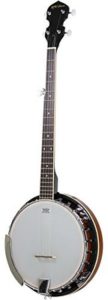
Three hundred dollars is enough to end up with a banjo that plays properly. It is not enough to buy one. Everything in this bracket arrives with the bridge loose in the box and the action set by nobody, and the difference between an instrument you keep and one that goes under the bed is almost entirely what happens to it after it lands. That is why the banjo recommended here costs a hundred and seventy-five dollars, and why the rest of the budget has a job.
Jameson 5-String Banjo
A five-ply maple and mahogany shell, a Remo head, a truss rod, a geared fifth peg and a resonator that unbolts in a minute, for around $175. Spend the remaining hundred on having it set up and you finish under the limit with a banjo that outplays anything bought raw at $300.
At a glance
| Banjo | Back | Rim | Brackets | Price band | Best for |
|---|---|---|---|---|---|
| Jameson 5-String | Removable resonator | 5-ply maple and mahogany | 24 | ~$175 | The whole budget, spent well |
| Ortega Americana OBJ150OP | Open back | Mahogany ply | 18 | ~$300 | One object, straight out of the box |
| AKLOT Open Back | Open back | Maple | 18 | ~$150 | Clawhammer and old-time |
| Vangoa 5-String | Removable resonator | Mahogany | 24 | ~$200 | Not knowing which music yet |
| Gold Tone AC-1 | Open back | 11″ composite | 16 | ~$315 | Arriving already adjusted |
What $300 actually buys
Below $200 it is one banjo wearing different badges
Put the specifications side by side and they stop being different products. A plied maple and mahogany shell, a mahogany neck, a stained hardwood or purpleheart fingerboard, a drum head, twenty-four brackets, an adjustable tailpiece, a chrome armrest, an adjustable truss rod, a geared fifth-string tuner. The Jameson and the Vangoa read almost identically, down to the bracket count, and what separates $145 from $200 is mostly what else is in the carton — a bag, a clip-on tuner, a strap, a handful of picks, a spare set of strings.
None of that is a reason to avoid them. It is a reason to buy the cheapest one whose specification you like and keep the change.
Between $200 and $300 the instrument barely moves
This is the stretch that gives the page its problem. Doubling the budget from $150 to $300 changes the wood on the fingerboard, sometimes the finish, occasionally the badge on the headstock — and leaves the parts that decide how a banjo plays exactly where they were. The rim is still plied. The head is still a stock Remo. Nobody has touched the bridge, the nut slots or the neck relief, because at this price nobody does.
Pyle makes the point for you. Their PBJ140 sits at $200 with 24 brackets, an armrest, a geared fifth peg and a sapele resonator, and the fingerboard it gives you for the extra forty dollars over their own $160 banjo is engineered wood rather than the rosewood on the cheaper one. Money spent inside this band moves sideways as often as up.
The one instrument in the band that is genuinely designed rather than commissioned is the Ortega Americana, and even there the honest comparison is close: Ortega publishes a full specification for it and put their name on it, which the import brands do not, but on paper it gives you a rosewood fingerboard and a satin finish in exchange for a hundred and twenty-five dollars and six brackets.
Brackets are the number nobody should be counting
Bracket count is the specification the budget banjos compete on hardest, and it measures almost nothing. Gold Tone puts sixteen on the AC-1, a banjo they draw themselves and adjust before it leaves the workshop. Ortega puts eighteen on the Americana. The $150 imports put on twenty-four. More hooks pull the head down at more points, which matters at the margins and is worth roughly nothing set against whether the bridge is standing in the right place.
The same goes for the words on the shell. Mahogany, sapele, nato and okoume are all being used to make the same laminated pot, and none of them is audible through a plastic head under a bridge nobody has positioned.
The setup is the upgrade
A banjo arrives with the bridge lying loose under the strings, and where it ends up standing decides whether the instrument plays in tune at the twelfth fret. Add to that the nut slots, which come cut high enough to make the first three frets hurt, and the neck relief, which is what the truss rod is for. A shop will do all of it for $50 to $100, and it does more for how a banjo plays than any specification on this page.
Which is the whole arithmetic of a $300 budget. A $175 banjo that has been through a workshop plays better than a $300 one that has not, and it costs less. Our guide to what a banjo costs goes through the rest of the ownership numbers.
Open back or resonator, decided by the music
A resonator is a wooden bowl bolted to the back that throws the sound forward. It makes the banjo louder and harder-edged, which is what bluegrass wants and what a clawhammer player is usually trying to get away from. It also adds two or three pounds to an instrument you will be holding for an hour at a time.
If you already know which music you are heading for, that settles half of this page. If you do not, buy something whose resonator unbolts and decide later — the Jameson and the Vangoa both do. Open back against resonator covers it properly, and the styles themselves are in bluegrass banjos and clawhammer banjos.
The picks
Jameson 5-String Banjo
- Removable mahogany resonator, two thumbscrews
- Five-ply maple and mahogany shell
- Remo Weatherking head, 24 brackets, chrome armrest
- Purpleheart fretboard, 5/8″ maple and ebony bridge
- Adjustable tailpiece
- Adjustable truss rod, geared fifth-string tuner
- ~$175
Everything a banjo has to have and nothing it does not. The resonator comes off with two thumbscrews, so one instrument covers bluegrass and clawhammer while you find out which of them you are — the single most useful feature at a price where nobody knows yet. The truss rod means a neck that goes out of line can be brought back rather than lived with, and the geared fifth peg holds where a friction peg slips.
It is also the banjo with by far the longest record behind it in this bracket, gathered over more than a decade of being what people buy when they ask this question. That is worth something on an instrument nobody inspects before shipping, because it is the only evidence available that the average one is fine.
What it does not give you is consistency. Two of these can arrive playing quite differently, and the fix for that is the setup the rest of your budget is paying for.
- The longest track record of anything in the bracket
- Resonator off in a minute, so the music can stay undecided
- Truss rod and a geared fifth peg
- Leaves $100 of a $300 budget for the setup
- Unit-to-unit variation; two can play quite differently
- Heavy with the resonator on, as all of these are
- Nothing about it is designed, only assembled
Ortega Americana OBJ150OP-WB
- Open back, mahogany ply rim, satin whiskey burst
- Mahogany neck, rosewood fingerboard with dot inlays
- 22 frets, 31 mm (1.22″) nut, adjustable truss rod
- Remo coated head, 18 brackets, built-in chrome armrest
- Maple and ebony bridge, die-cast chrome tuners
- ~$300
The one banjo under the limit that a company with a catalogue and a published specification put its own name on. Ortega lists every part of it — the rosewood board, the coated Remo, the maple and ebony bridge, the nut width to the millimeter — which is not something the brands below can be asked for at all, and it means the instrument you receive is the instrument that was described.
The coated head is the quieter, warmer choice against the frosted heads elsewhere here, and on an open back that suits old-time playing rather than fighting it. The satin finish is thinner than the high gloss the import banjos wear, and the armrest is part of the design rather than an afterthought bolted through the tension hoop.
The unflattering part is the arithmetic. Set the specification beside the Jameson’s and the gap is a rosewood fingerboard, a satin finish and a maker’s name, for a hundred and twenty-five dollars — and the Ortega has six fewer brackets. It is the better-made object. It is not, out of the box, the better-playing one, because neither has been adjusted. Take this if the banjo is going to be bought and played and never taken anywhere.
- A published specification from the company that made it
- Rosewood board and a coated Remo, unusual at the price
- Armrest built in, satin finish rather than heavy gloss
- An open back that is meant to be one, not a resonator removed
- Nearly twice the Jameson for a specification barely ahead of it
- Too new to have any owner record behind it
- Open back only, so bluegrass volume is off the table
- Still arrives unadjusted, like everything else here
AKLOT 5-String Open Back
- Open back, maple throughout, tiger maple rim
- Remo head, 18 brackets
- Two-way adjustable truss rod
- Gig bag, tuner, strap, picks, spare strings, bridge ruler
- Built in a 39″ full size and a 23″ short scale
- ~$150
An open back at a price where most banjos in this bracket are resonator instruments with the bowl glued on. Maple all the way through gives a brighter, drier voice than the mahogany-shelled banjos, and with no resonator behind it the sound stays where a clawhammer player wants it — quieter, closer, easier to sing over. It also skips the two or three pounds a resonator adds, which is the difference between an instrument that gets picked up and one that does not.
The two-way truss rod is the specification worth noticing. Most rods at this price only pull one way, so a neck that has gone the wrong direction cannot be corrected at all.
AKLOT builds this body in two sizes and they are different instruments — the 39-inch is the full-size five-string described here, the 23-inch is a short-scale banjo pitched for a much smaller player. Make sure you are getting the 39-inch one.
- A real open back rather than a resonator banjo undressed
- Two-way truss rod, which most of this bracket lacks
- Lightest of the sub-$200 picks by a clear margin
- Arrives with almost everything a beginner needs
- Too quiet for a bluegrass jam, and no resonator to add
- Maple is brighter than some players want for old-time
- Comes in a short-scale size that is easy to order by mistake
Vangoa 5-String Banjo
- Arched mahogany resonator, removable
- Remo frosted head, 24 brackets
- Sealed geared chrome tuners, geared fifth peg
- Adjustable truss rod
- Gig bag, tuner, strap, picks, spare strings
- ~$200
The same recipe as the Jameson with a heavier arched resonator and a fuller accessory kit. The frosted Remo is the brighter, snappier head, which flatters fast fingerpicking and gives a clearer note under a bluegrass roll; take the resonator off and you have a mellower open back for the price of two thumbscrews.
Worth knowing before you order: Vangoa builds this body several ways, and the one described here is the steel-strung acoustic with the frosted head. The same shape is also sold as a nylon-strung banjo and as an electric, and those are different instruments with different strings, different tension and a different job.
At $200 it is the dearest of the import banjos here and the specification does not move much beyond the Jameson’s. What it does buy is a kit you will otherwise assemble one piece at a time.
- Resonator off in a minute, so one banjo covers both styles
- Frosted Remo, which suits fingerpicking
- Most complete accessory kit of the picks
- Sealed geared tuners throughout
- Twenty-five dollars more than the Jameson for the same recipe
- Sold in nylon-strung and electric versions that are easy to confuse
- Shorter owner record than the Jameson
Fifteen dollars over the line
The next real step in a banjo is not at $350 or $400. It is at $315, and it is worth saying plainly because a reader holding three hundred dollars is fifteen away from a different class of instrument.
Gold Tone AC-1
- Open back, 11″ composite rim, 11″ Remo LC frosted head
- Mahogany neck, rosewood fingerboard, 22 frets, 263⁄16″ scale
- 13⁄16″ Zero Glide nut, two-way adjustable truss rod
- Maple bridge with an ebony cap, 16 brackets
- 3.75 lb, gig bag included
- ~$315
Every part of this banjo was chosen rather than sourced, and Gold Tone adjust the instrument in their own Florida workshop before it ships. That last point is the one that matters on this page: it is worth roughly what the setup would have cost you, so the real gap between the Jameson and the AC-1 is closer to eighty dollars than a hundred and forty.
Then there is the weight. Three and three-quarter pounds, against the eight to ten pounds a budget banjo with a resonator runs to. That is the difference between something you pick up out of an armchair and something that lives on a stand, and it appears on no specification list a shopper normally reads. Our guide to what a banjo weighs has the comparison in full.
The Zero Glide nut is the other detail worth the money for a beginner: it stops the tuning drifting every time a capo goes on or comes off. The rim is composite rather than wood, which is why it costs $315 instead of $600, why it weighs what it does and why it does not mind a cold car. Gold Tone warrants an AC-model banjo for five years and the cover transfers with the instrument, on condition it was bought from an authorized dealer.
- Adjusted by the maker before it ships, so no shop trip
- 3.75 lb, less than half what a budget resonator banjo weighs
- Zero Glide nut and a two-way truss rod
- Five-year transferable warranty
- Over the $300 limit, however narrowly
- Composite rim rather than wood
- Open back, with no resonator fitted or offered
Also worth a look
| Banjo | Back | Price band | Why it is not a pick |
|---|---|---|---|
| Pyle PBJ60 | Resonator | ~$160 | Same parts list, no armrest and a friction fifth peg despite what Pyle claims; take it if the budget is really the constraint |
| Pyle PBJ140 | Resonator | ~$200 | Pyle’s dearer banjo, and this one does have the geared fifth peg, plus an armrest, 24 brackets and a bundle of accessories. The catch is the fingerboard: engineered wood, where the cheaper PBJ60 has rosewood |
| Mulucky MB1101 | Open back | ~$170 | Maple open back with 24 brackets; the AKLOT does the same job for less |
| Kmise 5-String | Removable resonator | ~$145 | Cheapest full kit here; sapele back, okoume neck, and no Remo head specified |
What to spend the rest of the budget on
In order. A setup, at $50 to $100, which is not optional and is the reason the top pick here is the cheap one. A clip-on tuner, if one did not come in the box, because a banjo drifts and a beginner who cannot hear it will practice out of tune for months. A fresh set of strings, because the ones fitted at the factory have been on the instrument since it was crated.
What can wait: a case, a strap, finger picks, and the second banjo. If you are starting from nothing, the beginner’s guide and how to tune a banjo are the two to read first.
Frequently asked questions
Is a banjo under $300 good enough to learn on?
Yes, provided it has a truss rod and a geared fifth-string tuner, and provided it gets set up. Without the setup it will play stiff, sound sharp in first position and go dull, and you will conclude that the banjo is not for you when the real problem was a bridge in the wrong place. Everything recommended on this page has the two parts that matter.
What does a setup actually involve?
Standing the bridge in the right place and at the right angle, cutting the nut slots down to a playable depth, setting the neck relief with the truss rod, checking the head tension, and leveling anything that has gone wrong with the frets in transit. A shop will quote $50 to $100 for the lot. It is the single largest improvement available to a banjo in this price range, and it is not something a beginner can do by eye.
Should I buy used instead?
Three hundred dollars goes a long way on the used market and experienced players will tell you so. The catch is that it only works if you can tell a warped neck from a badly set-up one, and at this price the used market is largely banjos that somebody gave up on — which is to say banjos that were never set up either. If you have a player to take with you, buy used. If you do not, buy new and spend the difference at a workshop.
Why is the Gold Tone AC-1 worth going over budget for?
Because it arrives adjusted, which is the thing the rest of this page has to send you to a workshop for, and because it weighs less than half what a budget resonator banjo weighs. Add the setup cost to a $175 banjo and the two land within eighty dollars of each other, at which point the AC-1 is a designed instrument with a five-year warranty and the other is not.
Do more brackets mean a better banjo?
No. Gold Tone fits sixteen to a $315 banjo and the imports fit twenty-four to a $150 one. Brackets pull the head down against the rim, and past a certain number the extra ones are decoration. Judge a banjo in this bracket on whether it has a truss rod, a geared fifth peg and a proper Remo head, and then on what it costs.
How heavy are these?
A full-size banjo with a resonator on it runs to eight or ten pounds, which is a great deal to hold on a strap for an evening. Taking the resonator off a Jameson or a Vangoa saves two to three pounds, an open back like the AKLOT starts there, and the Gold Tone AC-1 is under four. It is the specification beginners never check and complain about most.
So which one?
Buy the Jameson at around $175 and book the setup with the change. That is the best-playing banjo three hundred dollars will produce, and it is not close.
If clawhammer is already settled and the budget is not, the AKLOT open back is the right shape of instrument for a hundred and fifty. If the banjo is never going to see a workshop, spend the whole three hundred on the Ortega Americana, which is the most carefully made thing under the limit. And if fifteen dollars is not the difference between buying and not buying, the Gold Tone AC-1 arrives set up and settles the question for several years. Above it, banjos under $1,000 is where the pot becomes wood.