In quest of getting your hands on the best ukuleles that come from renowned uke brands? How about Fender ukuleles?
But, are Fender’s ukuleles any good?
Just wait until you see how Fender manages to stay on top of the top ukulele brand list.
There are many reasons to invest in Fender ukuleles, namely top-notch quality, vintage models, materials used (tonewood), craftsmanship, not to mention those luxurious series—yes, they’ll have your heart at first sight.
Now, you can even match the capo of your guitar to the finish.

Although Fender is on every guitarist’s tongue these days, it also had a story of struggles and sacrifices, and no one—not even country artists—knew about Fender unless its bass guitars came into existence.
You will wonder that Leo Fender (the founder of the brand) didn’t have any idea about how to play guitars. It was just a hobbyist fascination with amplifiers and radios that he had back then. Then he sought the advice of local Southern California musicians who provided him feedback about his work and passion.
Also, Fender is that brand that used the same color for its guitars and other stringed instruments as cars in the 60s, and they were even named after the cars. Take Shell Pink Stratocaster for example, it’s named after 1956 Desoto Fireflite and the same color i.e., pink has been used.
Table of Contents
- 8 Best Fender Ukuleles
- 1. Fender Montecito Solid Koa Tenor Ukulele
- 2. Fender Venice Soprano Ukulele (Surf Green)
- 3. Fender Fullerton Telecaster Ukulele (Black)
- 4. Fender Zuma Classic Concert Ukulele (Aztec Gold)
- 5. Fender Billie Eilish Signature 2-in-1 Ukulele
- 6. Fender Grace Vanderwaal “Moonlight” Soprano Uke
- 7. Fender Seaside Soprano Ukulele Pack (Review)
- 8. Fender Rincon Tenor Ukulele Review
- FAQs: Fender Ukulele Buying Guide
- Conclusion!
8 Best Fender Ukuleles
Fender’s ukes are one-of-a-kind and top-of-the-line—no doubt. It’s a company that has been appreciated all around the world for its excellent stringed instruments, and its ukuleles are no exception.
But apart from all the goodness that fender ukuleles bring to the table, there is something else about these ukes—not all can afford fender ukes since they’re very expensive.
Not just that, Fender’s ukes and guitars are used by celebrities, artists, and actors, specifically Fender’s Stratocaster—which is a model of electric guitar family—has been notably used by these musicians.
Are Fender’s ukulele beginner-friendly?
Well, it depends. If you’re someone who doesn’t have any problem spending around $200, then yes, they are for you.
But don’t worry, other cheap models are priced around $70 and $100 that you’ll come across on this page.
So, without further ado, let’s jump to the list.
1. Fender Montecito Solid Koa Tenor Ukulele
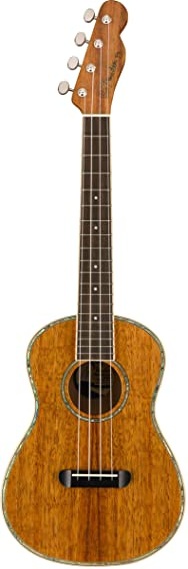
I don’t want to bombard you with tones of Soprano ukes because not everyone is interested in Sopranos, plus these are only for ukulists with small fingers, so I’d rather shed light on other models in the family: tenor and concert ukes.
What’s that one thing that makes Fender’s ukulele stand out?
Well, different people may different opinions about this, but what I feel is that it is a 4-in-line headstock that defines Fender’s style. If you wonder they Fender’s uke or guitars have different headstock than stringed instruments from other brands, read this.
Let’s talk about sound transmission. It’s furnished using Hawaiian koa that is known for producing warm, mellow tones, and revokes a feeling like you’re sitting near an island. Just that’s not all there is to this koa tonewood—there’s more to it than meets the eye, not to mention exotic grain and color.
Koa is known for producing relaxing tones and chatoyancy and perhaps that is why it’s a little pricier compared to other tonewoods. Experts suggest that this is one of the best tonewoods out there, and so do I.
Its abalone top binding and that elegant and stylish rosette are what make it eye-catching. There’s even a gigbag included in the package ensuring that you get the most out of safety.
This Fender uke features a hardtail bridge that means you will be having more control over the tuning. That way, if you try to bend one string, this action won’t de-tune other strings.
So, if you’re looking forward to investing in a uke that doesn’t add maintenance costs, this is the uke.
2. Fender Venice Soprano Ukulele (Surf Green)
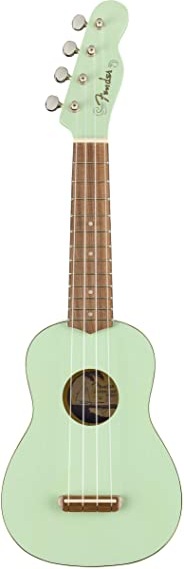
Is it possible to grab a Fender uke under $100 for real?
I know what you’re thinking right now. Even I didn’t believe first that this Venice soprano uke from Fender is up for grabs under 100 bucks, and guess what—I was wrong about that.
Although Fender distinguishes itself from other brands for its next-level and great-sounding guitars, people often end up underestimating its guitalele or ukulele.
It boasts a construction of basswood (which goes into the top, back, and sides) along with a no-tie bridge.
But, what exactly is a no-tie bridge?
A no-tie bridge gives you the freedom to re-string your uke without having to cut or be involved in complex knotting. What’s more, you’ll get to lay your eyes on a 4-in-line painted Tele headstock that gives you a Fender vibe so you could float on the cloud nine while playing your favorite song on this uke. This would also make the string changing process super easy because, after several years, you would want to change the strings.
Since it’s a soprano, it should be noted that it’s recommended for beginners or people with small hands. If you’re having large hands (or fingers), I’d say, go with this one which comes from the Zuma series and is also available in 3 different colors.
It’s a take-anywhere uke; take it to a beach, river, mountain, or one of your favorite with your mates, you’ll fall in love with the portability that it brings to the table.
I wish I could skip this part where I have to shed light on the tone delivery of this because I think you’re already aware of the quality and craftsmanship that Fender’s ukes offer. I mean, since Fender has been in the game for more than 70 years—since 1946, to be exact, so they must know what they are doing.
But I can also assume that you’re a beginner and, therefore, you may not know about the ins and outs of sound transmission of this uke. So, it’d be better if I tell you this.
Since this uke incorporates basswood, you’ll likely get a very rich, fuller sound response.
What I like about basswood is that it is lightweight, meaning you won’t have to feel the extra burden on your shoulder or hands—no matter if you choose to play sitting or standing.
3. Fender Fullerton Telecaster Ukulele (Black)
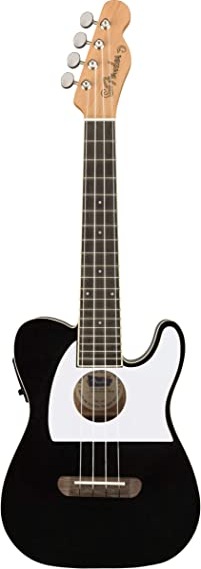
Need a Fender ukulele that looks exactly like a guitar? Meet this Telecaster uke that is nothing short of a guitar. It is aesthetic, boasts a no-tie bridge, and gives you a feeling like you’re playing an electric guitar. I believe it’ll make you smile every time you pick it up.
It boasts a one-of-its-kind telecaster body shape inspired by a solid-body electric guitar. To take it even further, Fender has provided a preamp system in this one that you can use to make the most out of tone controls. What’s more, there’s a built-in tuner—you no longer have to rely on an external clip-on tuner to get things done quicker.
The body is made of top-notch mahogany, spruce goes into the top, and it is equipped with nylon strings. If you’re someone who looks forward to achieving the spirit of rock ’n rock into every song you play on this, then look no further.
If you’re an admirer of the glossy finish, this uke will have your heart at first sight as it is very shiny. Even I’m not a huge fan of the glossy finish, I love its looks—hands down!
I honestly believe that Fender has to do something about their offering of colors because most ukes are only limited to just one color. However, that’s something you won’t have to struggle with in this one as it’s available in 5 colors.
You can choose a Telecaster, Stratocaster, or Jazzmaster style before adding this stylish uke to the card, it’s all up to your personal preference.
If you’re a lefty, I can understand what it feels like to strum a uke with the right hand (i.e. strings are installed in the reversed order, making things messy). Although there is no left-handed version of this uke, if you can’t help but need one, you’d love one of these left-handed ukuleles.
Speaking of the bridge, this one—like most Fender ukes—is furnished with Hardtail Bridge and I’ve already talked about its importance and performance above.
Not interested in this Fender ukulele?
Don’t worry, you’ll love another model below.
4. Fender Zuma Classic Concert Ukulele (Aztec Gold)
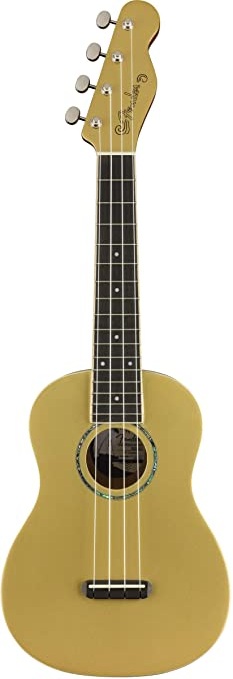
Does Zuma ring any bell? Well, it’s named after the Zuma beach located in Malibu, CA. If you didn’t know, now you know it—you can thank me later!
Crafted using a-one exotic tonewood sapele, it’s going to bring those rich, warm, and woody tones to the table. Its striking stripes can’t go unnoticed—but, that’s what sapele is famous for, right? But there’s more to this uke.
If you’re someone who enjoys a shiny uke you’d love this one as it sports a glossy finish and its one-of-its-kind headstock will make you wow. If you always wanted to choose a uke between a soprano and tenor, this uke would pay homage to Fender tradition.
As you’re reading this article, you may have noticed that Fender’s bridges are a specialty—the pull-through bridge will make the string-changing process a breeze. This uke would be your go-to uke for your studio and leisure.
Like other ukes, this one also features 4 strings that are tuned G-C-E-A because it’s been designed for right-handed people (lefty? See left-handed ukes). An a-one walnut wood goes into the fretboard while the back and body are made of a first-class sapele.
The scale length is 15 minutes so there will be enough space for your hands to move around when you’re busy strumming. Since it’s made of sapele, it is a little heavier than those made of mahogany. And, speaking of the user satisfaction, it gets a 5 out of 5 ratings (as of writing this article); this uke couldn’t get any better—hands down!
Next time you go to Zuma Beach for diving, fishing, or bodyboarding, don’t forget to take this ukulele along because it’ll be a great companion.
5. Fender Billie Eilish Signature 2-in-1 Ukulele
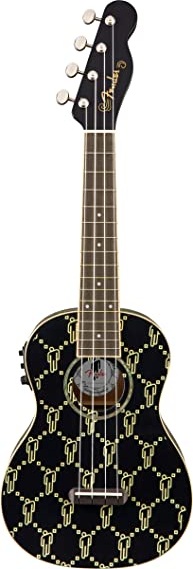
While it’s no wonder that most newbies try to get their hands on an acoustic ukulele. What if you could grab a 2-in-1 uke from Fender—a uke that can be played as an acoustic and electric uke, wouldn’t you get that?
What if I tell you that that uke has been used by famous singer Billie Eilish?
Now, I have your attention, don’t I?
This is a next-level Billie Eilish signature ukulele brought to life by Fender and boasts nylon strings, which means it will offer an extremely smooth strumming experience. Being an electric uke, it’s battery-powered and therefore will require you to use the batteries when you plan to use it on an amplifier. Also, the built-in digital tuner runs on the batteries.
However, if you’re planning to use it as an acoustic uke routinely, there’s no need to install the batteries.
If you’re a stan of Billie, this is the uke you need. It boasts low action and great sound transmission. Plus, there’s a built-in tuner that will help you do the tweaking with the strings for the first few days. Speaking of the amp, it’s up to you; use it with an amp (to boost the sound) or without one.
If you pay close heed to the patterns, you’d see those tiny stick-figures of humans, known as Blohsh and has been taken from Billie’s first major release Blohsh.
Although it’s not made of the most expensive tonal woods available on the market, you’ll still experience those sparkling and rich tones. No matter if you plug it into an amp or you go on playing without it, it’ll resonate well. On top of that, what this uke is famous for is the low action and, therefore, it’s worth the price tag.
So, if you’re a true Billie Eilish fan, I’d say, go for it without a second thought.
6. Fender Grace Vanderwaal “Moonlight” Soprano Uke
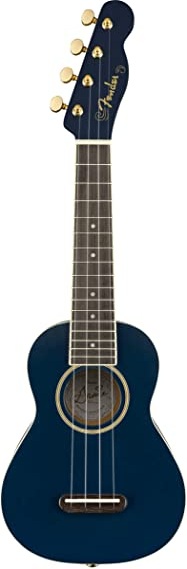
Just like aforesaid uke—which was for Billie Eilish fans—this one is for the admirers of Grace Vanderwaal.
It’s a marvelous uke that is made out of rich mahogany and uses stainless steel, gold-plated hardware, and a sparkly first-class rosette. So, yes, you can say this is a bit fancier than the “Venice” model we went over earlier. Being a soprano uke, it’s good for beginners, especially people with small to medium-sized hands.
If you take a look inside the soundhole, you’ll see a label inspired by the debut album of Grace. It’s packed with a pull-through Bridge that will give you the freedom to change the strings easily. There’s a Fender’s logo on the one side of the headstock, and on the other, you’ll find Grace’s signature.
Its aesthetics are unique, the body is stunning, and it has been designed with all people in mind. Put differently, you can gift to your 5-year-old kiddo or you can have it for your wife/husband for your anniversary—there’s no age bar.
What’s more, it’s a 2-in-1 ukulele, meaning you can use it however you like—i.e., on acoustic mode or when you want to plug it into an amp to make the most of sound amplification.
Though it may look like it features a glossy finish, the truth is, it does not. It comes in a navy blue satin finish (which I personally prefer because it’s neither too shiny nor dull), giving you an option somewhere in between matte and semi-gloss.
In fact, it’s an easy-to-play instrument and, therefore, highly recommended for beginners. I’ve already talked about different tonewoods and the role they play in the sound transmission of a uke, speaking of which, this one boasts a pure mahogany construction.
Having said that, you’ll experience those enticing tones out of this uke, not to mention those nylon strings. If you’re thinking of gifting this uke to someone, you can go on with this. However, if you’re looking for the same model with a bag, you should try out this one as it comes with a gigbag, a tuner, an instructional DVD, and a free Fender trial.
7. Fender Seaside Soprano Ukulele Pack (Review)
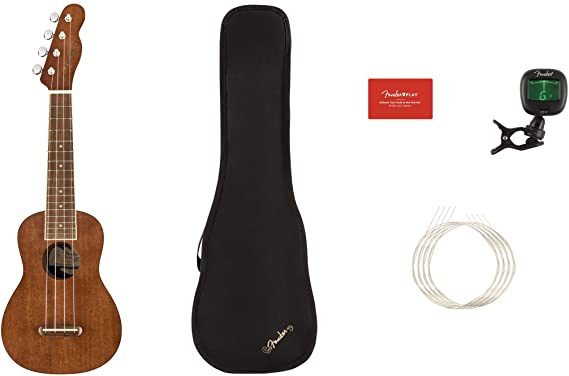
This is another soprano kit from Fender which boasts many of the Fender’s specialties, including a no-tie bridge and 4-in-line headstock. Made using first-class solid koa, this uke guarantees to deliver those warm, bell-like, joyful tones that will bring a big smile to your face.
As you may have noticed that Fender doesn’t provide loads of accessories in most of its uke series, but this one is different as it includes a padded gigbag, spare strings, clip-on tuner, and Fender free trial to help newbies try out premium how-tos on their website.
The headstock indicates that there’s a Fender logo and since it’s no signature uke, you won’t find anything on the other side of the headstock. Although there’s a tuner you can use to start playing right away, if you’re having trouble, a free 3-month subscription will have your back.
It’s highly comfortable and portable. Take it any place you like and play it however you wish, no hiccups in the learning curve whatsoever. Again, this is featuring a hardtail bridge, making the strings changing procedure child’s play.
There’s enough room for hands to move as the scale length is 13.6, speaking of which, it’s a 24-inch uke that will accommodate your hands like a charm. On top of it, you’ll get some basic add-ons in the package that will allow you to get the most of your learning.
So, did this Seaside uke find you enthralling?
If affirmative, don’t wait—strike the opportunity now!
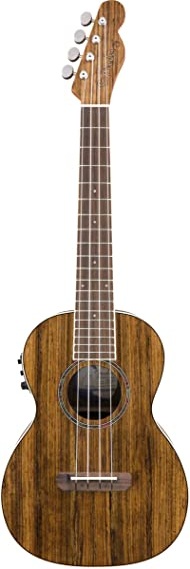
8. Fender Rincon Tenor Ukulele Review
Let’s come clean—unsustainable practices are killing our ethics, and we need to be serious about this.
But first things first, does ovangkol ring the bell?
Well, ovangkol is the same tonewood used in many Martin guitars. What sets this Fender ukulele apart from its counterparts is that it is made out of sustainable wood; yes, ovangkol is sustainable and could help diminish the carbon effect that our mother earth is already suffering from.
So, if you truly care about the environment, you’d definitely consider this sustainable ukulele and make a great positive impact.
Do you struggle while tuning your ukulele? Well, with this one, you won’t have to experience that anymore as it incorporates a pickup system that includes a built-in tuner using which you can effortlessly control the volume, bass, middle, and treble. Its Fender-style headstock—that features silver-plated tuning pegs—will offer you cool vibes, not to mention the ultimate precision.
The material that goes into the neck is nato wood, whereas the solid ovangkol has been incorporated in the top, back, and body. For a perfect intonation, Fender has used top-notch nut and saddle, not to mention those closed-back tuning pegs—no more rattling noises.
The abalone rosette makes it super stylish, which eventually will make you want to play it every single day. Although it’s priced over $200, it’s worth considering the tonal quality it possesses.
Are you concerned about the safety of your uke?
If so, there’s a gigbag included in the kit. The gigbag will keep your uke safe from dusk and bad weather conditions. Since it’s an acoustic-electric ukulele, it can be played by connecting to an amp, but before you that, you should know what you’re doing since it’ll produce an even more strong sound then.
I know this one is a bit pricey, but it’s my favorite because it is made out of using 100% sustainable wood.
FAQs: Fender Ukulele Buying Guide
Q.1: How to Choose a Fender Ukulele?
I’ve tried many ukes from different brands, and I can say that Fender is one of the top brands out there on the market today. Since they’ve been in the market since 1946, they know what they are doing.
There’s a Fender series that goes by the name of “Stratocaster”. You can see the famous names of players who have used guitars from this series right here and then make an intelligent decision.
So, yes, Fender ukes are pretty good—hands down!
Q.2: How to find a budget-friendly Fender Uke?
First things first—what is your budget like?
I know that for some buddies, investing in a top-of-the-line may not be an intimidating task, however, when it comes to those who are just starting out or the people who are on a low budget, the circumstances might be different.
I’m not saying that you must go for a Fender ukulele that is priced around 500 bucks, your budget should be your top priority, but that doesn’t mean you should invest in a cheap uke because cheap isn’t always best.
Q.3: What type of Uke should I choose?
As you have gone over the list, you may have noticed that Fender releases different types of ukes, including acoustic, electric, and hybrid—the acoustic-electric ukulele.
So, it’s up to your personal choice i.e. how you would like to use the ukulele after it’s been delivered. Some people who are a big fan of listening to loud sounds prefer connecting their uke to an external amp, which is only possible if you’re using an electric uke.
Q.4: Where are Fender ukuleles made?
Whether you’re interested in getting your hands on a Fullerton or another one, most Fender ukuleles are made in Indonesia, however, some are made in China. Although manufacturing plays a significant role, the way a uke sounds matters most.
The leaves to the next question.
Q.5: Which tonewood is best for Fender ukuleles?
What you must pay attention to first is the tonewood.
Different tonewoods produce different tones and therefore, it’s important to understand what kind of tone actually need.
My favorite tonewoods include Koa and Mahogany and I always prefer solid wood to laminated one because that offers bright, warm, resonant tones. However, if you pick a solid one, you have to take extra care of it.
Don’t have any idea about tonewood?
No worries—I’ve already explained different ukulele tonewoods types for your peace of mind.
Conclusion!
So there you have it—an unbiased, hands-on review on the 8 best Fender ukuleles. No matter whether you’re buying a Fender ukulele or it’s from some other brand like Kala or others, rules apply to every uke.
Since buying a uke isn’t something you will be doing every single day, you have to be careful with what you buy. The rule of thumb, therefore, is that you must ensure that Fender uke boasts high-quality tonewood, a-one bridge, and nylon strings for an uninterrupted playing experience.
When you’ve taken all such aspects into considerations, you’re good to make a well-versed decision, and when you’re done with that, it’s time for you to make your first tune one on the uke.
Must-reads:
Would you like to continue playing your ukulele even when it’s raining? It’s about time you try this waterman ukulele which is also from Kala.
That’s it for today, I’ll come with a surprise in the next one.
Till then, keep yourself busy in those unique finger-picking patterns!
Need the Best Fender Ukulele?
If this is your first time buying a Fender uke, you can try any of the aforesaid Fender ukuleles, however, If you still can’t make up your mind, you can go with the editor’s choice.
