
One of the questions I often get asked is…
“I’m left-handed. Can I play the ukulele with my right hand?”
Let me be honest with you.
I’m right-handed and I find myself in a difficult position when I try to do things with my left hand—and, there’s a logical explanation for that.
I mean, I can do things with my left hand that I usually do with my right one. However, when it comes to having precision doing some specific things like tightening or loosening nuts and bolts, you have to be careful—i.e., you have to do that with precision.
The same goes with ukulele strumming because it requires extra attention. Even I can’t picture myself holding a uke and strumming with my left hand because there’s always a risk of hurting fingers.
So, can you strum your ukulele with your right hand, considering you’re a right-handed person?
Well, the truth is, some people can while others find it quite hard.
Having said that, not all lefties can master the art of playing on a right-handed uke, and that’s where the left-handed ukuleles come in.
Table of Contents
- Best Left Handed Ukuleles
- Top 6 Left Handed Ukuleles for Lefties
- 1. Donner’s Left-handed Concert Ukulele
- 2. Ranch Left handed Concert Professional Ukulele
- 3. Caramel CT402L All Solid Mahogany Tenor Ukulele
- 4. Kmise Left Handed Mahogany Soprano Ukulele
- 5. Hola Left-handed Concert Ukulele with Padded Gig Bag
- 6. Luna Mahogany Tattoo Lefty Concert Ukulele
- Best Left Handed Ukuleles: FAQs (with Answers)
- The End!
Best Left Handed Ukuleles
The world is an awful place (I’ll explain why).
We can’t deny the fact that this world is meant for right-handed people for the most part. Most things are designed for right-handed people and, therefore, lefty people have to struggle with the situation. That’s because not all lefties can handle things with their right hands.

Remember those numeric keys on your computer keyboard, or scissors, or tape measure? They are only meant for the righties.
Those numeric keys on the right side of the keyboard are not helpful for lefties. The same goes with the scissors sticky, and if you use the tape measure, the numbers are upside down.
These troubles aren’t limited to these aforesaid things, the list goes on and on like this.
Top 6 Left Handed Ukuleles for Lefties
Although the lefties’ experience with doorknobs, DSLR cameras, or a ruler may suck, they no longer have to worry about holding or playing ukulele with their right hand and strum with the right one.
Yes, you read that right, courtesy of brands that are now making left-handed ukuleles!
There are both budget-friendly and top-of-the-next left-handed ukuleles available on the market these days. What’s surprising is that you don’t have to break the bank or pay extra bucks to get a lefty’s ukulele.
Although bazaar for left-handed ukes may look fresh to you, I’ve realized the new brands are entering the market and, therefore, the competition is getting stiffer.
That is the reason why hunting for the best left-handed ukulele is no longer a piece of cake. You have to pay close heed to the build quality of the ukulele—i.e., construction, tonewood, strings, reasonability, etc.
For your serenity, I’ve already put together a list of the 6 best ukuleles that lefties find quite useful. This list includes different types of ukuleles there are in the uke family, such as concert, soprano, baritone, etc., but majorly, the focus is on the left-handed concert ukuleles.
So, without further ado, let’s get started with the first pick we have on the list.
1. Donner’s Left-handed Concert Ukulele
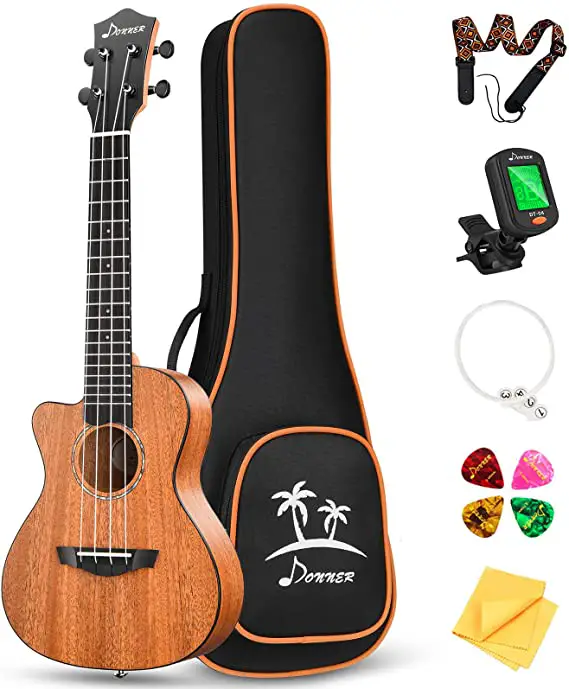
If you’re a lefty and always wanted to get your hands on the best ukulele designed with the left-handed people in mind, look no further—this concert uke is shaped for your eyes.
Following a pure mahogany construction, this uke is ready to produce pleasant and crisp sounds. Plus, those well-made Aquila strings from Italy will offer you the most sought-after tones. If you’re concerned about the playability, you can rest assured—this uke boasts fingerboard rosewood and that bridge that would offer you the same.
Its cutaway design will have your heart in the first place, the same goes with the sami-open finish that comes with a 9-cycle grinding, minimizing the effect of paint on the wood and, therefore, increasing the resonance.
Unlike old ukes, this one features quasi-closed tuning pegs that bring 45% more accuracy to the table. In other words, you won’t have to struggle with the tuning process since, in a new ukulele, that’s something you’ll need to do more often. So, you’ll need to bear with the tuning process until the strings are fully stretched. Some folks believe that they can get over with the process by stretching using their hands, however, that’s something I won’t recommend doing.
It’s not just those warm, rich, and bright sounds that this left-handed uke brings to the table, it’ll exceed all your expectations if we talk about that cutaway design.
As you know that when you order your ukulele, it has to ship from someplace (the seller), and therefore, there are chances for the uke strings to damage along the way. That is why they don’t send you a tuned ukulele to avoid damage in transportation. You have to do it yourself.
This beautiful uke—that is designed for lefties—can be their companion to any journey. No matter if you’re meant to use it for educational purposes or you would like to use it just for fun, you’re good to go.
Use it for online lessons or to inspire creativity while sitting with your friends, this won’t let you down whatsoever—hands down!
Pros
- Made of mahogany
- Next-level design; has cutaway
- Aquila strings for better sound transmission
- Easy protection; offers a padded gigbag
- Includes all accessories
- Sami-open finish (9-cycle grinding)
Cons
- None considering the price
2. Ranch Left handed Concert Professional Ukulele
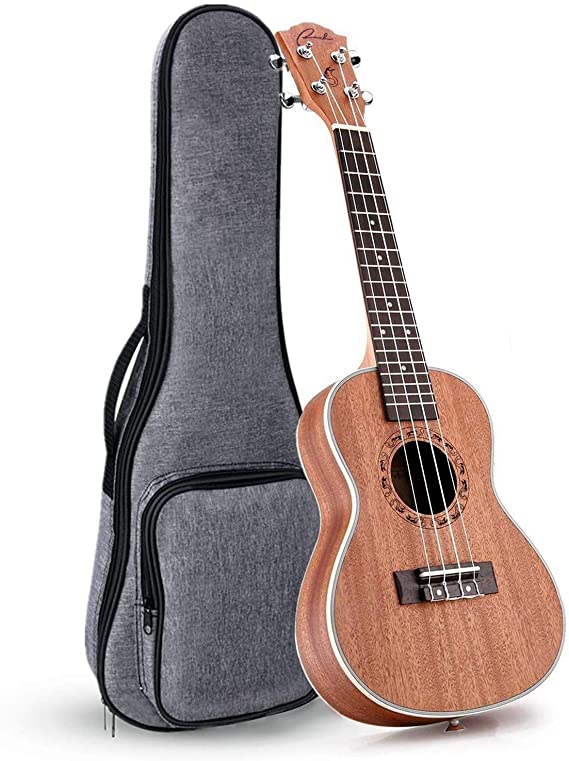
People with small hands find soprano ukes helpful as they are small and easier to hold, and easily accommodate their hands, some folks prefer concert ukuleles to soprano ukes, and then some like to go with the baritone—the people who have large hands.
Whether your favorite uke is a soprano, concert, or a tenor, this left-handed uke from Ranch will have you hooked. Of course, this is made for the lefties so you can rest assured. And unlike right-handed ukes that follow G-C-E-A string order, this left-handed ukulele is having strings in A-E-C-G order. Therefore, you should consider it a jewel.
Now, let’s shed on the specifications so you could have much-needed insights on whether or not this one is made for you.
Crafted with tiptop Sapele, it has won the hearts of thousands of uke players out there. Also, what makes the process easier is that eye-catching and long-lasting strap that keeps the ukulele stable if you like to play standing.
Coming to the sound transmission, it’s packed with high-quality Aquila strings that are known to deliver excellent tones. What’s more, it boasts an arched back that helps strengthen the overall resonance and therefore offers those warm and bright tones.
Speaking of sound, not only does body matter but also bridge and fingerboard play a significant role. However, there’s nothing to worry about—both of these parts of this uke are made of a-one rosewood.
How about the protection? Is there anything that comes with this left-handed ukulele that will offer safety?
Yes, there’s a padded gigbag that keeps the ukulele protected from all unwanted dust, heat, scratches, and whatnot. It’s not just the way this uke sounds, there’s more to the elegance. Although it doesn’t feature any cutaway design, its laser-etched design around the soundhole will make your day for sure.
Pros
- Made of high-quality Sapele
- Available in different sizes
- Lots of colors to choose from
- Follows A-E-C-G string order for lefties
- Arched back for better resonance
- Aquila strings for better tones
- Laser-etched design; stands out
Cons
- Not many accessories
3. Caramel CT402L All Solid Mahogany Tenor Ukulele
If you had a chance to get your hands on a left-handed ukulele used by professional players, would you let the matter rest?
I believe not—not at least if the main attraction is solid mahogany that this ukulele boasts.
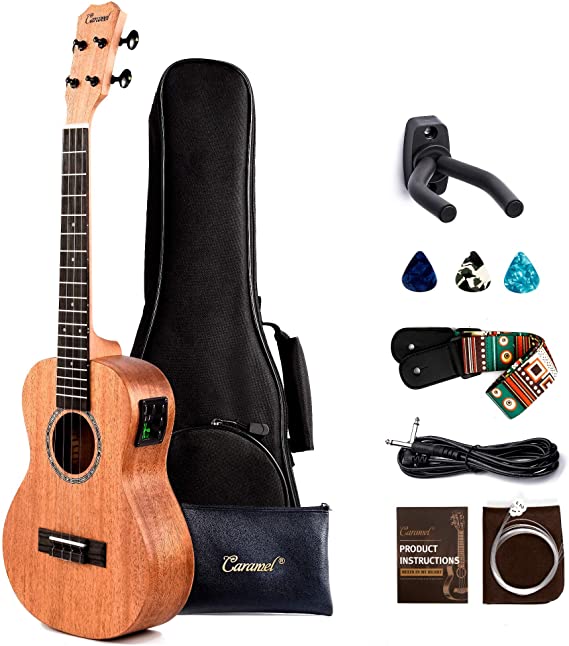
What’s great about this uke is that it is an acoustic-electric ukulele. That means you can either play it as is or you can use an amplifier to amply the sound like never before. Yes, this uke is capable of turning your room into a studio without doing much.
If you’ve already read my take on different uke sizes, you may have already noticed that this one a tenor ukulele. On top of being a 2-in-1 ukulele, it can outshine other ukes like a charm as it comes with all accessories that beginners need and boasts a 3-band EQ along with a built-in tuner—a lifesaver. You can even see what’s going on with the ukulele or tuning in a tiny LCD.
Speaking of the craftsmanship, it couldn’t get any better, and the credit goes to that abalone ring that surrounds the soundhole. Furthermore, there’s a guarantee of precise tuning because it’s packed with 1:18 copper pegs for more stable and finer tuning. To offer you serenity, there’s an extra pack of strings.
To take it even further, Caramel has provided a wall hanger that you won’t see in any other uke pack. There’s an EQ cable as well that will make sure you get the most out of your sound production.
Frets are well-finished and the fretboard is smooth so you don’t cut your fingers playing strumming your uke. The same goes with the left-handed nylon string design. This is a G-C-E-A ukulele (strings are arranged in that order).
Pros
- 2-in-1 ukulele; an electric-acoustic uke
- Made of one-of-its-kind wood: solid mahogany
- Packs all require accessories for beginners
- High-quality strings from Italy; uses Aquila strings
- Includes a wall hanger; makes handing easy peasy
- Elegant; attractive abalone ring around soundhole
- 18:1 copper pegs for precise tuning
Cons
- A little expensive
4. Kmise Left Handed Mahogany Soprano Ukulele
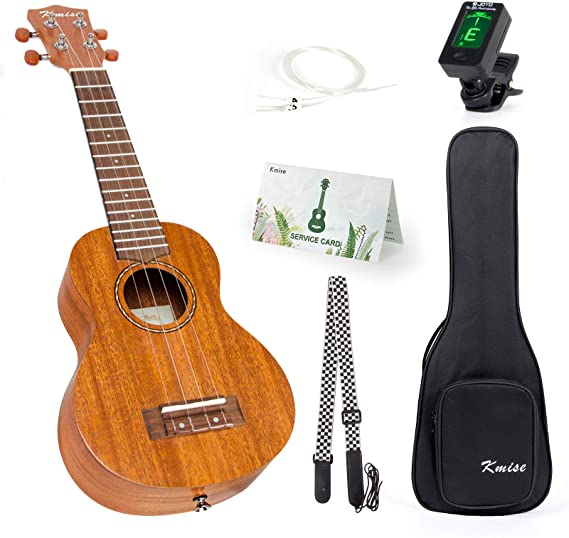
Are you in search of a ukulele that is made of AAA mahogany—a tonewood with a good grade?
If you don’t want to compromise on the tonewood quality, look no further—this reasonably priced ukulele is designed for you.
The fretwire is neat, the fretboard is smooth, and this uke requires lower action—a feature that pro players always prefer in a uke. Unlike other ukuleles that are tuned G-C-E-A, this one is meant only for lefties, meaning it is tuned in the reversed order—i.e., it’s tuned A-E-C-G.
Let’s admit it—tuning is something that everyone newcomer has to face because strings need some time to stretch out. Therefore, the only thing you can do is bear with it, and this happens with every ukulele out there.
The fretboard doesn’t feel harsh on hands and, therefore, this ukulele is safe to hold and play like a pro. Plus, you won’t have to struggle with scratching anymore. Unlike other cheap ukes that sometimes cause loads of buzzing, luthiers have pre-tuned it at a lower action so you don’t have to put up with buzzing.
Also, this isn’t the first time I’ve reviewing Kmise’s ukulele, I’ve already gone over some other in the ukes for newbies, soprano ukes, and cheap ukes. Be sure to check that out as well.
Pros
- Brought to life using AAA grade mahogany
- Tuned A-E-C-G; uke designed for lefties
- Hassle-free; Pre-tuned by the luthiers
- 18:1 tuning pegs that offer precise tuning
- A perfect uke for gifting someone
- Reasonably priced; good for newbies
- Includes basic add-ons
Cons
- Doesn’t include picks
5. Hola Left-handed Concert Ukulele with Padded Gig Bag
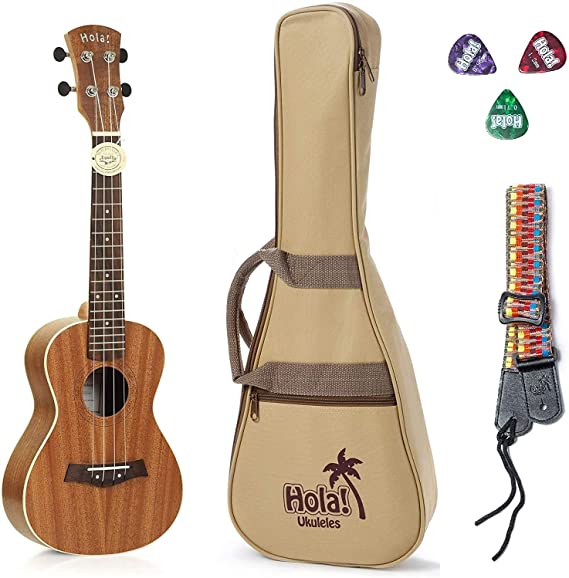
I’ve already discussed how Hola has won the hearts of millions of people by offering those Hawaiian vibes—this uke made for lefties is no exception. I would not call this one a cheap uke, but it isn’t an expensive one like this 2-in-1 uke from Kala. Although you may not be familiar with this model, it looks a lot like this deluxe concert uke.
What’s unique about this model?
Is it worth your money in 2021 or it’s one of those cheap quality ukes?
Well, it’s definitely worth your attention and this is for a lot of reasons. Its back is made of top-notch mahogany and nato wood while a combination of both rosewood and mahogany goes into the top. It’s a lightweight uke (it only weighs 0.4 kilograms) which means you don’t have to worry about the strain on your shoulders.
If you’ve been skeptical about buying a new left-handed ukulele, this one will be a lifesaver as it’s made for the lefties. The features that make this uke stand out from others include a laser-engraved rosette, a built-in strap pin, and those 18 frets. Since there are more frets on this one, you will be able to reach the higher notes—if that’s your specialty. Also, you don’t have to drill a hole, thanks to the fitted strap pin.
Although its strap is a beauty, if you don’t like the color, you may consider these ukulele straps that complement all ukuleles you would use them with.
Apart from the strap, the bundle includes 3 colored picks and a gigbag (the padded one) that offer extreme safety. The tuning pegs are made of rubber and walnut goes into the bridge, allowing the uke to easily translate the vibration of strings. Furthermore, this giftable uke comes with free live ukuleles classes for 2 months.
To get the live free lessons, all you need to is contact Hola with the order ID and you will be able to join the classes online.
Pros
- Designed with first-class mahogany
- 18 silver frets; plays on high notes
- Laser-etched rosette design
- Free live lessons for 2 months
- Built-in a-one Aquila strings
- Good-quality padded gig bag
- 3 picks included in the pack
- Comes with a strap for stability
- Built-in strap pin; no-drill ukulele
Cons
- No tuner
6. Luna Mahogany Tattoo Lefty Concert Ukulele
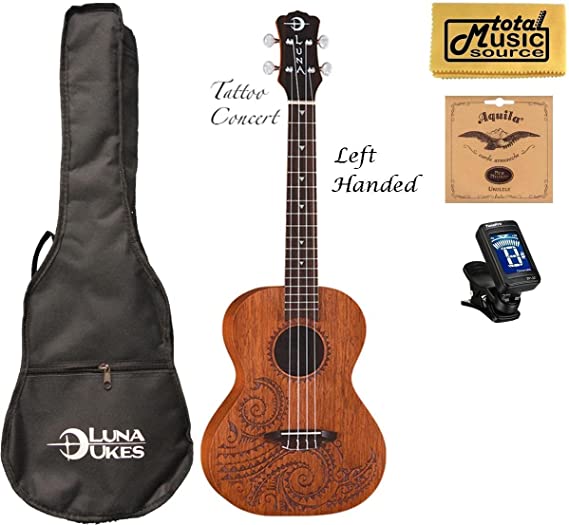
Every time you see a ukulele from Luna, no matter if it’s a lefty or righty, you will notice one thing, they are all top-rated by the verified people.
Luna more often than not takes design inspiration from Hawaii and other countries in the world and reflects them in the ukuleles. Although tattoo-based ukes from this brand feature many shapes, such as island, bird, sharks, and sun, this one is based on Hawaiian body ornamentation.
It’s an acoustic ukulele made of mahogany, meaning you cannot connect an external amp in any way. If you have a lefty daughter or son, they’re going to love it. To make things easy, Luna has included an instructional CD, a gigbag, a cleaning cloth, and a digital tuner.
Put simply, you won’t have a pain in the neck while tuning your ukulele—assuming that this is what you’ll need to do every time you play it (at least, in the beginning). While people have adored this stunning, great-sounding uke, if you’re on a tight budget, you may not like it since it’s a little expensive. Even if you travel a lot, you’d enjoy having its company.
No matter if you’re kiddo is 10 years old or they are more like 15 or 16 years old, this is a go-to instrument of people with different age.
Also, people who have bought this one suggest that the shipping process is lightning fast—you won’t have to wait for years for your order to arrive at the destination (i.e. your place).
Let me be completely honest with you. I didn’t find anything wrong with this ukulele. The only thing that makes me have second thought is the pricing model—it’s a bit expensive as compared to other models I’ve shed light on above.
However, I wouldn’t call it a minus factor because people who believe in getting top-of-the-line products would get it without hesitation. That’s why I don’t want to force you into buying this one if you’re not having the budget because there are other good-quality cheap ukes that you’d find fascinating.
Now, let’s be familiar with the ins and outs:
Pros
- Made of high-quality mahogany (back & sides)
- Boasts next-level Aquila strings (from Italy)
- Complete bundle; includes all accessories
- Laser-etched tattoo; elegant—eye-catching uke
- Designed for left-handed ukulele players
- Top-rated; loved by many ukulists
- Suitable for people of different ages
Cons
- Expensive one
Best Left Handed Ukuleles: FAQs (with Answers)
Still having questions? Here’re the questions that people ask most about the left-handed ukuleles. Stay in the know by taking a glimpse at the answers.
Q.1: Are there left-handed ukuleles for real?
Yes, absolutely. Although these ukuleles didn’t exist early, many brands are now making ukuleles for lefties (left-handed people).
Q.2: Should you buy a left-handed ukulele?
I’d say, yes. It all comes down to the tuning of a ukulele—the way it is tuned. If you have been playing ukulele for a long time, you would have noticed that the uke is tuned G-C-E-A, one that is meant for right-handed people. If the same uke is handed over to a left-handed person, the tuning is reversed and, that’s where things get troublesome. That’s why left-handed ukes are tuned A-E-C-G so lefties can have peace of mind.
Q.3: Are left-handed ukulele beginner-friendly?
Yes, of course! Just like the ukes made for righties, ukes designed for lefties can also be used by type of people—age doesn’t play any role here. However, I’d say that you should keep your hand size in mind while shopping for uke because a soprano is recommended for people with small hands.
Q.4: What’s the best left-handed ukulele?
In my opinion, both the ukulele and the brand that makes it play an important role. If you take a closer look at the list, you’ll see different brands listed, but not all brands have the same prominence and trust of the users (people who have been investing in the company’s products lately).
I’d personally suggest you go with the Donner since it’s reasonably priced, include all accessories (that most beginners need), made of mahogany, and boasts a cutaway design.
The End!
Let’s come clean—the world is a hard place to live in. Everything is made with right-handed people in mind, no one cares about left-handed people.
And it just breaks my heart!
From scissors to the number pad (located on the right side) on the computer to measure tapes to spiral notebooks to whatnots, everything is designed with the right-handed people in mind and only lefties have to feel all the pain.
The same goes with the ukuleles—they’re mostly designed for right-handed people.
But, things are changing now, and brands that only made ukuleles for rights are now also making ukuleles for left handed people. I mean, that’s comforting, isn’t it?
If you are a lefty and want to get one of the best left handed ukuleles, this is the only page you’ll ever need, even in the future because we’ll be adding others in the upcoming days for you.
Till then, you can get one of the above-reviewed left-handed ukes for your peace of mind.
Get a Left-handed Uke and Strum like a Pro!
If this is your first time buying a left-handed ukulele, the list above should give you peace of mind. However, if you still can’t decide which one is the perfect-fit lefty uke for you, go with the editor’s choice.

