
A harp with evenly balanced strings and a pleasant, resonant voice can inspire you to pursue greater musical skills.
However, selecting the best harp can get murky, especially for first-time buyers. Harps are one of those musical instruments that is not “standardized” – it can be tough to sort through the different options.
There’s an assortment of harp models to suit various playing styles and desires.
| Image | Product | Features | Price |
|---|---|---|---|
Best Overall  |
| Check Price | |
Best Full Size Harp  |
| Check Price | |
Best Value  |
| Check Price | |
Best Harp For Kids 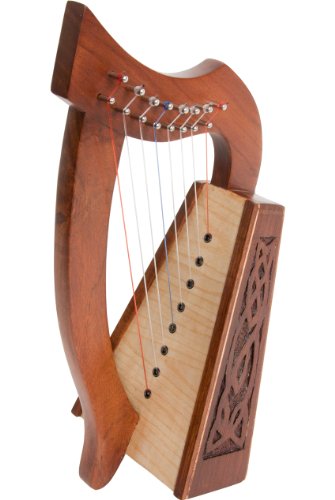 |
| Check Price | |
Best Budget Option  |
| Check Price | |
Best Lyre Harp  |
| Check Price |
Table of Contents
- Top 16 Harps For Beginners 2023
- #1 Best Overall – Roosebeck 12 String
- #2 Best Lyre For Beginners – Donner DLH-002 Lyre Harp
- #3 Best Value – LotMusic Store Harp
- #4 Best Harps For Kids – Roosebeck Lily Harp
- #5 Best Lap Harp For Beginners – Music Maker
- #6 Best Budget Option – Roosebeck Knotwork Harp
- #7 Best Full Size Harp – Rees Harps Harpsicle Harp
- #8 Royal Celtic Irish Knee Harp
- #9 Roosebeck Heather Harp – 22 Strings
- #10 Fullsicle Black Harp
- #11 Minstrel Harp – 29 Strings – Knotwork
- #12 Roosebeck Pixie Harp – 19 Strings
- #13 Rees Harps Sharpsicle Harp Natural Maple
- #14 Roosebeck Pixie Harp Irish Celtic Style
- #15 Sturgis Irish Celtic Lever Harp
- #16 AKLOT 15-String Beginner Harp
- Buyers’ Guide: Choosing The Perfect Harp
- Best Harp Brands For Beginners
- Final Thoughts
- FAQ
Top 16 Harps For Beginners 2023
#1 Best Overall – Roosebeck 12 String


This Baby Harp is perfect for anyone just starting out. It’s easy to use, and comes with an extra set of strings and a tuning tool, so you can keep it sounding its best.
Plus, the beautiful engraved walnut frame will make it a showpiece in any room.
This enchanting harp is perfect for beginners of all ages!
You will love playing this instrument, and thanks to the included tuning tool and extra set of strings, you’ll be able to keep it in tune for hours of enjoyment.
#2 Best Lyre For Beginners – Donner DLH-002 Lyre Harp


This beautiful Donner DLH-002 Lyre Harp has 10 metal strings and a bone saddle, making it perfect for beginners.
It’s made of mahogany for superior resonance, and comes with a high-density black gig bag to protect it while you’re on the go.
Plus, it includes a wrench, set of strings, and instruction book – so you’re ready to start playing right out of the box!
#3 Best Value – LotMusic Store Harp


If you’re looking for a beautiful and high-quality harp, look no further than the LotMusic Harp!
This harp features 15 international standard strings, made from high-quality materials for a more stable tone.
Plus, the different color strings make it easy to identify tones quickly.
The body of the harp is made from solid birchwood for both durability and a warm tone, and it comes with a gig bag, strap, and tuning wrench, so you can start practicing right away.
#4 Best Harps For Kids – Roosebeck Lily Harp


This one is the perfect product for those who need an affordable harp for their kid.
It feels great just holding this instrument – you’ll be motivated to play it even more often than you thought.
With 8 strings and a compact form, your child will be on his or her way to learning in no time.
This hobby can be quite addicting, but you won’t regret it!
This harp also comes with a beautiful rosewood frame that is handcrafted.
It comes with a free tuner as well.
This is a fantastic option for people on a budget that also want a great-looking harp with beautiful sound quality.
#5 Best Lap Harp For Beginners – Music Maker


Looking for a way to make your musical dreams a reality? Look no further than the Music Maker Lap Harp!
This unique and easy-to-use instrument is perfect for any beginner – simply slide in a song sheet and start plucking those strings!
Plus, each Music Maker is made with select hardwoods and ash, ensuring that each one is totally unique.
#6 Best Budget Option – Roosebeck Knotwork Harp


Introducing the Roosebeck Knotwork Harp – a handcrafted masterpiece imported from talented artisans all over the world!
This beautiful instrument is perfect for any aspiring musician, and features authentic materials that give it a truly unique look.
With 12 DuPont hard nylon strings, a range from F to High C, and no sharpening levers, this harp is easy to learn and play.
A tuning tool and extra string set are included, along with a beautiful carved Irish knotwork frame.
You’ll love the rich tones and stunning craftsmanship of this unique harp!
#7 Best Full Size Harp – Rees Harps Harpsicle Harp


Perfectly designed and sturdily made, with the best 26 string combination and spacing, this is one of the best harp options available in the market.
It’s portable and made from high quality materials. It also has no bridge, making it best for starters.
It will fit perfectly in the storage cabin in many airlines; therefore, you can move it to your new location whenever you need to. It’s also easy to play while sitting on its optional chair.
Pros
- Beautiful design
- Lightweight
- Well-built
- Tuning key
Cons
- Relatively expensive
Conclusion:
If you want something well-built and something you’ll be playing for a long time, then we suggest the Harpsicle.
#8 Royal Celtic Irish Knee Harp


When it’s important to you that your harp is truly top of the line, then you need to get the Royal Celtic Irish Knee Harp. Indeed, this is a world class harp that has been made with refined quality for your ultimate satisfaction as a frequent harp player.
You will note that the bridge pins as well as the sharping levers that have been modified are excellent in regard to all strings, and they grant the provision of access to all keys to ensure the enhancement of your harp playing every time, whether you’re just practicing or playing for your own enjoyment, or whether you’re entertaining a crowd.
You’ll be pleased that this harp is easy to maintain in terms of tune, as it is truly a professional quality harp that provides a superb level of clarity for all music.
This harp will thrill you and your listeners due to the great sound that it produces. Each time you pluck the strings of this impressively designed harp it demonstrates a professional quality.
As a result, you can have the confidence that this harp will be able to keep up with all your plucking of the strings to produce elegant harp music that is pleasant and satisfying – just the way you need it to be.
The wood on this harp is sturdy, the strings are adequately tight enough, and the harp is overall comfortable to play.
#9 Roosebeck Heather Harp – 22 Strings


The Roosebeck Heather Harp TM, 22 Strings harp is one of the best beginner harps on the market today, as well as one of the most popular.
With a height of 36 inches, it’s great for both adults and children. Weighing only around 15 lbs, it’s also fairly portable.
Its 22 Nyl22 DuPont hard nylon strings are color coded to help you tune, which you can do with the tuning key it comes with. It also comes with an extra set of strings.
The notes range from C3 to C6. The wood features, such as the engraved and inlaid rosewood frame with a birch soundboard, make you feel like you’re playing a thousand dollar harp.
Pros
- Handcrafted and high quality
- Beautiful
- Extra strings
- Tuning key
- Great price
Cons
- No manual
Conclusion:
With its handcrafted, classy look, you cannot get a better harp for the price as a beginner harpist.
#10 Fullsicle Black Harp


The Fullsicle Black Harp, produced by the Harpsicle Harp Company, is truly a world class harp that provides an undeniably exhilarating playing experience every time.
It looks ultra majestic in its beautiful black finish, to add even more spiffiness to your overall harp experience. You do need to allow up to six to eight weeks for delivery, as the harps are made once you order one.
This is the amount of time that is required to carefully construct your new harp with ultimate detail and true quality. As a result, the waiting time is truly worth it.
You will appreciate the inclusion of the book and DVD that are provided to aid in learning to play the harp if you have no prior harp playing experience, or if you have a bit of experience but are still at the beginner stages.
As a result, the book and DVD will prove to be instrumental in aiding you to improve your harp playing skills. You’ll appreciate the fact that there are sharping levers on all strings, which aid the strings to pronounce with more clarity for each note.
Also, the harp comes with the added convenience of bridge pins on all strings, for the ultimate harp playing experience. They’ll help you produce high quality, delightful music every time you play this fine harp.
#11 Minstrel Harp – 29 Strings – Knotwork


This beautiful harp stands 38 inches tall with 29 DuPont nylon strings.
It comes with twenty-four sharping levers with an engraved Sheesham frame. It has very high quality finishing with strong birch soundboard fliers.
This harp has an exceptionally attractive Celtic design, with a hand-carved panel which produces the best sound (since the strings are always tight).
The harp has a hand-carved inside panel, thus making it very attractive. It has a high quality and engraved finish of birch.
Recommended for beginners interested in learning folk and classical songs.
Pros
- Handcrafted and high quality
- Affordable with little or no maintenance costs at all.
- It comes tuned on delivery, making it easy to play immediately after delivery.
- 30-day warranty and return policy.
Cons
- Limited designs
- More expensive than the Heather Harp
- Weighs 22 lbs
Conclusion:
For 29 strings, and at this price point, it’s a great harp for beginners who really want to take their playing to the next level.
#12 Roosebeck Pixie Harp – 19 Strings


The Roosebeck Pixie Harp has 19 strings and is handcrafted with an inlaid and engraved rosewood frame, making it very beautiful.
It has exceptional string strength, with a birch soundboard for exquisite sound.
An extra string set is provided to ensure that, even in the case of a broken string, you’ll still enjoy your beautiful harp.
It’s approximately 30 inches tall, and features 19 DuPont nylon strings with octave C below, High C, and Middle C.
It also comes with basic harp playing/reading notes and fingering positions to help you out while playing your harp.
Caring and maintenance notes are included, to ensure that you can replace your strings with ease.
Pros
- High quality
- Looks great
- Tuning tool & extra strings
- Relatively inexpensive
Cons
- Hard to find accessories
- Not eligible for Prime
Conclusion:
This harp is great if you are on a tight budget and want a harp that can play most songs easily.
#13 Rees Harps Sharpsicle Harp Natural Maple


The Rees Harps Sharpsicle Harp has 26 strings and is similar to other Harpsicle Harps, but with the slight difference of a bridge of pins across all the strings.
This harp is improved with the Robinson sharpening levels on all F and C strings. It’s possible to play more than six keys at the same time. The harp laps and the straps are crucial when stabilizing your harp.
You can get it in either natural maple or black. It also comes with a tuning wrench.
Pros
- Extremely high quality
- Excellent tone and easy to play
- Value for your money
- Tuning wrench
- Prime eligible
Cons
- Case sold separately
- More expensive than most beginner harps
Conclusion:
It is a bit more expensive than the rest, but you get what you pay for in quality. If you know you’re going to be playing for a long time, then this is the perfect harp for you.
#14 Roosebeck Pixie Harp Irish Celtic Style


This harp has 19 DuPont nylon strings. Strings range from High C, Middle C, to F below. 19 sharping levers included.
Approximately 30 inches tall, with inlaid and engraved walnut frames, it’s a very beautiful harp.
The Roosebeck 19-String Pixie Harp Irish Celtic Style – Walnut, is made with high quality materials, making it a very durable harp.
It also has a high quality soundboard ply for excellent sound and tone production, and a finished birch for strength — not to mention a tuning tool with an extra set of strings provided at a little additional cost.
Pros
- Lightweight
- Beautiful
- Less expensive
- Tuning tool & extra strings
Cons
- Case sold separately
- Not eligible for Prime
Conclusion:
The Pixie Irish Celtic Harp is a great harp for people who are just starting out and want a good looking harp for a low price. There are definitely some better options, though.
#15 Sturgis Irish Celtic Lever Harp


A 22 string harp which comes with a free carrying bag as well, which is waterproof.
This harp has a very high level of creativity, since the solid wood is hand-polished with beautiful engravings. It’s not the best quality, though, which is why this harp is lower on our list.
It’s also recommended to change your harp strings immediately after you purchase it, to prevent the strings from oxidizing and reducing their life.
It does come with an extra replacement pair of stings, which is very crucial since your harp strings can break after some time playing. It also comes with a tuning key.
Pros
- Free carrying bag
- Tuning key & extra strings
- Relatively inexpensive
Cons
- Quality
- Not Prime eligible
Conclusion:
This harp does not have the best quality, but it does come with a free carrying case, which would usually cost around $60 – $100.
#16 AKLOT 15-String Beginner Harp


The Aklot Mahogany Harp is a solidly constructed harp that has a superior quality in tone to make your harp music sound velvety smooth. This tone quality adds to the essence of the beauty of the music overall.
The Aklot company has always been committed to a high level of excellence in terms of the standard that it applies concerning the construction of the harps that it produces.
You will appreciate the fact that the string spacing is meticulously correct, which makes this the perfect harp choice for those who are just entering the world of playing harp music.
If you have, therefore, been unfortunately disappointed by other harps that may have cost a lot of money, but that were poorly made in terms of the string placement not being completely correct, you can have the peace of mind now that you will not experience such an issue with this fine quality harp.
This is a nice harp that is light in weight and that is easily portable, which demonstrates the fact that this is a high quality harp that is super convenient.
Buyers’ Guide: Choosing The Perfect Harp
Choosing a harp depends on what you prioritize: Sound, Price, Portability, Appearance, or other factors.
Once you know your priorities, here’s what to look for when buying your first harp.
Harp Size
Even though the larger the harp, the warmer and richer the tone, playing the harp is a physical experience. Get something that’s comfortable! A well-fitting harp lets you enjoy every session with it while also preserving your health.
You don’t want to practice for a gig and blunder on the day of, because of some muscle problems caused by practicing.
Beginners are advised to match their stature (height) to their harp size, so the harp fits the body comfortably. A well-fitting harp can be held rightly and played freely.
The guide to matching statures is as follows:
- For adults, if you sit on 18-inch high stools, then get a floor size model with 34 strings maximum.
- For small children, those in the 5-10 age bracket, a 12-inch stool is what they sit on, and the best harp model is a 28-string set floor model.
Harp Sound
The sound your instrument makes is the feature that will make you satisfied with each playing session.
Before buying a harp, know that its voice and the music you make is what you’re going to live with, so get something that gives rich, resonant sounds when plucked.
Here’s what you should watch out for:
- Harps with evenly balanced strings are responsive and produce full range sounds.
- The mass of the string affects how the plucking energy gets converted to vibrations. Low notes are generated by strings with large mass, while strings with less mass generate high notes.
- The back of the harp is essential too, because it helps reinforce the vibrations of the soundboard, leading to vibrant voices. Therefore, look out for harps with well-crafted backs.
- Good design has the harp back running parallel to the soundboard, so every vibration gets reinforced.
[PRO TIP: Find a multi-instrument tuner that works well with the harp, and you’ll save yourself tons of frustration. This multi-instrument tuner fits that bill.]
Harp Strings
String composition and configuration affects the sound quality.
Most of the best harps have evenly balanced strings that are responsive to the plucking energy, for rich vibration and pleasant, resonant sounds.
When you pluck the string of your harp, energy gets transmitted to the soundboard, resulting in vibrations (notes) at specific frequencies.
What affects the energy transmission, therefore, is the string mass.
The string mass is affected by the string diameter, its composition, and construction.
Nylon strings have a bigger diameter, but have less mass compared to thin steel strings. Wrapped strings, however, have more mass than monofilament.
When evaluating strings, use these guides:
- Look out for whether the tension is consistent throughout the harp – bottom to top.
- The most common number of strings for all types of harps is 34-36. This amount allows you to play wide-ranging music.
- Go for harps with thick strings for low notes, or thin strings for high notes.
How many strings should a beginner harp have? 15 to 34 strings is a good amount to start with if you are a beginner.
[PRO TIP: Don’t overthink it when it comes to strings. Look for harp strings with lots of 4+ star reviews and you should be safe. These harp strings come in at 4.5 stars after more than 250 reviews.]
Type of Harp
There are two broad categories of harps you can choose from, depending on the music you make:
Lever or Celtic Harps are the best for making folk music. They’re smaller in size and allow for manual maneuvering of the pitch across the range, using some levers. They feature 27-40 lighter strings.
The Pedal Harp is suitable for playing contemporary music. It’s a sizeable harp featuring brilliant pedal mechanisms for making key changes.
Beginners mostly start practicing on the Lever harp before proceeding to the Pedal as they master the craft. The lever harp doesn’t involve a lot of key changes, and features a manageable number of strings for beginners.
Price & Budget for Harps
The material and quality of the craftmanship are major factors in determining the price of the harp.
The price that your favorite harp goes for depends on the materials used, the quality of the craftmanship, and its rendering.
All in all, harps (like all other handcrafted, stringed or solid wood musical instruments) go for higher prices because great skills and quality materials are employed to design the product.
If you get a lower priced harp, be prepared to compromise on sound quality because of poor design features such as unbalanced string mass, a poor quality harp back, and more.
If you want a harp with great musical potential, be prepared to pay more for the craftmanship.
Harp Portability
Do you wish to bring your harp along with you and hone your skills wherever you are? Or do you wish to share music at the bedside?
Small-sized harps for travel, or strolling harps that you can play while moving around, might be good options if mobility is important to you.
For novice players, however, practicing on floor size models is the best, as you don’t have to concentrate too much on balancing the harp on your lap, a table, or a stand.
Larger harps are often more comfortable to play than smaller harps.
Wherever you’re taking your harp, don’t forget to pick up a case or gig bag when you purchase your instrument (if it’s not already included).
[PRO TIP: Try to find a harp case that also gives you waterproof and dustproof protection. This harp case checks those boxes.]
What are you using the harp for?
Does your music involve lots of key changes, or is it diatonic? You should know the music you want to play before getting your harp:
- If you are into folk music, lever harps allow for the playing of traditional, hymn, Celtic, or classical music that does not include lots of key changes. This includes the lyre harp.
- For contemporary music with lots of key changes, however, get a Pedal Harp, which features brilliant pedal mechanisms for convenient key changes. Go with this option if you want to play some romantic or popular orchestral and opera music.
Not sure what type of music you want to play first? Add a couple of good instructional books to your purchasing list when you’re getting your harp. They’ll be invaluable to help keep you motivated as you’re learning.
[PRO TIP: Look for variety in your instructional books when you’re learning the harp. This harp book has a great variety of songs you can learn, both in terms of types of harp (it includes songs for both pedal and lever harps) and the genre of songs (classical, pop, Broadway, standards, and more).
Harp Appearance
Do you wish to be the stylish harp player in the room? Or are you more concerned with the pure quality of sound that you give your audience? Depending on your priority here, you can use the following guide:
- Pedal Harps are more impressive in appearance, and have large sound boxes and full range.
- Lever harps, on the other hand, are not as impressive as Pedal Harps, but still get the job done.
Best Harp Brands For Beginners
There are a lot of harps out there, but not all are suited well for beginners. Knowing which brands to go with will accelerate your learning path.
Final Thoughts
Learning a new instrument could go from an exciting to a frustrating experience, depending on the vibe you get from the instrument you choose. Purchasing your harp for the first time is a big decision!
We hope you’re better equipped now to choose wisely and get exactly what you want.
FAQ
What should I look for when choosing a harp for beginners?
When choosing a harp for beginners, look for a model that is lightweight and portable, has a full sound, and is affordable. You should also consider the quality of the craftsmanship and the reputation of the brand.
What is the difference between lever and pedal harps?
Lever harps have strings that are activated by a lever, while pedal harps have strings that are activated by pedals. Lever harps are more affordable and more portable than pedal harps, making them a better choice for beginners. Pedal harps are more complex and are typically used by professional harpists.
How do I determine the right size harp for me?
The right size harp for you will depend on your height, arm length, and playing style. You should choose a harp that is proportional to your body and allows you to reach all of the strings comfortably.
How long does it take to learn to play the harp?
The amount of time it takes to learn to play the harp will vary depending on the individual. Some people may learn to play basic melodies within a few months, while others may take several years to master the instrument. Consistent practice and lessons with a qualified instructor will help you make progress more quickly.
What type of music can be played on a harp?
A wide variety of music can be played on a harp, including classical, folk, and pop. Harps are versatile instruments that can be used to play many different styles of music.
What is the best way to care for my harp?
The best way to care for your harp is to keep it in a clean, dry place when not in use, and to wipe it down after playing. You should also have it professionally serviced on a regular basis to ensure that it remains in good condition.
Is it possible to play the harp without taking lessons?
While it is possible to play the harp without taking lessons, it is highly recommended that you receive instruction from a qualified instructor. Taking lessons will help you make progress more quickly, and will also ensure that you are playing correctly and avoiding bad habits.
